
千万工程

Search documents
淳安县深化“水”和“山”的价值转化 靶向发力缩小“三大差距”
Hang Zhou Ri Bao· 2026-02-28 02:05
Group 1 - The core message emphasizes the importance of a proactive work atmosphere and quick execution in achieving development goals, particularly in the context of the "Six Major Actions" and narrowing the "Three Major Gaps" [1] - In the past year, the region has shown significant progress in ecological protection and economic development, with key economic indicators performing better than the previous year and exceeding provincial and municipal averages [1] - The current year is seen as a critical period for the region, focusing on environmental protection and transforming ecological value into economic benefits [1] Group 2 - The region plans to enhance industrial development by focusing on strengthening characteristic industries and promoting collaboration among the primary, secondary, and tertiary sectors [2] - Urban-rural integration is identified as a core development path, with initiatives aimed at improving living standards and reducing disparities through various measures [2] - The release of the "No. 1 Document" outlines 104 key tasks aimed at promoting urban-rural integration, narrowing the "Three Major Gaps," and advancing common prosperity [2]
协同推进城乡建设
Xin Lang Cai Jing· 2026-02-23 20:40
Group 1 - The city of Xining aims to build an innovative, livable, beautiful, resilient, civilized, and smart city by 2025, with a focus on high-quality urban development [1] - The urban sewage treatment rate is projected to increase from 95% in 2024 to 96% in 2025, while the proportion of green buildings in new constructions is expected to rise from 98% in 2024 to 100% [1] - The city has secured a central government subsidy of 1.2 billion yuan for urban renewal and aims to complete 34 underground pipeline renovation projects with a total of 1.257 billion yuan in national bond funding [1] Group 2 - Xining is integrating housing condition improvements with geological disaster relocation projects, completing 40 model villages and improving living conditions for 7,000 rural households [2] - In the heating sector, 40 annual tasks have been completed, including the renovation of 220.4 kilometers of heating pipelines and 145 heat exchange stations [2] - A digital platform for four heating enterprises has been established, enhancing the visibility and control of heating operations, thereby strengthening supply reliability for the upcoming winter [2]
山西省农村水利水电工作会议召开
Xin Lang Cai Jing· 2026-02-19 02:30
Core Insights - The provincial water resources department held a meeting to implement the spirit of the national and provincial rural water conservancy and hydropower work conferences, focusing on key tasks for 2026 [1] Group 1: Rural Water Supply - The province aims to promote a "3+1" management model for rural water supply, implementing maintenance for 1,900 rural water supply projects benefiting over 2 million people [2] - The construction of integrated urban-rural water supply projects is ongoing in 48 counties and 50 areas [2] - There will be a focus on water quality monitoring and ensuring the operation of purification and disinfection facilities in rural water supply projects [2] Group 2: Agricultural Irrigation - During the "14th Five-Year Plan" period, the province added and restored irrigation areas totaling 1.8 million acres, achieving a total irrigation area of 23.56 million acres [1] - The effective utilization coefficient of irrigation water in farmland reached 0.583, successfully completing all target tasks [1] - The management level of large and medium-sized irrigation districts will be improved, with modernization projects for 16 irrigation districts being promoted [2] Group 3: Green Transformation of Small Hydropower - The province is focusing on the ecological flow release of small hydropower, with pilot projects for centralized control and green upgrades for 24 small hydropower stations [2] - The aim is to enhance the green transformation of small hydropower facilities [2]
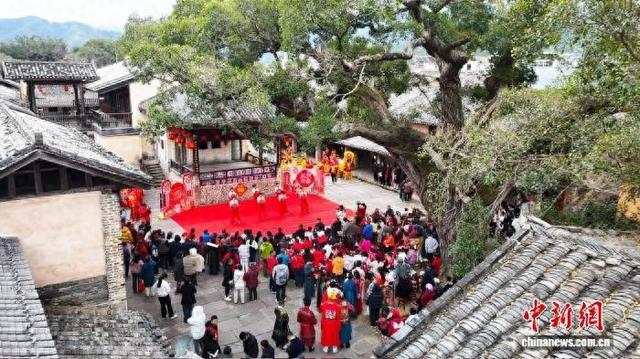
(新春走基层)粤北始兴新春巡游串起老民俗与新生活
Xin Lang Cai Jing· 2026-02-18 09:02
Core Viewpoint - The New Year parade in Shixing County, Guangdong, successfully blends traditional customs with modern life, celebrating the Spring Festival with local residents and tourists [1][3]. Group 1: Event Overview - The New Year parade took place on February 17, themed "One Horse Leads to the Future," featuring a variety of performances that highlight local culture and traditions [1][3]. - The starting point of the parade was Zhouqian Ancient Village, recognized as a traditional village in China, showcasing its rich Hakka heritage through preserved architecture [3][4]. Group 2: Cultural Performances - The parade included diverse performances such as the newly recognized Qiancha Dance, dragon and lion dances, Hanfu displays, waist drum performances, and dances celebrating the New Year [3][4]. - Local children participated in performances, expressing joy and sending New Year blessings to the community [3][5]. Group 3: Community Engagement - The parade concluded at the Zhouso Future Community, where residents celebrated their new homes after relocation, marking a significant milestone in their lives [4][5]. - Community members organized their own performances, enhancing the festive atmosphere and fostering a sense of unity and joy among the villagers [5].

新春走基层|中埂村变身记
Xin Lang Cai Jing· 2026-02-16 05:41
Core Viewpoint - The article highlights significant improvements in infrastructure and living conditions in Shihai Village, Sichuan Province, over the past 12 years, showcasing the positive impact of local development initiatives on the community's quality of life and economic prospects. Infrastructure Improvements - The infrastructure has seen substantial upgrades, including the renovation of the Zhonggeng Tunnel, which now features a brick arch ceiling and solar lights, making travel more efficient. The journey from Chengdu to the village has been reduced to 40 minutes, compared to a full day previously [3]. Living Environment Enhancements - The living conditions have improved markedly, with the transformation of traditional dry toilets into flush toilets and the installation of biogas systems for cooking. The village has adopted better sanitation practices, leading to cleaner public spaces [4][5]. Community Development Initiatives - The village has implemented the "Million Project" experience to enhance living environments, with landscaping becoming a standard practice in residential areas [5]. - There is a growing desire among villagers to develop local industries, with recent meetings held to discuss agricultural and tourism opportunities, particularly leveraging the proximity to two national 4A-level scenic spots [6]. Economic Opportunities - The local government is encouraging the development of homestays by urging residents to utilize extra rooms in their homes. Additionally, a new industrial park has been established, creating numerous job opportunities for local residents [7][9].
中埂村变身记(新春走基层·建设宜居宜业和美乡村)
Ren Min Ri Bao· 2026-02-15 23:13
Infrastructure Improvement - The infrastructure in Shihai Village has significantly improved over the past 12 years, with the construction of a new tunnel and paved roads, reducing travel time from one day to just 40 minutes [3][4]. - The previously rough tunnel has been renovated with brick arches and solar lights, enhancing the overall accessibility of the area [3]. Living Environment Enhancement - The living conditions have been upgraded, including the replacement of traditional dry toilets with flush toilets and the installation of biogas systems for cooking [4]. - The village has adopted practices from the "Million Project" to improve the living environment, with landscaping becoming a standard [5]. Economic Development and Opportunities - There is a strong desire among villagers to develop local industries, with recent meetings held to discuss needs and development strategies [6]. - The local government is encouraging the development of homestays by urging villagers to utilize extra rooms in their homes [7]. - A new industrial park has been established in the county, creating numerous job opportunities, which has sparked interest among residents like Li Xiaorong to work locally [9].
赵刚主持召开省政府第四次常务会议
Shan Xi Ri Bao· 2026-02-13 00:42
Group 1 - The provincial government is focusing on implementing the "Three Rural" work to promote comprehensive rural revitalization, guided by Xi Jinping's important instructions [1][2] - The meeting discussed and agreed on the implementation opinions for agricultural modernization and rural revitalization, emphasizing the importance of food security and agricultural productivity [2] - Key tasks include consolidating poverty alleviation achievements, enhancing rural public services, and promoting the development of county-level industries [2] Group 2 - The meeting highlighted the need to adhere to ecological civilization principles and enhance environmental protection responsibilities, aiming for improved ecological quality in the province [3] - Specific focus areas include pollution prevention, ecological safety in key regions, and the development of a high-level ecological protection plan [3]
铺就乡村振兴新图景
Xin Lang Cai Jing· 2026-02-10 22:10
Core Viewpoint - Agricultural and rural modernization is essential for China's overall modernization, serving as the "foundation" for advancing this goal [1] Group 1: Agricultural and Rural Modernization - The "14th Five-Year Plan" emphasizes the total goal of agricultural and rural modernization, promoting comprehensive rural revitalization and urban-rural integration [1] - The experience from the "Ten Thousand Projects" is being utilized to create a new vision for shared prosperity between urban and rural areas [1] - The theme of the 2024 Central Document No. 1 focuses on learning from the "Thousand Villages Demonstration, Ten Thousand Villages Rectification" project to effectively advance rural revitalization [1] Group 2: Classification and Targeted Approach - Rural revitalization requires a classified and orderly approach, avoiding a "one-size-fits-all" strategy due to the diverse conditions across rural areas [2] - The "Rural Comprehensive Revitalization Plan (2024-2027)" outlines specific strategies for different types of villages, such as enhancing industrial development in clustered villages and promoting urban-rural integration in suburban villages [2] Group 3: Systematic and Strategic Tasks - Achieving agricultural and rural modernization is a systematic and strategic task, with the "Ten Thousand Projects" experience providing practical pathways for implementing rural revitalization strategies during the "14th Five-Year Plan" [3] - There is a need to improve rural governance and cultural standards while addressing infrastructure and living conditions in rural areas [3] - Continuous efforts are required to consolidate and expand the achievements of poverty alleviation, integrating regular assistance into the rural revitalization strategy to prevent large-scale poverty [3]
锚定农业农村现代化扎实推进乡村全面振兴 为走好高质量发展新路提供坚实基础支撑
Xin Lang Cai Jing· 2026-02-09 22:25
Core Viewpoint - The meeting emphasized the importance of modernizing agriculture and rural areas in Guizhou, aligning with national policies and focusing on comprehensive rural revitalization to support high-quality development [1][2]. Group 1: Agricultural Modernization - The provincial government aims to transform agriculture into a modern industry, ensuring rural areas meet modern living standards and improving farmers' quality of life [1]. - There is a focus on developing modern mountain characteristic high-efficiency agriculture, emphasizing product quality and brand development while adhering to land and food security regulations [2]. Group 2: Support Policies and Implementation - The meeting highlighted the need to establish a regular support policy system, enhance monitoring and assistance precision, and ensure robust post-relocation support for poverty alleviation [2]. - It was stressed to optimize rural planning and construction, improve living environments, and promote cultural activities to foster a civilized rural atmosphere [2]. Group 3: Leadership and Responsibility - The importance of strengthening the Party's leadership and enhancing responsibility implementation was underscored, with a call for better coordination among departments and resource integration [2]. - The provincial government is urged to adapt policies to new demographic changes and focus on cultivating and expanding operational entities to achieve new progress in rural revitalization [2].
中国蓝观察丨中央一号文件中的浙江元素
Xin Lang Cai Jing· 2026-02-04 12:21
Core Viewpoint - The 2026 Central Document emphasizes the importance of agricultural modernization and rural revitalization, highlighting the "Ten Thousand Projects" as a guiding experience for national strategy [1][4][30]. Group 1: Ten Thousand Projects - The "Ten Thousand Projects" has been included in the Central Document for three consecutive years, reflecting the Party's strong commitment to rural revitalization [4][29]. - The essence of the "Ten Thousand Projects" lies in localized, gradual, and systematic governance, which has been reiterated in the 2026 document [5][30]. - Originating in Zhejiang, the "Ten Thousand Projects" has evolved from environmental improvement to comprehensive rural revitalization over the past 20 years [7][32]. Group 2: County-Level Industries - The 2026 Central Document calls for the cultivation and expansion of county-level industries to enhance rural prosperity, aligning with Zhejiang's "local specialty wealth" model [11][36]. - It emphasizes the integration of technology, green agriculture, quality agriculture, and brand agriculture to promote deep integration of rural industries [11][36]. Group 3: Agricultural Entrepreneurs - The term "agricultural entrepreneurs" appears for the first time in the 2026 document, highlighting the need to cultivate local industry leaders and governance talents [16][41]. - Since 2015, Zhejiang has focused on nurturing a young, professional, and knowledgeable workforce of agricultural entrepreneurs, with over 108,000 trained by 2025 [18][43]. - The next steps include deepening the training of agricultural entrepreneurs to facilitate resource flow and contribute to common prosperity [20][45]. Group 4: Fengqiao Experience - The "Fengqiao Experience," a grassroots governance model originating in Zhejiang, has been incorporated into the Central Document, signifying its elevation to national policy [21][46]. - This model emphasizes resolving conflicts locally and has become a significant experience in China's grassroots governance [22][49]. - The inclusion of the "Fengqiao Experience" in the 2026 document reflects its ongoing relevance and integration into the broader goals of a "Safe China" and "Rule of Law China" [25][50]. Group 5: Overall Implications - The Central Document serves as a comprehensive policy guide, reflecting the evolution of rural revitalization strategies from local initiatives to national policies [27][52]. - The experiences from Zhejiang are expected to provide valuable insights and sustained momentum for China's agricultural modernization efforts [27][52].
