
石油精神

Search documents
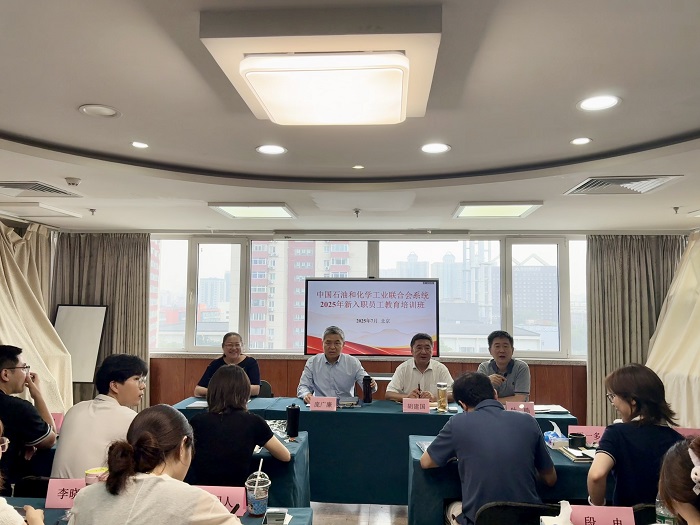
中国石化联举办新入职员工教育培训班
Zhong Guo Hua Gong Bao· 2025-07-28 03:04
Core Viewpoint - The training program for new employees at China Petroleum and Chemical Industry Federation (Sinopec) aims to enhance their understanding of the industry, improve personal qualities, and instill a service-oriented mindset, fostering a culture centered on innovation, respect, trust, and care [1][3]. Group 1: Training Objectives and Structure - The training program includes diverse methods such as lectures, specialized guidance, team-building exercises, and discussions to equip new employees with essential skills and knowledge about the petrochemical industry [3]. - The program focuses on teaching party-building theories, workplace etiquette, document writing, and career planning to help new employees quickly adapt to the workplace [3]. Group 2: Leadership Expectations - The leadership emphasizes the importance of proactive learning, effective training outcomes, and adherence to training discipline among new employees [3]. - New employees are encouraged to strengthen their party identity, recognize their roles, and take on responsibilities as future leaders in the industry [4]. Group 3: Cultural and Ethical Guidance - The training includes a call to embrace the spirit of Daqing and the Iron Man spirit, urging new employees to promote the excellent traditions of the petrochemical industry [5]. - Specific advice is given regarding career development, emphasizing loyalty, practical engagement, and the rejection of complacency in their professional journeys [4][5].


传承践行石油精神“加油争气”端牢新征程能源饭碗
Zhong Guo Neng Yuan Wang· 2025-06-06 02:36
Core Viewpoint - The article emphasizes the significance of the "oil spirit" in China's oil industry, highlighting its historical development and the need to carry forward this spirit to ensure energy security and national strength in the new era [1][2][3]. Group 1: Historical Development of the Oil Industry - The oil industry in China has a rich history characterized by the dedication and sacrifices of millions of workers, leading to significant achievements and the establishment of a strong national industrial backbone [1][2]. - From the founding of New China to 1978, the annual crude oil production increased dramatically from over 100,000 tons to approximately 100 million tons, significantly contributing to the national economy and foreign exchange earnings [3]. - The oil industry's total output value rose from 0.5% of national industrial output in 1952 to 5.8% in 1978, with fiscal contributions increasing from 2.1% to 26.5% during the same period [3]. Group 2: Modernization and Global Competitiveness - Since the reform and opening up in 1978, the oil industry has actively embraced foreign investment and technology, leading to a significant leap in scale and technological advancement, establishing globally competitive enterprises [4]. - Major oil fields like Daqing have produced a cumulative total of 2.46 billion tons of crude oil over 62 years, contributing 2.9 trillion yuan in taxes and fees [4]. - The industry is now focusing on enhancing domestic exploration and development efforts, aiming to secure energy resources and ensure national energy security [5]. Group 3: The Oil Spirit and Its Implications - The "oil spirit," characterized by patriotism, hard work, and dedication, is seen as a vital asset for the industry, inspiring generations of oil workers to overcome challenges and achieve remarkable feats [6][7]. - The spirit emphasizes the importance of perseverance, practical efforts, and a scientific approach to work, which have been crucial in the industry's development [9][10]. - The article calls for a renewed commitment to the oil spirit, urging the industry to embrace innovation and international cooperation to enhance its global competitiveness [11][12].