离岸信托

Search documents
宗氏三兄妹去年已申请对宗馥莉临时禁令!遗嘱与信托冲突何解
2 1 Shi Ji Jing Ji Bao Dao· 2025-07-18 11:17
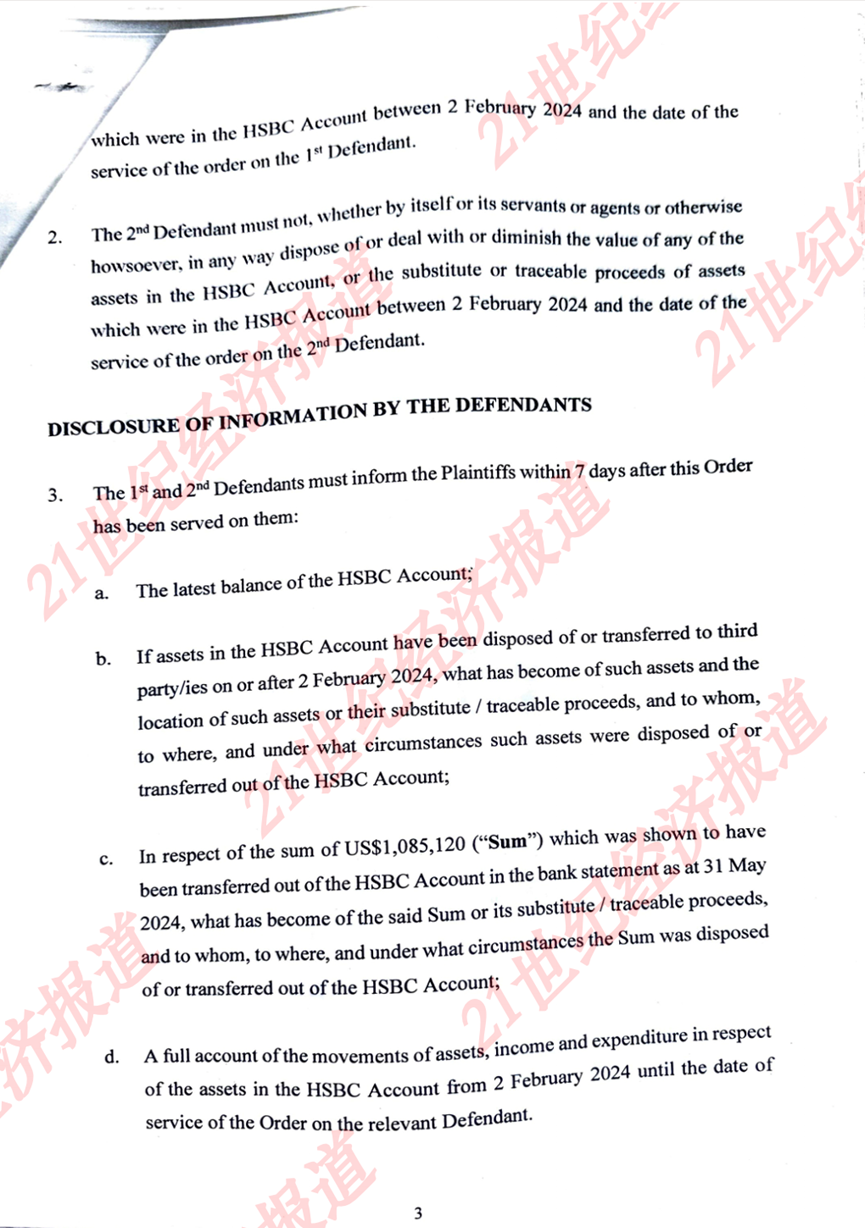
Core Viewpoint - The inheritance dispute involving Zong Fuli and three individuals claiming to be the children of Zong Qinghou has escalated, with legal actions initiated to prevent asset disposal from a HSBC account linked to Jian Hao Ventures Limited [1][4]. Group 1: Legal Proceedings - The Hong Kong High Court issued an order prohibiting Zong Fuli and Jian Hao Ventures Limited from disposing of or diminishing the value of assets in the HSBC account [4]. - The plaintiffs are required to provide the latest balance of the HSBC account and details of any asset transfers since February 2, 2024, including the circumstances surrounding a transfer of $1,085,120 on May 31, 2024 [3][4]. Group 2: Trust and Inheritance Issues - Reports suggest that the HSBC account may serve as a trust account established by Zong Qinghou for his three children, with a total amount of $2.1 billion [7]. - Legal experts indicate that the existence of a trust could complicate the inheritance process, especially since Zong Qinghou's will states that all overseas assets are to be inherited by Zong Fuli, excluding the other children [9][10]. Group 3: Company Structure and Trust Management - Jian Hao Ventures Limited, established in the British Virgin Islands, is speculated to be a vehicle for holding trust assets, potentially allowing Zong Fuli to manage these assets due to perceived gaps in the trust's legal framework [5][6]. - The trust's effectiveness is not contingent on the total amount deposited, as it can be established with minimal initial funding, which raises questions about the legitimacy of asset transfers made by Zong Fuli [8][9]. Group 4: Potential Scenarios for Asset Transfer - Several scenarios are proposed regarding how Zong Fuli may have accessed and transferred trust assets, including the possibility of her being designated to manage the trust or the lack of timely updates to the company's banking authority [10][11][12]. - Legal interpretations suggest that if the trust was not fully established, funds could still be accessed, or if Zong Fuli is a beneficiary, she may have rights to manage the assets under specific conditions [12][13].

21亿美元信托争夺战,Deepseek揭开娃哈哈海外资本迷局
Sou Hu Cai Jing· 2025-07-18 08:07
Core Viewpoint - The article discusses a legal battle involving the heirs of Zong Qinghou, founder of Wahaha Group, over a $2.1 billion offshore trust and $1.8 billion in assets frozen in a Hong Kong bank account, highlighting the complexities of cross-border asset management and inheritance issues in private enterprises [1][10]. Group 1: Trust Dispute - The focus of the dispute is a $2.1 billion offshore trust established in 2003, with Zong Qinghou promising to fund it through dividends from Wahaha Group when profits exceeded 3 billion RMB [3]. - As of early 2024, the trust account had approximately $1.8 billion, with $300 million still to be funded, and a $110,000 withdrawal raised allegations of improper asset disposal [3][4]. - Zong Fuli's legal team argued that the funds were for business expansion, providing invoices and contracts to support their claims [3]. Group 2: Offshore Capital Structure - Zong Qinghou's offshore structure began in the 1990s, with the establishment of Wahaha (USA) Group Corp in California, which served as a foundation for his family's asset management [4]. - The offshore structure allowed for capital flow from domestic companies to offshore entities, facilitating investments in overseas assets, such as a $25 million purchase of a luxury home in Los Angeles [4][5]. Group 3: Legal Battles Across Jurisdictions - The legal conflict spans China, Hong Kong, and the U.S., with differing judicial systems complicating the case [7]. - In Hangzhou, the heirs are seeking to confirm their inheritance rights to 29.4% of Wahaha Group's shares, valued at over 20 billion RMB [7]. - In Hong Kong, the court must determine the legitimacy of the trust based on its funding source, which is tied to the company rather than personal assets [7][8]. Group 4: Systemic Challenges in Inheritance - The case reveals risks in cross-border asset planning for private enterprises, including the failure of asset isolation and the mixing of trust funds with company assets [9]. - Legal documentation flaws, such as the lack of formal trust registration and insufficient witness signatures on the will, raise questions about the trust's validity [9]. - The offshore structure may trigger significant cross-border estate tax liabilities, complicating the inheritance process further [9].
杭州成立专班介入宗庆后遗产纠纷
YOUNG财经 漾财经· 2025-07-17 08:12
Core Viewpoint - The article discusses a legal dispute involving Zong Fuli, the current chairwoman of Wahaha Group, and her half-siblings, who are suing her for access to a trust fund established by their late father, Zong Qinghou, which is valued at approximately $700 million each [4][5]. Group 1: Legal Proceedings - The three plaintiffs, Zong Jichang, Zong Jieli, and Zong Jisheng, have filed lawsuits in both Hong Kong and Hangzhou courts, claiming rights to trust fund assets that their father promised to establish [5][6]. - A temporary injunction has been issued by the Hong Kong court, preventing Zong Fuli and Jian Hao Ventures Limited from disposing of or reducing any assets in a HSBC account linked to the trust [9][10]. - The plaintiffs have requested Zong Fuli to fulfill four disclosure obligations within seven days, including the current balance of the HSBC account and details of any asset transfers since February 2, 2024 [11][12]. Group 2: Trust Fund Details - The trust fund in question was reportedly set up by Zong Qinghou through HSBC, with an estimated balance of $1.8 billion as of early 2024 [5][18]. - Legal experts suggest that the trust may not be fully effective if Zong Fuli can directly access and transfer funds, indicating potential issues with the trust's structure and documentation [18]. - The involvement of Jian Hao Ventures Limited as a second defendant raises questions about Zong Fuli's control over the trust assets and the operational independence of the offshore trust [19].