
空气质量

Search documents
10月,168个重点城市中空气质量较好的前20位城市名单出炉!
Yang Shi Wang· 2025-11-26 06:56
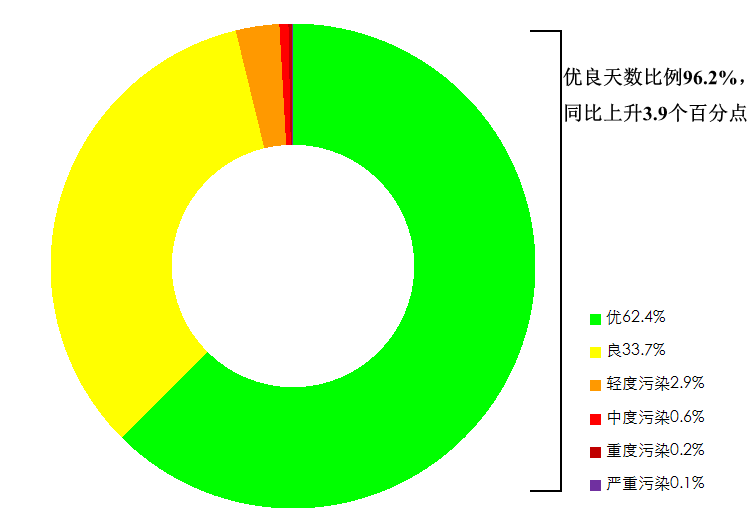
Core Viewpoint - The air quality in China has shown significant improvement in October 2025, with reductions in various pollutants and an increase in the proportion of days with good air quality across major cities [1][3]. Overall Situation - The average PM2.5 concentration across 339 cities was 23.5 micrograms per cubic meter, a year-on-year decrease of 17.5% - PM10 averaged 39 micrograms per cubic meter, down 18.8% year-on-year - O3 averaged 103 micrograms per cubic meter, a decrease of 16.9% - SO2 averaged 7 micrograms per cubic meter, down 12.5% - NO2 averaged 18 micrograms per cubic meter, a reduction of 18.2% - CO remained stable at 0.8 milligrams per cubic meter - The proportion of days with good air quality was 96.2%, an increase of 3.9 percentage points year-on-year, while days with heavy pollution were 0.3%, up 0.1 percentage points [3]. Key Regions Beijing-Tianjin-Hebei and Surrounding Areas - PM2.5 concentration was 34.7 micrograms per cubic meter, down 37.1% year-on-year - O3 concentration was 104 micrograms per cubic meter, down 30.7% - The proportion of good air quality days was 88.8%, an increase of 19.0 percentage points - No days of heavy pollution were reported [8]. Yangtze River Delta - PM2.5 concentration was 23.2 micrograms per cubic meter, down 16.2% year-on-year - O3 concentration was 124 micrograms per cubic meter, down 10.8% - The proportion of good air quality days was 96.7%, an increase of 3.8 percentage points [9]. Fenwei Plain - PM2.5 concentration was 28.9 micrograms per cubic meter, down 33.7% year-on-year - O3 concentration was 91 micrograms per cubic meter, down 34.1% - The proportion of good air quality days was 96.5%, an increase of 8.4 percentage points [10]. Key Cities - Among 168 key cities, the top 20 cities with the best air quality included Guiyang, Kunming, and Suining, while the bottom 20 cities with the worst air quality included Baoding, Shijiazhuang, and Tianjin - The cities with the lowest PM2.5 concentrations were Lhasa, Zhoushan, and Suining, while those with the highest concentrations included Baoding, Handan, and Zhuzhou [12].

11月下半月中国空气质量整体以优良至轻度污染为主
Zhong Guo Xin Wen Wang· 2025-11-15 09:02
Group 1 - The overall air quality in China during the second half of November is expected to be primarily good to lightly polluted, influenced by multiple cold air masses [1][2] - In specific regions such as North China, Central South China, and Northeast China, moderate or above pollution levels may occur due to local conditions [1] - The Beijing-Tianjin-Hebei region is forecasted to have good to lightly polluted air quality, with beneficial dispersion conditions during cold air intervals [1] Group 2 - The Fenwei Plain region is expected to have predominantly good air quality, with potential for light pollution during cold air intervals [2] - The Northwest region is also predicted to maintain good air quality, although light pollution may arise due to dust storms between November 22 and 24 [2]
短期热力升级 闷热感十足
Su Zhou Ri Bao· 2025-10-05 23:07
Weather Conditions - On October 5, the minimum temperature in Suzhou was 24.2℃, with a maximum temperature reaching 34.3℃ by 4 PM, indicating a hot and humid day [1] - October 6 is expected to be cloudy with temperatures rising slightly, providing decent conditions for moon viewing during the Mid-Autumn Festival [1] Typhoon Impact - Typhoon "Maidam" made landfall as a strong typhoon in the eastern coastal area of Xuwen County, Guangdong Province, around 2:50 PM on October 5 [1] - The core impact of "Maidam" is expected from October 5 to 6, bringing heavy rain and strong winds to regions including Hainan, Guangdong, Guangxi, and Yunnan, with some areas experiencing extreme rainfall [1] Forecast and Air Quality - The Suzhou Meteorological Station forecasts cloudy weather from the night of October 5 to the morning of October 6, with an east wind of 3 to 4 levels [1] - The minimum temperature on the morning of October 6 is expected to be around 25℃, with a maximum of about 35℃ during the day [1] - Air quality in Suzhou is reported as excellent during the night of October 5 to the morning of October 6, and good in the afternoon of October 6 [1]
近期最高气温33℃左右 注意防暑防晒
Su Zhou Ri Bao· 2025-10-05 00:21
Weather Summary - On October 4th, Suzhou experienced light rain in the southern region, with localized hourly rainfall being significant [1] - The minimum temperature recorded in the morning was 22.7℃, while the maximum temperature reached 28.5℃ by 4 PM, with increased humidity making it feel muggy [1] - A cold front is expected to bring noticeable cooling to most northern regions of China after the holiday, with maximum temperatures in North China dropping below 15℃, indicating a more pronounced autumn chill [1] - In contrast, southern regions will continue to experience high temperatures, particularly in central and eastern Jiangnan and northern South China [1] - Typhoon "Maidum" is approaching, leading to significant wind and rain impacts in areas from South China to Yunnan [1] Future Weather Forecast - The Suzhou Meteorological Station predicts cloudy conditions with occasional overcast skies on the night of October 4th [1] - On October 5th, the weather will remain cloudy with an east wind of 3-4 levels, and the morning minimum temperature is expected to be around 25℃, with a daytime maximum of approximately 33℃ [1] - UV radiation intensity is moderate, and precautions for sun protection are advised [1] - The weather on October 6th is also expected to be predominantly cloudy, with temperatures ranging from 26℃ to 34℃ [1] - Air quality in Suzhou is forecasted to be "excellent" from the night of October 4th to the morning of October 5th, transitioning to "good" by the afternoon of October 5th [1]
生态环境部:10月上半月全国大部空气质量以优良为主 局地可能出现轻度污染
Zheng Quan Shi Bao Wang· 2025-09-30 13:41
Core Viewpoint - The Ministry of Ecology and Environment forecasts that the overall air quality in most parts of the country will be good in the first half of October, influenced by precipitation and cold air, with localized mild pollution possible [1] Summary by Relevant Sections - **Air Quality Forecast** - The air quality in the majority of the country is expected to be predominantly good, with localized areas potentially experiencing mild pollution [1] - **Pollutants** - The primary pollutants identified are O3 (ozone) and PM2.5 [1] - **Regional Impacts** - Areas affected by dust storms, including Gansu's Hexi region, Ningxia, Qinghai, and western Inner Mongolia, may experience mild pollution, while southern Xinjiang could see moderate pollution [1]
7月城市平均空气质量优良天数比例达93.0%
Ren Min Ri Bao· 2025-08-26 22:22
Core Insights - The Ministry of Ecology and Environment reported that the average PM2.5 concentration in 339 cities was 14.5 micrograms per cubic meter in July, representing an 8.2% year-on-year decrease [1] - The average number of days with good air quality was 93.0%, an increase of 1.0 percentage points year-on-year [1] Group 1: National Air Quality - PM2.5 average concentration in 339 cities: 14.5 micrograms per cubic meter, down 8.2% year-on-year [1] - PM10 average concentration: 28 micrograms per cubic meter, down 3.4% year-on-year [1] - Average days with good air quality: 93.0%, up 1.0 percentage points year-on-year [1] - Average days with severe pollution: 0.2%, down 0.1 percentage points year-on-year [1] Group 2: Regional Air Quality - Beijing-Tianjin-Hebei region PM2.5 average concentration: 18.3 micrograms per cubic meter, down 21.1% year-on-year [1] - Average days with good air quality in this region: 75.7%, down 4.6 percentage points year-on-year [1] - Beijing's PM2.5 concentration: 18.3 micrograms per cubic meter, down 31.2% year-on-year [1] - Average days with good air quality in Beijing: 83.9%, up 16.2 percentage points year-on-year [1] Group 3: Yangtze River Delta and Fenwei Plain - Yangtze River Delta PM2.5 average concentration: 14.6 micrograms per cubic meter, down 3.9% year-on-year [1] - Average days with good air quality in the Yangtze River Delta: 87.8%, down 5.9 percentage points year-on-year [1] - Fenwei Plain PM2.5 average concentration: 18.5 micrograms per cubic meter, down 20.6% year-on-year [1] - Average days with good air quality in the Fenwei Plain: 82.1%, up 14.1 percentage points year-on-year [1]
7月空气质量状况公布 全国PM2.5浓度大幅下降
Yang Shi Xin Wen· 2025-08-26 07:10
Core Insights - The average PM2.5 concentration in 339 cities in July was 14.5 micrograms per cubic meter, representing an 8.2% year-on-year decrease [1] - The average PM10 concentration was 28 micrograms per cubic meter, down 3.4% year-on-year [1] - The proportion of days with good air quality was 93.0%, an increase of 1.0 percentage points year-on-year [1] - The proportion of days with heavy pollution or worse was 0.2%, a decrease of 0.1 percentage points year-on-year [1] Regional Analysis - In the Beijing-Tianjin-Hebei region, the average PM2.5 concentration was 18.3 micrograms per cubic meter, down 21.1% year-on-year, with no days of heavy pollution reported [1] - The PM2.5 concentration in Beijing specifically was 18.3 micrograms per cubic meter, reflecting a 31.2% year-on-year decrease [1] - In the Yangtze River Delta region, the average PM2.5 concentration was 14.6 micrograms per cubic meter, down 3.9% year-on-year, with no days of heavy pollution [1] - In the Fenwei Plain region, the average PM2.5 concentration was 18.5 micrograms per cubic meter, down 20.6% year-on-year, with an 82.1% good air quality day ratio, up 14.1 percentage points year-on-year [1] City Rankings - Among 168 key cities, the top 20 cities with the best air quality included Huangshan, Haikou, Lishui, and Fuzhou [2] - The bottom 20 cities with the poorest air quality included Yangquan, Jiaozuo, and Luliang [2]
7月中国地级及以上城市平均空气质量优良天数比例为93%
Zhong Guo Xin Wen Wang· 2025-08-25 23:55
Group 1 - The average proportion of days with good air quality in China's cities at the prefecture level and above was 93.0% in July, an increase of 1.0 percentage points year-on-year [1] - The average concentration of PM2.5 in July was 14.5 micrograms per cubic meter, a decrease of 8.2% year-on-year, while the average concentration of PM10 was 28 micrograms per cubic meter, down 3.4% year-on-year [1] - The proportion of days with heavy pollution or worse was 0.2%, a decrease of 0.1 percentage points year-on-year [1] Group 2 - In the Beijing-Tianjin-Hebei region and surrounding areas, the average PM2.5 concentration was 18.3 micrograms per cubic meter, a decrease of 21.1% year-on-year, with an average good air quality days proportion of 75.7%, down 4.6 percentage points year-on-year [1] - The PM2.5 concentration in Beijing was 18.3 micrograms per cubic meter, a decrease of 31.2% year-on-year [1] - In the Fenwei Plain, the average PM2.5 concentration was 18.5 micrograms per cubic meter, a decrease of 20.6% year-on-year, with an average good air quality days proportion of 82.1%, an increase of 14.1 percentage points year-on-year [1] Group 3 - Among 168 key cities, the top 20 cities with the best air quality included Huangshan, Haikou, Lishui, and Fuzhou [2] - The bottom 20 cities with the worst air quality included Yangquan, Jiaozuo, and Luliang [2]
7月,全国339个地级及以上城市平均空气质量优良天数比例为93.0%
Yang Shi Wang· 2025-08-25 15:46
Group 1 - The average PM2.5 concentration in 339 cities was 14.5 micrograms per cubic meter in July, showing a year-on-year decrease of 8.2% [1] - The average PM10 concentration was 28 micrograms per cubic meter, down 3.4% year-on-year [1] - The average O3 concentration increased to 138 micrograms per cubic meter, reflecting a year-on-year rise of 4.5% [1] - The average SO2 concentration was 6 micrograms per cubic meter, with a year-on-year decrease of 14.3% [1] - The average NO2 concentration was 11 micrograms per cubic meter, down 8.3% year-on-year [1] - The average CO concentration was 0.6 milligrams per cubic meter, showing a year-on-year decrease of 14.3% [1] - The proportion of days with good air quality was 93.0%, an increase of 1.0 percentage points year-on-year [1] - The proportion of days with heavy pollution was 0.2%, a decrease of 0.1 percentage points year-on-year [1] - The average number of days exceeding standards due to dust storms was 0.6%, with heavy pollution days at 0.2% [1] Group 2 - Among 168 key cities, the top 20 cities with the best air quality included Huangshan, Haikou, and Lishui [2] - The bottom 20 cities with the worst air quality included Yangquan, Jiaozuo, and Luliang [2] - The top 20 cities with the lowest PM2.5 concentrations included Lishui, Zhoushan, and Dazhou [2] - The bottom 20 cities with the highest PM2.5 concentrations included Hebi, Tangshan, and Suizhou [2]
生态环境部:7月全国339个地级及以上城市平均空气质量优良天数比例为93%
Zheng Quan Shi Bao Wang· 2025-08-25 13:26
Core Insights - The Ministry of Ecology and Environment reported that in July 2025, the average proportion of days with good air quality across 339 cities was 93.0%, an increase of 1.0 percentage points year-on-year [1] - The proportion of days with heavy pollution or worse was 0.2%, a decrease of 0.1 percentage points compared to the previous year [1] - The average number of days exceeding air quality standards due to sandstorms was 0.6%, with heavy pollution days accounting for 0.2% of this total [1]