
绿色租赁

Search documents
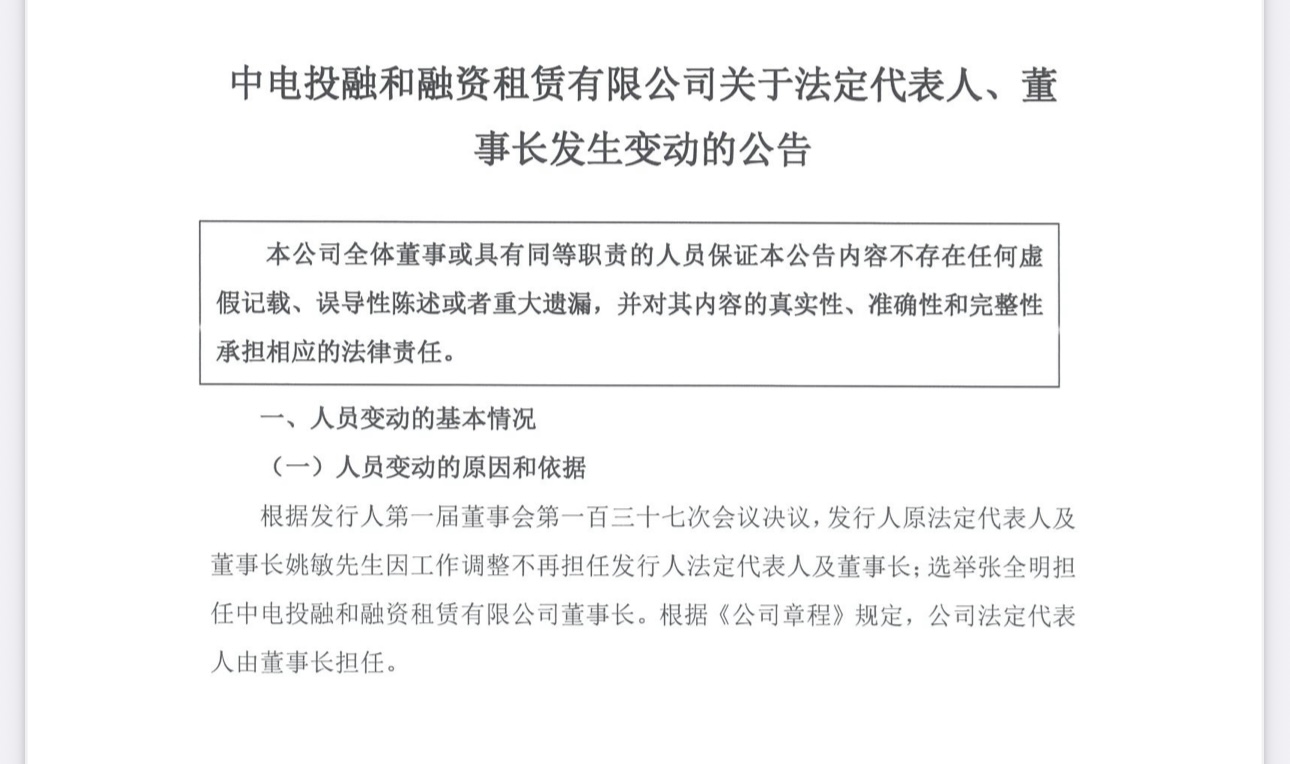
国家电投旗下融和租赁“换帅”,国电投山东院张全明接棒董事长
Qi Lu Wan Bao· 2025-08-13 15:02
Core Viewpoint - The announcement of a leadership change at China Power Investment Group's financing leasing subsidiary, Ronghe Leasing, highlights the company's ongoing focus on clean energy and its significant asset management scale in the sector [1][3]. Company Overview - Ronghe Leasing, established in March 2014, is the first leasing company set up by a central enterprise in the Shanghai Free Trade Zone, with a registered capital of 1.507 billion USD (approximately 10.035 billion RMB) [3]. - The company holds the highest AAA credit rating from China Chengxin International Credit Rating Co., Ltd. and has been recognized as a green enterprise with a Ge-1 rating [3]. Leadership Change - Yao Min has stepped down as the legal representative and chairman of Ronghe Leasing, with Zhang Quanming elected as the new chairman [3][4]. - Zhang Quanming currently serves as the director, general manager, and deputy secretary of the Party Committee at China Power Investment Group Capital Holdings Co., Ltd. [4]. Asset Management and Focus - Ronghe Leasing has managed assets exceeding 130 billion RMB, with over 75% of its asset structure focused on the energy and power industry [3]. - The company has invested in wind and solar power, with a cumulative installed capacity exceeding 71 million kilowatts, emphasizing its commitment to green leasing [3]. Market Strategy - In response to market uncertainties, Ronghe Leasing is expanding its equity investment along the industrial chain, developing new material projects such as sodium battery cathodes, silicon-carbon anodes, and solid-state batteries [3]. - The company aims to promote the green and low-carbon transformation of the energy industry, achieving cumulative tax and profit contributions exceeding 10 billion RMB [3].

租”力全开 为新型工业化装上“加速齿轮
Jin Rong Shi Bao· 2025-08-13 04:04
Core Insights - The financing leasing industry is focusing on transforming its traditional model to better integrate into the real industrial chain, enhancing its role as a "device updater" and "technology upgrader" in the new industrialization process [1][3] Industry Development - As of June 2025, there are approximately 7,020 financial leasing and financing leasing companies in China, with a total contract balance of about 5.42 trillion yuan [2] - The industry is encouraged to rely on policy support to accelerate transformation and expand its influence [2] Policy Guidance - The People's Bank of China and seven other departments issued guidelines to support new industrialization, emphasizing the dual functions of financing and asset leasing [3] - The guidelines aim to deepen the collaboration between financing leasing and key sectors such as electronic information, aviation manufacturing, and green low-carbon industries [3] Green Leasing Initiatives - Hebei Province has implemented a series of supportive policies for independent energy storage projects, including a direct leasing business for energy storage equipment worth 176 million yuan [4] - Experts suggest that financial leasing companies should innovate green leasing products, integrating tools like "green bonds" and "carbon finance" [4] Financial Innovation - A notable policy initiative is the promotion of asset securitization for manufacturing financing leasing, which is expected to enhance liquidity and expand funding sources [5][6] - This initiative will help leasing companies optimize asset management and improve funding allocation efficiency [6] Infrastructure Support - The guidelines also emphasize the importance of supporting digital infrastructure construction through long-term loans and various financing methods [7] - Financing leasing companies are encouraged to provide support to service providers in digital transformation, creating a closed-loop ecosystem [7] Collaborative Efforts - The guidelines call for enhanced cooperation among various financial institutions to mitigate risks and improve information sharing [8] - Financing leasing institutions are encouraged to develop service systems that combine leasing with guarantees, securities, and equity investments to support advanced manufacturing [8]
2025年融资租赁行业分析
Lian He Zi Xin· 2025-03-16 09:37
Investment Rating - The report indicates a cautious outlook for the financing leasing industry, reflecting a contraction in the sector since 2022 [3][12]. Core Insights - The financing leasing industry has been experiencing a decline in both the number of companies and business scale, attributed to stricter regulations and macroeconomic pressures [3][12]. - As of June 2024, the total number of financing leasing companies in China decreased to 8,671, a reduction of 180 companies compared to the end of 2023, primarily affecting foreign-funded leasing companies [3][4]. - The total balance of financing leasing contracts was approximately 56,060 billion yuan, showing a slight decrease of 0.60% from the end of 2023 [3][4]. - The average issuance interest rate for bonds by financing leasing companies in 2024 was 2.37%, down from 3.06% in 2023, indicating a significant reduction in financing costs [7][14]. - Regulatory policies are expected to unify, with an emphasis on supporting the real economy and promoting green financing initiatives [10][14]. Summary by Sections Industry Overview and Regulatory Policies - The financing leasing industry has faced a contraction since 2022, with a notable decrease in the number of companies and business scale due to regulatory tightening and economic challenges [3][12]. - The regulatory environment has shifted, with the China Banking and Insurance Regulatory Commission taking over the responsibilities for the operation and regulation of financing leasing companies [5][9]. Future Development - The financing leasing industry is anticipated to continue its slow growth into 2025, with increasing differentiation among companies and ongoing pressures for business transformation [12][14]. - There is a focus on enhancing service capabilities to the real economy, particularly in green financing, as regulatory bodies encourage financing leasing companies to innovate in this area [10][14].