自动驾驶世界模型

Search documents
自动驾驶前沿方案:从端到端到VLA工作一览
自动驾驶之心· 2025-08-10 03:31
Core Viewpoint - The article discusses the advancements in end-to-end (E2E) and VLA (Vision-Language Architecture) algorithms in the autonomous driving industry, highlighting their potential to enhance driving capabilities through unified perception and control modeling, despite their higher technical complexity [1][5]. Summary by Sections End-to-End Algorithms - End-to-end approaches are categorized into single-stage and two-stage methods, with the latter focusing more on joint prediction, where perception serves as input for trajectory planning and prediction [3]. - Single-stage end-to-end models include various methods such as UniAD, DiffusionDrive, and Drive-OccWorld, each emphasizing different aspects and likely to be optimized by combining their strengths in production [3][37]. VLA Algorithms - VLA extends the capabilities of large models to enhance scene understanding in production models, with internal discussions on language models as interpreters and various algorithm summaries for modular and unified end-to-end VLA [5][45]. - The community has compiled over 40 technical routes, facilitating quick access to industry applications, benchmarks, and learning pathways [7]. Community and Resources - The community provides a platform for knowledge exchange among members from renowned universities and leading companies in the autonomous driving sector, offering resources such as open-source projects, datasets, and learning routes [19][35]. - A comprehensive technical stack and roadmap for beginners and advanced researchers are available, covering various aspects of autonomous driving technology [12][15]. Job Opportunities and Networking - The community has established job referral mechanisms with multiple autonomous driving companies, encouraging members to connect and share job opportunities [10][17]. - Regular discussions on industry trends, research directions, and practical applications are held, fostering a collaborative environment for learning and professional growth [20][83].

4000人了,死磕技术的自动驾驶黄埔军校到底做了哪些事情?
自动驾驶之心· 2025-07-31 06:19
Core Viewpoint - The article emphasizes the importance of creating an engaging learning environment in the field of autonomous driving and AI, aiming to bridge the gap between industry and academia while providing valuable resources for students and professionals [1]. Group 1: Community and Resources - The community has established a closed loop across various fields including industry, academia, job seeking, and Q&A exchanges, focusing on what type of community is needed [1][2]. - The platform offers cutting-edge academic content, industry roundtables, open-source code solutions, and timely job information, streamlining the search for resources [2][3]. - A comprehensive technical roadmap with over 40 technical routes has been organized, catering to various interests from consulting applications to the latest VLA benchmarks [2][14]. Group 2: Educational Content - The community provides a series of original live courses and video tutorials covering topics such as automatic labeling, data processing, and simulation engineering [4][10]. - Various learning paths are available for beginners, as well as advanced resources for those already engaged in research, ensuring a supportive environment for all levels [8][10]. - The community has compiled a wealth of open-source projects and datasets related to autonomous driving, facilitating quick access to essential materials [25][27]. Group 3: Job Opportunities and Networking - The platform has established a job referral mechanism with multiple autonomous driving companies, allowing members to submit their resumes directly to desired employers [4][11]. - Continuous job sharing and position updates are provided, contributing to a complete ecosystem for autonomous driving professionals [11][14]. - Members can freely ask questions regarding career choices and research directions, receiving guidance from industry experts [75]. Group 4: Technical Focus Areas - The community covers a wide range of technical focus areas including perception, simulation, planning, and control, with detailed learning routes for each [15][29]. - Specific topics such as 3D target detection, BEV perception, and online high-precision mapping are thoroughly organized, reflecting current industry trends and research hotspots [42][48]. - The platform also addresses emerging technologies like visual language models (VLM) and diffusion models, providing insights into their applications in autonomous driving [35][40].
分钟级长视频生成!地平线Epona:自回归扩散式的端到端自动驾驶世界模型(ICCV'25)
自动驾驶之心· 2025-07-07 12:17
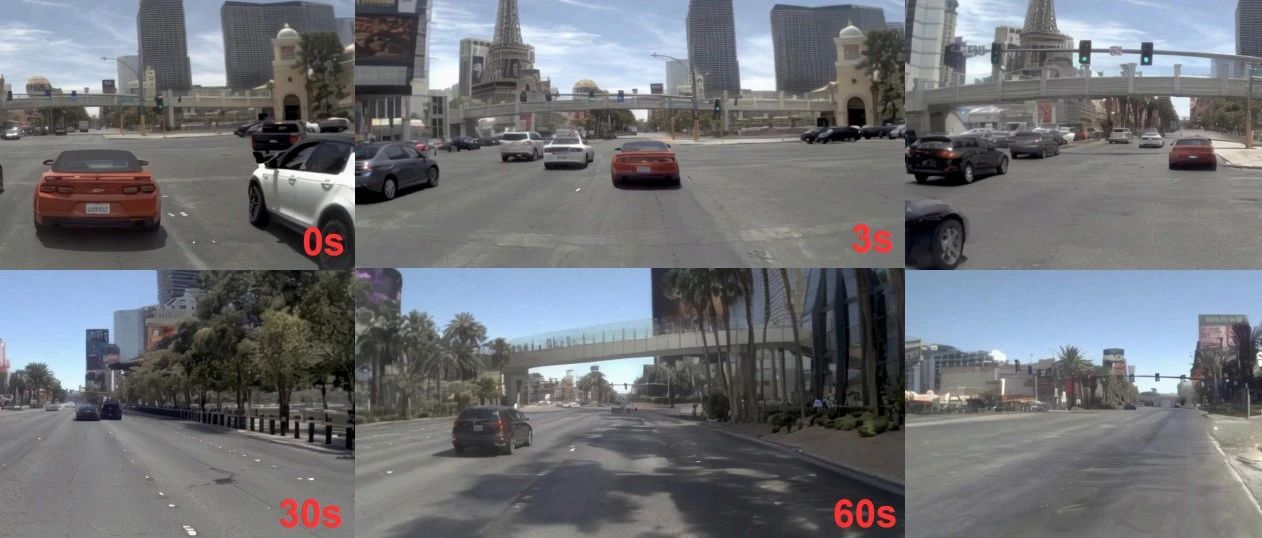
Core Insights - The article discusses the development of Epona, a novel autoregressive diffusion world model for autonomous driving, which integrates the advantages of diffusion models and autoregressive models to support long video generation, trajectory control, and real-time motion planning within a single framework [2][33]. Group 1: Research Motivation - The research highlights the growing interest in world models as a key technology for simulating physical environments and assisting agents in planning and decision-making, particularly in high-dynamic and complex tasks like autonomous driving [6]. - Current world model architectures face significant limitations, particularly in their ability to provide high-quality long-term predictions and real-time motion planning [7]. Group 2: Innovations of Epona - Epona introduces two key innovations: decoupled spatiotemporal modeling, which separates temporal dynamics from fine-grained future world generation, and modular trajectory and video prediction, allowing seamless integration of motion planning and visual modeling [2][19]. - The model employs a new "chain-of-forward training strategy" to address error accumulation in autoregressive cycles while achieving high-resolution, long-duration generation [2][23]. Group 3: Performance Metrics - Epona demonstrates a 7.4% improvement in FVD metrics compared to existing methods, with the capability to predict durations of several minutes [2][26]. - In experiments, Epona can generate high-quality driving videos exceeding 2 minutes (600 frames) in length, significantly outperforming other state-of-the-art models [26]. Group 4: Comparison with Existing Models - Epona's design contrasts with existing models that either lack critical planning modules or are limited by low resolution and short-term generation capabilities [9][31]. - The article compares Epona's performance metrics with other models, showing significant advantages in both video length and quality [29][30]. Group 5: Future Implications - The advancements presented by Epona could pave the way for the next generation of end-to-end autonomous driving systems, reducing reliance on complex perception modules and expensive labeled data [6][33].
理想新一代世界模型首次实现实时场景编辑与VLA协同规划
理想TOP2· 2025-06-11 02:59
Core Viewpoint - GeoDrive is a next-generation world model system for autonomous driving, developed collaboratively by Peking University, Berkeley AI Research (BAIR), and Li Auto, addressing the limitations of existing methods that rely on 2D modeling and lack 3D spatial perception, which can lead to unreasonable trajectories and distorted dynamic interactions [11][14]. Group 1: Key Innovations - **Geometric Condition-Driven Generation**: Utilizes 3D rendering to replace numerical control signals, effectively solving the action drift problem [6]. - **Dynamic Editing Mechanism**: Injects controllable motion into static point clouds, balancing efficiency and flexibility [7]. - **Minimized Training Cost**: Freezes the backbone model and employs lightweight adapters for efficient data training [8]. - **Pioneering Applications**: Achieves real-time scene editing and VLA (Vision-Language-Action) collaborative planning within the driving world model for the first time [9][10]. Group 2: Technical Details - **3D Geometry Integration**: The system constructs a 3D representation from single RGB images, ensuring spatial consistency and coherence in scene structure [12][18]. - **Dynamic Editing Module**: Enhances the realism of multi-vehicle interaction scenarios during training by allowing flexible adjustments of movable objects [12]. - **Video Diffusion Architecture**: Combines rendered conditional sequences with noise features to enhance 3D geometric fidelity while maintaining photorealistic quality [12][33]. Group 3: Performance Metrics - GeoDrive significantly improves controllability of driving world models, reducing trajectory tracking error by 42% compared to the Vista model, and shows superior performance across various video quality metrics [19][34]. - The model demonstrates effective generalization to new perspective synthesis tasks, outperforming existing models like StreetGaussian in video quality [19][38]. Group 4: Conclusion - GeoDrive sets a new benchmark in autonomous driving by enhancing action controllability and spatial accuracy through explicit trajectory control and direct visual condition input, while also supporting applications like non-ego vehicle perspective generation and scene editing [41].