金融风险管理

Search documents
23项“禁令”齐发!这类金融组织迎强监管→
Jin Rong Shi Bao· 2025-07-16 12:57
Core Viewpoint - The recent issuance of the "Interim Measures for the Supervision and Administration of Local Asset Management Companies" marks a significant improvement in the regulatory framework for local AMCs in China, aiming to guide the industry towards more standardized and sustainable development [1][4]. Summary by Relevant Sections Regulatory Framework - The new measures comprehensively regulate the business boundaries, risk management, and supervisory mechanisms of local AMCs, clearly defining what is permissible and what is prohibited, thus enhancing risk management and compliance levels [1][3]. Business Operations - Local AMCs are primarily focused on preventing and resolving regional financial and real economy risks, with a defined scope of operations including the acquisition, management, and disposal of non-performing assets [3][4]. - The measures prohibit local AMCs from engaging in activities such as helping financial institutions conceal non-performing assets and providing financing channels for local government financing platforms [5][6]. Risk Management - Specific risk management requirements are established, including limits on exposure to single clients and groups, ensuring that local AMCs maintain a balanced risk profile [7][8]. - Local AMCs are required to hold a minimum amount of high-quality liquid assets to manage liquidity risks effectively [8]. Regulatory Responsibilities - The provincial local financial management institutions are designated as responsible for the supervision and risk management of local AMCs, ensuring a unified and authoritative regulatory approach [9]. - The measures emphasize the importance of collaboration between local and national regulatory bodies to promote healthy industry development [9]. Transition Period - A transition period is set for local AMCs to comply with the new regulations, which is expected to last no more than three years, allowing companies to adjust their business models accordingly [10][11].
新财观 | 建立上海国际金融风险管理中心的价值、挑战与对策
Xin Hua Cai Jing· 2025-07-15 14:15
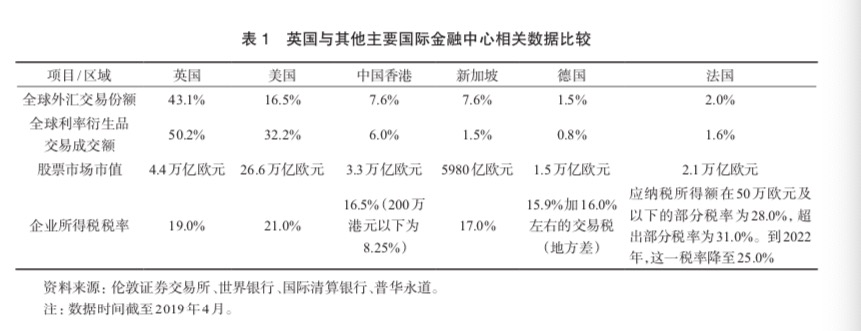
Core Insights - London remains a leading global financial center despite challenges from Brexit and competition from other financial hubs, showcasing resilience and competitiveness in various key sectors [4] - The establishment of an international financial risk management center in London is supported by its extensive banking network, technological concentration, and strong fintech ecosystem [3][4] Group 1: Global Financial Market Position - London holds a 43.1% share of global foreign exchange trading, significantly higher than the US at 16.5% and Hong Kong and Singapore both at 7.6% [1] - The UK leads in global interest rate derivatives trading with a 50.2% market share, followed by the US at 32.2% [1] - London is the largest center for gold pricing and trading, with an average daily transaction volume of 47.1 million ounces and a daily turnover of $126 billion [4] Group 2: Advantages of London as a Financial Hub - The UK has the largest concentration of international banks in Europe, facilitating multinational companies in managing currency and liquidity risks [3] - London is home to the largest cybersecurity market in Europe, valued at over £6 billion, employing over 30,000 people [3] - The city is a key player in the global insurance and reinsurance market, accounting for 10% of the world's market share [3] Group 3: Recommendations for Shanghai's Financial Risk Management Center - Shanghai should develop a comprehensive financial risk management product system that covers various types of risks and encourages innovation [5] - The city needs to enhance its financial risk monitoring and control mechanisms to improve the identification and management of potential risks [6] - Establishing a competitive financial market in Shanghai requires reducing costs for international entities and improving the investment environment [7] Group 4: Innovation and Policy Support - Shanghai aims to create a leading technology industry cluster to support the development of its international financial risk management center [8] - The city plans to enhance its financial technology capabilities and establish a robust information network and data security center [8] - Policies will be introduced to support the establishment of a controllable offshore financial system in the Pudong New Area [8]

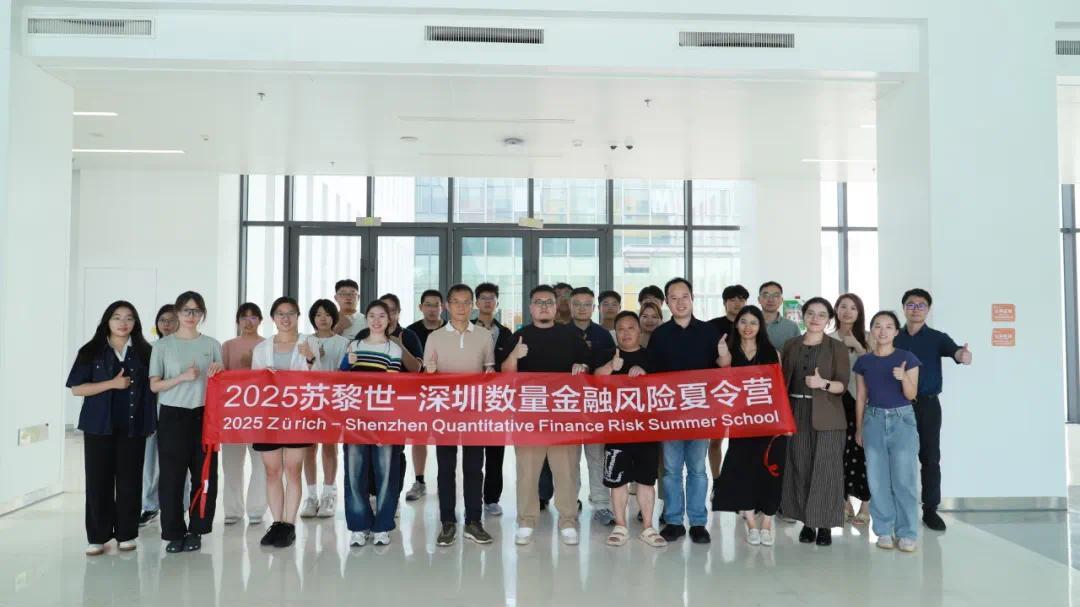
量化金融风险夏令营,AI时代的投资大师培养班
Zhong Guo Jin Rong Xin Xi Wang· 2025-07-13 10:14
Core Insights - The "2025 Zurich-Shenzhen Quantitative Finance Risk Summer Camp" was successfully inaugurated, organized by several institutions including the Southern University of Science and Technology and Zurich University [1] - The event featured notable speakers including Didier Sornette, who emphasized the critical role of risk management in finance [4] - The summer camp aims to enhance students' critical thinking and professional skills through interactions with experienced experts [4] Group 1: Event Overview - The summer camp is a two-week program taking place in Zurich and Shenzhen, focusing on trends in quantitative finance, financial market risks, and the application of machine learning [11] - The theme of this year's camp is "Focus on Data, Seize Opportunities," with a strong emphasis on practical aspects of quantitative investment [11] - The camp attracted over 20 outstanding students and professionals from various universities and financial institutions [12] Group 2: Key Speakers and Their Contributions - Didier Sornette highlighted the importance of risk management and encouraged students to engage with experts [4] - Lin Jun, CEO of Shenzhen Kangjie Wendo Technology Co., introduced the company's business logic emphasizing the significance of data in industry development [5] - Dr. Shao Hao delivered a lecture on the current state and frontiers of quantitative investment, discussing the challenges faced by traditional investment methods and the advantages of quantitative approaches [9] Group 3: Industry Relevance - Quantitative finance is increasingly important for financial risk management, utilizing interdisciplinary methods from mathematics, statistics, and computer science [12] - The development and application of quantitative finance provide comprehensive risk management tools and decision support for financial institutions and investors [12]