AI下半场

Search documents
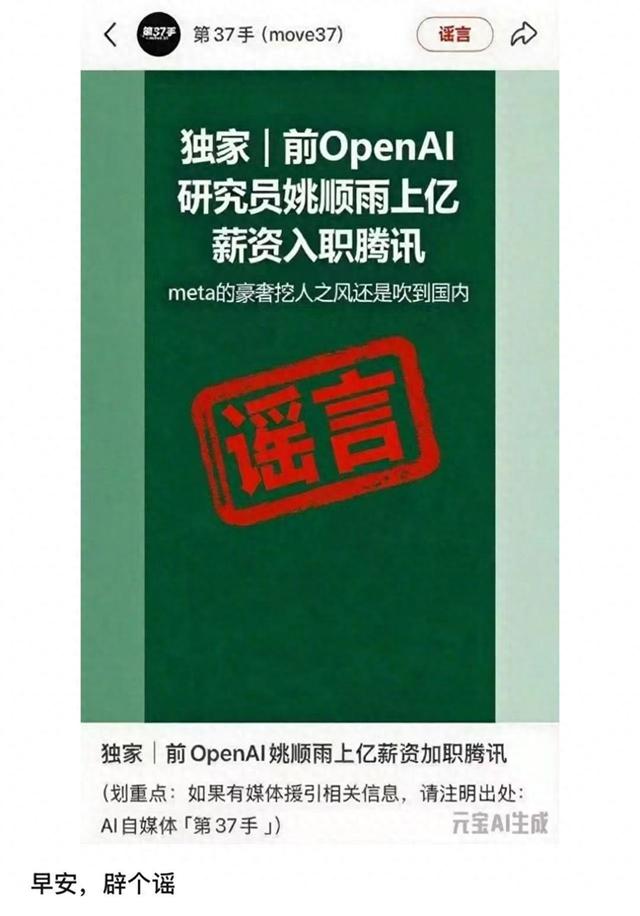
腾讯官方辟谣“前 OpenAI 研究员姚顺雨上亿薪资入职腾讯”
Huan Qiu Wang· 2025-09-12 08:33
Group 1 - Tencent officially refuted rumors regarding former OpenAI researcher Yao Shunyu joining the company with a salary of "over 100 million" [1] - The clarification was made through Tencent's official WeChat account "Goose Factory Blackboard" [1] Group 2 - Yao Shunyu graduated from Tsinghua University and obtained a PhD in Computer Science from Princeton University [3] - He joined OpenAI in 2024, contributing to the development of intelligent agent products and deep research [3] - Yao proposed the Tree of Thoughts framework to improve decision-making models during his doctoral studies [3] - He led the ReAct method, which introduced the "reasoning-action" interaction paradigm for language agents [3] - In 2025, he spearheaded the Computer-Using Agent project, integrating a new paradigm of reinforcement learning and shifting AI technology focus from training-oriented to evaluation-oriented, introducing the concept of "AI's second half" [3]


腾讯打出「AI岗位薪酬不限」的底气来自哪?
机器之心· 2025-06-13 04:31
Core Viewpoint - The article discusses the evolving job market for AI graduates, emphasizing the shift from model parameters and training techniques to defining valuable problems and creating evaluation systems that fit real-world scenarios [2][6][11]. Group 1: Industry Trends - The AI job market is rapidly changing, with companies of all sizes actively recruiting AI talent [2]. - The focus of AI competition is shifting from merely improving model performance to understanding how to apply AI effectively in real-world contexts [6][11]. - The saturation of benchmark tests is occurring faster, indicating diminishing returns from traditional model development approaches [6][11]. Group 2: Company Selection Criteria - Graduates should consider companies that can sustain AI development, focusing on user engagement and the ability to create a complete cycle from technology development to commercial application [11][12]. - The strength of the coupling between technology and business is crucial; AI should be a core driver rather than a supplementary feature [12]. - Companies must demonstrate commercial validation of AI capabilities, such as having revenue-generating AI applications and clients willing to pay for AI features [13][14]. Group 3: Tencent as a Case Study - Tencent exemplifies a company with a broad and deep engagement in various fields, providing a rich environment for AI development [15][16]. - Tencent's AI technologies are integrated into its core business operations, enhancing user engagement and driving revenue growth [17][18]. - The company has clear AI monetization cases, with significant revenue contributions from AI-driven advertising and gaming sectors [18][19]. Group 4: Talent Development Programs - Tencent's "Qingyun Plan" is a high-priority initiative aimed at nurturing top technical talent, offering competitive compensation and a supportive environment for innovation [21][22]. - Participants in the Qingyun Plan have opportunities for significant contributions to AI projects and can publish research in top conferences [23][24]. - The program emphasizes a non-traditional management culture, allowing for exploration and creativity in research [24][25].

姚顺雨提到的「AI下半场」,产品评估仍被误解
机器之心· 2025-06-02 05:22
Core Insights - The focus of AI is shifting from problem-solving to problem-definition, emphasizing the importance of evaluation over training [1][4] - The evaluation process is a continuous practice that drives development and requires a scientific approach [7][10] Evaluation Framework - Building a product evaluation system is fundamentally about applying the scientific method, involving a cycle of questioning, experimentation, and analysis [8] - Initial steps include observing data, examining inputs, outputs, and user interactions to identify operational strengths and weaknesses [8] - Data labeling is crucial, prioritizing problematic outputs to create a balanced and representative dataset for targeted evaluation [8] Hypothesis and Experimentation - Formulating hypotheses about errors is essential, which may involve analyzing retrieval documents and reasoning paths [9] - Designing experiments to validate these hypotheses is necessary, including rewriting prompts or updating retrieval components [9] - Measuring results quantitatively is critical to determine the effectiveness of changes made during experiments [9] Evaluation-Driven Development (EDD) - EDD helps create better AI products by defining success criteria through product evaluation before development begins [12] - The process involves establishing baseline evaluations and continuously assessing each adjustment to ensure measurable progress [12] - EDD fosters a feedback loop that is rooted in software engineering practices, ensuring that improvements are based on objective data [12] Automation and Human Oversight - Automated evaluation tools enhance monitoring but cannot replace human oversight; regular sampling and analysis of user feedback are still necessary [14][15] - High-quality labeled data is essential for calibrating automated tools to align with human judgment [14] - Maintaining a feedback loop of data sampling, output labeling, and tool optimization is crucial for effective evaluation [14][15]

深度|清华姚班学霸、OpenAI姚顺雨:AI下半场从“算法竞赛”转向“效用定义”,重构评估框架,将技术能力转化为真实世界价值
Z Potentials· 2025-04-25 03:05
Core Insights - The article discusses the transition of AI from a phase focused on model innovation and benchmark testing to a new phase emphasizing problem definition and evaluation [3][23][30] - It highlights the importance of reinforcement learning achieving generalization capabilities, allowing it to tackle diverse tasks previously thought to be unrelated [3][4][21] Group 1: AI's First Half - The first half of AI's development was characterized by significant breakthroughs in training methods and models, such as Transformer and GPT-3, which focused on improving model performance on benchmarks [4][5][7] - The emphasis was on creating new models rather than defining tasks, leading to a cycle of developing increasingly difficult benchmarks that could be solved with existing methods [7][8][23] Group 2: Breakthrough Formula - The effective formula for AI's success includes large-scale language pre-training, scaling (data and compute), and the integration of reasoning and action [9][14] - The realization that prior knowledge is crucial for generalization has shifted the focus from solely algorithm development to understanding the environment and prior knowledge [15][21] Group 3: Transition to the Second Half - The second half of AI will focus on redefining evaluation frameworks and creating new assessment methods that reflect real-world applications rather than just benchmark performance [26][27][29] - The industry faces the "utility problem," where existing evaluation frameworks do not align with real-world tasks, necessitating a reevaluation of how AI's effectiveness is measured [27][29] Group 4: Future Directions - The new game in AI's second half involves leveraging existing formulas to solve real-world tasks while innovating new components to enhance these formulas [32] - Companies will need to create new hypotheses that challenge existing paradigms to achieve significant breakthroughs and develop valuable products worth billions or trillions [30][32]