AI Video Generation

Search documents
Disney: AI Video Generation Will Supercharge IP-Rich Entertainment Giants
Seeking Alpha· 2025-10-08 16:02
I'm a full time value investor and writer who enjoys using classical value ratios to pick my portfolio. My previous working background is in private credit and CRE mezzanine financing for a family office. I'm also a fluent Mandarin speaker in both business and court settings, previously serving as a court interpreter. I have spent a good chunk of my adult working life in China and Asia. I have worked with top CRE developers in the past including The Witkoff Group , Kushner Companies, Durst Organization and ...



AI视频生成“暗战”起风
Hua Er Jie Jian Wen· 2025-09-29 00:01
Core Insights - User payment models have not yet been established in large language models but are quietly taking root in the AI video generation sector [1] - The commercialization prospects of AI video generation extend beyond individual creators to include film production and embodied intelligence [2] Group 1: Market Developments - AI video generation startup Runway achieved an annual revenue exceeding $90 million, while Kuaishou's AI video app "Keling" generated over 250 million yuan in the second quarter [1] - Domestic startups like Beijing Shengshu Technology's "Vidu" and Beijing Aishi Technology's "Paimo" have surpassed 10 million users [2] - Manycore Tech Inc. plans to launch AI video generation products targeting end consumers [2] Group 2: Technological Advancements - OpenAI's Sora 1.0, launched in February 2024, is the first AI video generation model capable of producing videos up to 60 seconds long [3] - Domestic companies are catching up, with major players like ByteDance, Kuaishou, and Baidu exploring AI video generation applications [4] - Baidu's upgraded "Baidu Steam Engine" now supports the generation of videos of unlimited length, breaking previous limitations [8] Group 3: Industry Applications - The film industry is among the first to adopt AI video generation, as demonstrated by the animated series "Tomorrow Monday," which utilized Vidu's AI model for production [6] - Kuaishou's "Keling" serves various customer segments, including professionals and content creators in the film industry [7] Group 4: Commercialization and Pricing Strategies - AI video generation companies are exploring different commercialization models, with pricing varying significantly across platforms [9] - Kuaishou's "Keling" reported revenue exceeding 250 million yuan in the second quarter of 2025, while Shengshu Technology's Vidu achieved an annual recurring revenue of $20 million [9] - A price war is emerging among major companies to attract professional creators, with Baidu's pricing being significantly lower than competitors [10] Group 5: Technical Challenges - Despite improvements in spatial consistency, issues such as facial expression distortion and background inconsistencies persist across various AI video generation models [13] - The core challenge lies in accurately modeling long-term motion trajectories and multi-scale semantic coherence [14] - Companies are focusing on optimizing algorithms and building large-scale high-quality video training datasets to address these challenges [15] Group 6: Data Utilization and Privacy - High-quality datasets are crucial for training AI video generation models, with some companies reportedly using adult films as training material, raising copyright concerns [17] - Domestic platforms may have more flexibility in utilizing training materials, particularly video platforms like Kuaishou and Douyin, which have access to user-generated content [18]
阿里巴巴投出AI视频生成赛道最大单笔融资
Xin Lang Cai Jing· 2025-09-16 08:10
Core Insights - AI video generation company "Aishi Technology" has completed a Series B financing round, raising over $60 million [1] - The financing round was led by Alibaba, with participation from various investors including Dacheng Capital, Shenzhen Capital Group, Beijing AI Fund, Hunan Broadcasting Media, Giant Network, and Antler [1] - This financing round marks the largest single financing amount in the domestic video generation sector [1]

好莱坞特效师花300多块钱,用AI做了一部科幻短片
Di Yi Cai Jing· 2025-08-21 12:57
Core Insights - The AI-generated short film "Return" by visual effects director Yao Qi demonstrates significant advancements in AI technology, although it still has room for improvement in realism and synchronization [1][4][6] Cost and Production - The production cost of the AI-generated short film was approximately 330.6 RMB, compared to several million RMB for a traditional live-action or CGI film [3][4] - The short film was created in about one week, utilizing over 120 video segments, showcasing the efficiency of AI in content creation [1][4] Market Dynamics - The demand for video generation models has surged, prompting companies like Baidu to develop their own models, such as "MuseSteamer," in response to specific market needs [4][5] - The video generation market is highly competitive, with major players like Kuaishou, ByteDance, Alibaba, and Tencent actively participating [5][6] Technological Advancements - Baidu's latest video generation model can produce multi-character, voiced videos, marking a significant step forward from previous silent video generations [5][6] - Current technology limitations restrict video length to 5-10 seconds, with costs increasing exponentially for longer videos, presenting a challenge for practical applications [5][6] Future Outlook - The video generation industry is still in its early stages, with significant potential for growth as companies continue to innovate and improve their models [6]


速递|Moonvalley发布首个公开数据训练的AI视频模型Marey:如何实现360度镜头控制与物理模拟
Z Potentials· 2025-07-09 05:56
Core Viewpoint - Moonvalley, an AI video generation startup, emphasizes that traditional text prompts are insufficient for film production, introducing a "3D perception" model that offers filmmakers greater control compared to standard text-to-video models [1] Group 1: Product Offering - Moonvalley launched its model Marey in March as a subscription service, allowing users to generate video clips up to 5 seconds long, with pricing tiers of $14.99 for 100 points, $34.99 for 250 points, and $149.99 for 1000 points [1] - Marey is one of the few models trained entirely on publicly licensed data, appealing to filmmakers concerned about potential copyright issues with AI-generated content [1] Group 2: Democratization of Filmmaking - Independent filmmaker Ángel Manuel Soto highlights Marey's ability to democratize access to top-tier AI narrative tools, reducing production costs by 20% to 40% and providing opportunities for those traditionally excluded from filmmaking [2] - Soto's experience illustrates how AI enables filmmakers to pursue their stories without needing external funding or approval [2] Group 3: Technological Capabilities - Marey possesses an understanding of the physical world, allowing for interactive storytelling and features like simulating motion while adhering to physical laws [3] - The model can transform scenes, such as converting a video of a bison running into a Cadillac speeding through the same environment, with realistic changes in grass and dust [4] Group 4: Advanced Features - Marey supports free camera movement, enabling users to adjust camera trajectories and create effects like panning and zooming with simple mouse actions [5] - Future updates are planned to include new control features such as lighting adjustments, depth object tracking, and a character library [5] - Marey's public release positions it in competition with other AI video generators like Runway Gen-3, Luma Dream Machine, Pika, and Haiper [5]

摩根士丹利:快手科技_人工智能视频生成热度攀升,Sedance 1.0 Pro 强劲首发为下一个驱动力
摩根· 2025-06-23 02:09
Investment Rating - The investment rating for Kuaishou Technology is Equal-weight [6] Core Insights - The competition in the AI video generation sector has intensified with the launch of ByteDance's Seedance 1.0 pro, which has achieved the top ranking in both text-to-video and image-to-video categories, outperforming competitors like Google's Veo 3.0 and Kuaishou's Kling 2.0 [2][3] - The pricing of Seedance 1.0 pro is competitive at Rmb3.67 for a 5-second video, which is 60-70% lower than similar market offerings, and it generates videos relatively quickly at approximately 40 seconds for a 5-second output [2][3] - The report suggests that while the recent releases from ByteDance and Minimax could significantly increase competition, it is premature to determine the long-term market leader in AI video generation [3] - Kuaishou's Kling model has shown strong financial performance year-to-date, which has positively influenced its share price, but there is a caution against overvaluing Kling before the competitive landscape stabilizes [3] Summary by Sections Industry Overview - The AI video generation market is experiencing heightened competition with new entrants and advancements in technology [1][3] Company Performance - Kuaishou Technology's Kling model is expected to exceed revenue guidance, reflecting strong market demand [4] - Financial projections for Kuaishou indicate a revenue increase from Rmb127 billion in 2024 to Rmb165 billion by 2027, with EBITDA growing from Rmb20 billion to Rmb37 billion in the same period [6] Valuation Metrics - The price target for Kuaishou Technology is set at HK$60.00, with a slight upside of 1% from the current price of HK$59.40 [6] - Key financial metrics include a projected P/E ratio of 11.2 for 2025 and an EV/EBITDA ratio of 7.1 for the same year [6]

ICML 2025 | 视频生成模型无损加速两倍,秘诀竟然是「抓住attention的时空稀疏性」
机器之心· 2025-05-07 07:37
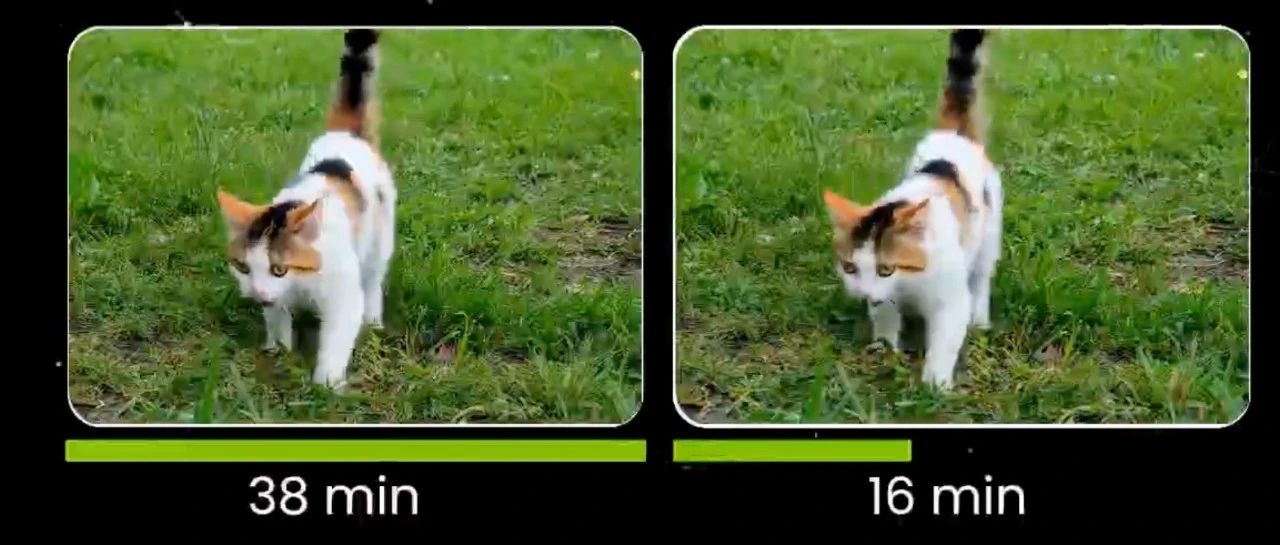
Core Viewpoint - The article discusses the rapid advancement of AI video generation technology, particularly focusing on the introduction of Sparse VideoGen, which significantly accelerates video generation without compromising quality [1][4][23]. Group 1: Performance Bottlenecks in Video Generation - Current state-of-the-art video generation models like Wan 2.1 and HunyuanVideo face significant performance bottlenecks, requiring over 30 minutes to generate a 5-second 720p video on a single H100 GPU, with the 3D Full Attention module consuming over 80% of the inference time [1][6][23]. - The computational complexity of attention mechanisms in Video Diffusion Transformers (DiTs) increases quadratically with resolution and frame count, limiting real-world deployment capabilities [6][23]. Group 2: Introduction of Sparse VideoGen - Sparse VideoGen is a novel acceleration method that does not require retraining existing models, leveraging spatial and temporal sparsity in attention mechanisms to halve inference time while maintaining high pixel fidelity (PSNR = 29) [4][23]. - The method has been integrated with various state-of-the-art open-source models and supports both text-to-video (T2V) and image-to-video (I2V) tasks [4][23]. Group 3: Key Design Features of Sparse VideoGen - Sparse VideoGen identifies two unique sparsity patterns in attention maps: spatial sparsity, focusing on tokens within the same and adjacent frames, and temporal sparsity, capturing relationships across different frames [10][11][12]. - The method employs a dynamic adaptive sparse strategy through online profiling, allowing for optimal combinations of spatial and temporal heads based on varying denoising steps and prompts [16][17]. Group 4: Operator-Level Optimization - Sparse VideoGen introduces a hardware-friendly layout transformation to optimize memory access patterns, enhancing the performance of temporal heads by ensuring tokens are stored contiguously in memory [20][21]. - Additional optimizations for Query-Key Normalization (QK-Norm) and Rotary Position Embedding (RoPE) have resulted in significant throughput improvements, with average acceleration ratios of 7.4x and 14.5x, respectively [21]. Group 5: Experimental Results - Sparse VideoGen has demonstrated impressive performance, reducing inference time for HunyuanVideo from approximately 30 minutes to under 15 minutes, and for Wan 2.1 from 30 minutes to 20 minutes, while maintaining a PSNR above 29dB [23]. - The research indicates that understanding the internal structure of video generation models may lead to more sustainable performance breakthroughs compared to merely increasing model size [24].