Agent技术

Search documents
离开百川去创业,8个人用2个多月肝出一款热门Agent产品,创始人:Agent技术有些玄学
3 6 Ke· 2025-06-26 11:09
Core Insights - The article discusses the entrepreneurial journey of Xu Wenjian, highlighting his experiences at Baichuan Intelligent and his transition to founding a new venture focused on AI agents [3][6][9]. Company Background - Xu Wenjian joined Baichuan Intelligent during its peak and later left to pursue his entrepreneurial ambitions [2]. - Baichuan Intelligent was recognized for its strong technical capabilities in the AI field, which significantly influenced Xu's career [6][7]. Entrepreneurial Journey - Xu's early career included working at Didi, where he restructured a technical architecture, which sparked his interest in entrepreneurship [4]. - He faced challenges in two initial startup projects, one focused on cloud coding and another on AI education, both of which ultimately failed due to various issues including lack of persistence and strategic direction [5][6]. Insights on AI and Agents - At Baichuan, Xu's team was among the first to recognize the value of AI agents, leading to the development of a demo version of an agent workflow [8]. - Xu believes that agents have the potential to reshape the world, equating their importance to that of large models in AI [8][10]. New Venture: Mars Electric Wave - Xu co-founded Mars Electric Wave with Feng Lei, focusing on content consumption through AI, particularly in the audio space [9][10]. - The company aims to create personalized audio experiences, with a three-phase development plan: achieving human-like expression, personalization, and deep exploration in vertical fields [10][11]. Product Development - The first product, ListenHub, was developed in a short timeframe of two months, featuring three engines for intent analysis, content generation, and audio transformation [15][16]. - The team emphasizes quality over experience in hiring, focusing on candidates' growth potential and alignment with company values [12][13]. Market Position and Strategy - ListenHub has gained traction with approximately 10,000 registered users and over 1,000 daily active users, despite initial operational challenges during its launch [19][20]. - The product operates on a subscription model, with plans to focus on international markets for monetization [22][24]. Competitive Landscape - Xu views competition with large companies as a partnership rather than direct rivalry, emphasizing the importance of refining their product and user experience [25][26]. - The company aims to maintain a small, agile team to preserve its core values and operational efficiency [27]. Conclusion - Xu expresses a commitment to navigating the uncertainties of entrepreneurship, valuing the support from family and friends as he pursues his passion in the AI field [28].


Anthropic接棒OpenAI狙击谷歌,刷新AI编程模型热度
Di Yi Cai Jing· 2025-05-23 11:20
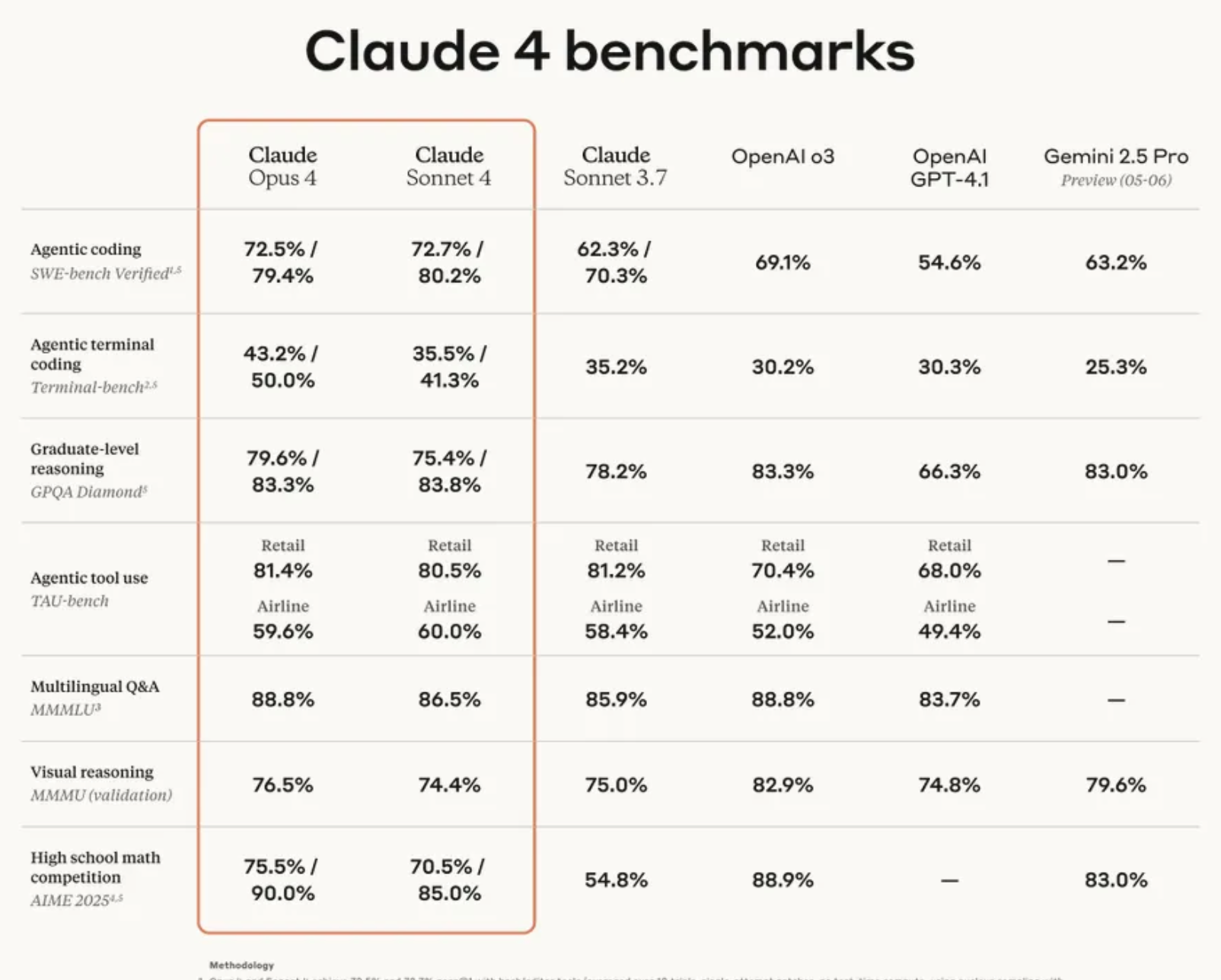
Core Insights - Anthropic has launched the Claude 4 series of large models, including Claude Opus 4 and Claude Sonnet 4, to compete with Google's Gemini 2.5 Pro in the programming domain [1][2] - The new models are designed to enhance Anthropic's influence in the programming field, focusing on enterprise-level AI solutions with a safety-first approach [2][7] Model Specifications - Claude Opus 4 is tailored for complex, long-duration tasks and intelligent workflows, while Claude Sonnet 4 is an upgraded version of Sonnet 3.7, offering improved code and reasoning capabilities [2][3] - Both models utilize a hybrid architecture for rapid responses and deeper reasoning, available on Anthropic API, Amazon Bedrock, and Google Cloud's Vertex AI [2] Performance Comparison - In various coding benchmarks, Claude Opus 4 and Sonnet 4 outperformed previous models, with Opus 4 achieving 79.4% in SWE-bench Verifiedis and 83.3% in reasoning GPQA Diamonds [6] - Claude Sonnet 4 is noted for its efficiency and speed, making it suitable for everyday development tasks, while Opus 4 is more appropriate for large, complex projects [3][4] Industry Trends - The AI programming sector is witnessing significant developments, with major companies like Apple and Tencent also entering the space, indicating a growing market for AI-driven coding solutions [7][8] - The industry is bifurcating into two main directions: Copilot assistants, which are human-led with AI support, and Agent systems, where AI autonomously executes tasks under human supervision [7][8] Future Outlook - The CEO of Anthropic emphasized a shift from merely teaching AI to code towards enabling it to independently complete projects, reflecting a broader trend in AI development [8][9] - Despite the advancements, challenges remain in technology maturity, cognitive alignment, and safety, which need to be addressed for further growth in the AI programming market [8][9]
MCP不是万灵药
腾讯研究院· 2025-05-07 08:29
Core Viewpoint - The article discusses the rise of Model Context Protocol (MCP) as a unifying tool invocation protocol in the AI industry, highlighting its rapid adoption and the excitement surrounding it, while also addressing its limitations and the need for realistic expectations regarding its applicability across different scenarios [3][4][5]. Summary by Sections What is MCP? - MCP is an open technical protocol designed to standardize interactions between large language models (LLMs) and external tools and services, functioning as a universal translator for AI models [5][6]. Why is MCP Needed? - Prior to MCP, AI tool invocation faced two main issues: fragmented interfaces requiring custom code for each combination and inefficient development processes [6][8]. MCP's Functionality - MCP employs a universal language format (JSON - RPC) allowing developers to interact with all tools supporting this protocol after a single learning phase [8][10]. MCP's Architecture - MCP consists of three core components: MCP Host (execution environment), MCP Client (communication hub), and MCP Server (service endpoint), facilitating smooth communication between AI models and external services [11][15]. MCP's Development Challenges and Market Chaos - The rapid growth of MCP has led to a chaotic market with many tools lacking practical value, as many developers rushed to create MCP-compatible services without thorough testing [24][34]. MCP's Limitations - While MCP has been beneficial for local client applications, it faces challenges in server-side and cloud applications due to its dual-link mechanism, which complicates implementation and maintenance [28][29]. Market Confusion - The current MCP market is characterized by low usability, with many tools failing to deliver real value, leading to inefficiencies in tool selection and usage [34][35]. MCP's Role in the AI Ecosystem - MCP is not a one-size-fits-all solution; it is a communication protocol that does not dictate how tools are selected or used, emphasizing the need for a collaborative approach among various AI components [39][40]. Future Directions - The article suggests that MCP's evolution may lead to a more streamlined and valuable tool ecosystem, as the market naturally selects for quality and utility over time [36][46].