AI编程

Search documents
突发!Claude Code 被开源了,全网疯传
程序员的那些事· 2026-03-31 13:27
Core Viewpoint - Anthropic's AI programming tool Claude Code experienced a significant source code leak, with 512,000 lines of TypeScript code being unintentionally released due to a publishing error, leading to widespread excitement in the developer community [1][4]. Group 1: Incident Details - The leak was not a result of a hacking incident but rather a mistake by Anthropic during the release of version 2.1.88 to the npm repository, where a debugging Source Map file was mistakenly included [1]. - The leaked file, approximately 60MB in size, contained 1,906 original source files and complete source code, allowing for easy restoration without the need for decompilation [3]. - The leaked content revealed critical architectural details, including the core framework based on Bun and React+Ink, a 46,000-line inference engine, and over 40 tool implementations, as well as unannounced features like the "Capybara" codename product and the Kairos permanent memory system [3]. Group 2: Consequences and Reactions - This incident marks the second time Anthropic has made a similar mistake, having previously leaked source code in February 2025 due to the same oversight [4]. - Anthropic has urgently removed the problematic npm package and taken down the GitHub mirror repository via DMCA, but the source code has already been widely backed up and disseminated, making complete recovery impossible [4]. - The leak has been described as an "epic textbook" for global programmers to learn top-tier AI engineering practices, while it represents a significant security incident for Anthropic [4]. Group 3: Community Response - The leaked version has gained immense popularity, with over 31,000 forks and 21,900 stars on GitHub, indicating a strong community engagement [7]. - The incident has sparked humorous reactions on social media, with users mimicking previous memes related to corporate layoffs, highlighting the viral nature of the leak [9].


前端大神Cheng Lou新项目火了!「文字绕图」玩法炸裂,Bad Apple新版火出圈
机器之心· 2026-03-30 06:52
Core Viewpoint - The article discusses the recent popularity of the open-source project Pretext, a text layout library developed by Cheng Lou, which significantly enhances text rendering on the web without manipulating the DOM, achieving speeds hundreds of times faster than traditional methods [3][10]. Group 1: Project Overview - Pretext is a JavaScript/TypeScript library that allows for rapid and precise text measurement and layout, redefining how text is rendered on web pages [3][10]. - The project has gained significant traction, with over 12.6k stars on GitHub shortly after its release, indicating strong community interest and engagement [10][11]. - Cheng Lou, a core member of the React team and currently working at Midjourney, emphasizes the project's potential as a foundational infrastructure for UI engineering in the coming years [6][9]. Group 2: Technical Innovations - Pretext addresses a major bottleneck in UI design related to text layout and measurement, particularly relevant in the AI era, allowing for more creative and functional user interfaces [17]. - The library operates by splitting input text into segments and measuring them on a canvas, caching results to optimize performance, which is a departure from traditional methods that require rendering text first [18]. - The project is lightweight, only a few kilobytes in size, and supports various languages and character sets, making it versatile for different applications [17]. Group 3: Comparison and Value Proposition - Unlike Apple's closed applications like Pages and Keynote, Pretext is an open-source solution that works across multiple browsers, providing a high-performance dynamic layout that was previously unattainable with CSS [22]. - Cheng Lou encourages the community to recognize the broader potential of the technology rather than focusing solely on its immediate applications, advocating for an open-minded approach to technological advancements [24].

AI 一键生成网站之后,最残酷的差距出现了:代码不再值钱,审美决定生死
AI前线· 2026-03-28 05:33
Core Viewpoint - The article discusses the emergence of a design renaissance in 2026, emphasizing that true differentiation in web design will stem from aesthetic sensibility and the ability to create memorable user experiences rather than just technical capabilities [6][10]. Group 1: Website Experience and Design - Lando Norris's personal website has gained attention for its immersive experience, featuring advanced 3D animations and micro-interactions that encourage users to explore [2][4]. - The website's design is not merely a showcase of technology but is meticulously crafted to enhance brand perception and user engagement [4][5]. - The attention to detail in the website's design, such as hover effects and dynamic animations, reflects a significant investment of time and effort, making it stand out from template-based designs [5][14]. Group 2: Future of Design - Wes Bos predicts that 2026 will be a pivotal year for design, as the proliferation of UI frameworks and AI tools will lead to a focus on aesthetic choices and user experience [6][9]. - The article highlights a shift in the design landscape where the ease of creating functional websites raises the question of how to achieve differentiation in design [10][11]. - There is a growing trend of brands needing to create unique and engaging experiences to capture user attention in a saturated market [11][12]. Group 3: Performance and Technical Aspects - The Lando Norris website is noted for its performance, achieving smooth interactions without relying on heavy frameworks like React, which is often associated with slower performance [20][21]. - The developers behind the website focused on optimizing rendering performance, avoiding elements that could slow down the user experience, such as shadows [21][22]. - The article suggests that the success of such websites may signal a shift in how single-page applications are developed, emphasizing performance alongside aesthetic appeal [20][21]. Group 4: Investment and Brand Strategy - The discussion touches on the financial implications of investing in high-quality design, questioning the return on investment for such projects [25][32]. - It is suggested that the value of a well-designed website may not be directly measurable in sales but rather as an extension of brand strategy and identity [25][32]. - The article raises concerns about the sustainability of design investments in an environment where many tools allow for quick and easy website creation, potentially diluting the uniqueness of brand experiences [26][37].

卡帕西都整破防了:AI Coding没门槛,可部署环节真嗯啊的难
量子位· 2026-03-27 05:10
Core Insights - The main point of the article is that deployment, rather than coding, has become the bottleneck in AI programming, as highlighted by Karpathy's experiences with application development [1][2][21]. Group 1: Deployment Challenges - Karpathy emphasizes that the development process for applications should be streamlined to allow for direct code invocation, minimizing manual configuration [2][21]. - He recounts his experience with the "MenuGen" project, where he faced significant challenges during the deployment phase, realizing that coding was only a small part of the overall process [3][9]. - The deployment process involved numerous obstacles, including outdated API calls, rate limits, and configuration issues, which made the experience frustrating [10][12][19]. Group 2: Tools and Solutions - Karpathy suggests that many applications do not need to be fully developed products; instead, they should be generated from simple commands [23]. - He points to Stripe Projects as a promising solution that aims to simplify deployment by providing an integrated platform for developers to manage various tasks with minimal commands [25][29]. - Other emerging tools like Firebase Studio and Railway are also mentioned as efforts to optimize the AI programming deployment process, aiming to consolidate coding, backend configuration, and deployment into a single workspace [30][34]. Group 3: Industry Implications - The article highlights a growing recognition within the developer community that deployment issues are a significant barrier to leveraging AI in programming [21][39]. - There is a call for more user-friendly tools that can automate deployment processes, making it easier for developers and AI agents to work together [27][30]. - The expectation is set for future advancements that could potentially eliminate the need for manual coding altogether, hinting at a more integrated approach to AI programming [40].

OpenClaw代码越改越崩?新研究EvoClaw揭示:Agents持续开发成功率仅13.37%
量子位· 2026-03-25 04:58
Core Insights - By the end of 2025, AI programming will transition from being an auxiliary tool like Copilot to an Agent era dominated by AI with human oversight [1] - The emergence of OpenClaw in early 2026 will evolve Agents from executing single tasks to long-term operational systems, necessitating continuous self-iteration of software interfaces based on real-world interactions [2] Group 1: AI Programming Evaluation - Current top models can satisfactorily address isolated tasks like writing functions or fixing bugs, but struggle significantly in continuous software evolution scenarios, with performance dropping from scores above 80% to below 40% [6] - Existing AI programming benchmarks often overestimate the capabilities of Coding Agents by focusing on independent tasks rather than the continuous evolution of software, which is a persistent process [8][10] - The EvoClaw benchmark introduces a new evaluation paradigm that requires AI to autonomously execute multiple interdependent tasks within the same codebase, revealing vulnerabilities in AI's performance during continuous iterations [10] Group 2: EvoClaw Benchmark Design - EvoClaw is designed to assess AI's ability to handle software evolution by utilizing a milestone-based approach, which aggregates code submissions into cohesive units while preserving task dependencies [17] - The evaluation includes metrics such as Recall (completeness of functionality implementation) and Precision (reliability of modifications), with a combined score calculated using F1 weighting [29][31] - The dataset for EvoClaw spans five major programming languages and covers real development cycles across multiple release intervals, ensuring a comprehensive assessment of AI capabilities [27] Group 3: Performance Analysis - In continuous evaluation scenarios, top models like Claude Opus 4.6 achieve a maximum score of only 38.03%, indicating a significant drop in performance compared to independent evaluations [34] - The analysis shows that while Recall continues to grow, Precision quickly saturates, leading to a stagnation in performance as the complexity of tasks increases [42] - The study highlights that even with unlimited iteration opportunities, AI models will eventually hit a performance ceiling, unable to fully resolve all tasks due to accumulated technical debt [40][44] Group 4: Future Directions - The findings suggest that current AI models are more akin to on-demand code generators rather than comprehensive engineering solutions, lacking the ability to proactively manage technical debt and overall project governance [54] - There is a clear differentiation among models, with some like GPT and Claude series showing steady improvement in continuous evolution capabilities, while others like Gemini series struggle with sustained performance [54] - The future of AI programming lies in evolving from passive code generation to active restructuring and long-term planning, enabling AI to function as a seasoned engineer with a holistic view of projects [54]
套壳 Kimi 被锤!马斯克火速吃瓜,Cursor 紧急认错
程序员的那些事· 2026-03-22 03:18
Core Viewpoint - The article discusses the controversy surrounding Cursor's announcement of its new AI model, Composer 2, which was initially praised for its performance but later revealed to be based on a Chinese model, Kimi K2.5, leading to significant backlash and scrutiny in the tech community [1][3]. Group 1 - Cursor announced its new model Composer 2, claiming a benchmark score of 61.3, significantly outperforming competitors like Claude Opus, which scored 4.6, and priced at only 1/10th of the competition, with a cost of $0.5 per million tokens [1]. - Within 24 hours, a developer discovered that the underlying model ID pointed to Kimi K2.5, indicating that Cursor's model was not entirely original, as it shared similarities with Kimi's tokenizer [1]. - Elon Musk publicly commented on the situation, confirming that the model was indeed Kimi 2.5, which undermined Cursor's claims of originality [3]. Group 2 - In response to the backlash, Cursor's official statement clarified that they obtained a compliant commercial license from Kimi through a hosting platform, asserting that there was no infringement [4]. - Cursor's executives issued an apology, acknowledging a significant oversight in not properly attributing the foundational model, but emphasized that they had made substantial modifications, achieving four times the computational power through deep tuning [5].

YC CEO 开源 GStack 爆火,软件公司的最小单位变了
投资实习所· 2026-03-21 06:02
Core Insights - GStack represents a significant evolution in AI programming, transitioning from an "assistive tool" to an "organizational structure" [1] - It is not merely an upgraded tool but a complete "rewriting of engineering organization" [1] - GStack disassembles an AI assistant into 15 defined roles and 6 tool capabilities, allowing users to manage a virtual team rather than just querying AI [1] GStack's Methodology - GStack employs a strong process constraint rather than a more powerful model, enforcing a closed-loop for each critical step: Re-ground → Simplify → Recommend → Options [2] - The insight behind GStack is that AI lacks "management" rather than capability, positioning it as an AI middle management layer [2] Team Structure - GStack forms a complete engineering team with 15 roles, functioning as a minimal viable software company [3] - The decision-making layer focuses on helping users "think about problems" rather than just writing code, encoding Y Combinator's investment experience into an interface [3] Execution and Quality - The execution layer addresses system design, while the quality and delivery layer ensures AI takes responsibility for results, not just code generation [5] - GStack includes a review system that transforms software development from "feeling-driven" to data-driven continuous iteration [6] Implications for Stakeholders - For founders, GStack compresses the startup process into a streamlined pipeline, enabling one-person companies to operate effectively with AI and defined processes [7] - For investors, GStack democratizes judgment, allowing founders to self-correct and potentially diminishing the advantages of investors in identifying promising projects [7][9] - For engineers, the role shifts from coding to managing AI and designing processes, indicating a new programming paradigm [9][10] Production Metrics - GStack has produced over 600,000 lines of code, with approximately 35% being tests, and recent activity includes 140,751 new lines and 362 commits in the last week [8] Market Reception - GStack's popularity is partly attributed to Garry Tan's position as Y Combinator CEO, raising questions about its valuation and market impact [11]

计算机行业周报:OpenClaw持续火热
Guoxin Securities Co., Ltd· 2026-03-19 05:45
Investment Rating - The report gives a "Positive" investment rating for the computer industry, expecting the industry index to outperform the market index by over 5% in the next six months [29]. Core Insights - The computer sector index fell by 0.92% last week, underperforming the CSI 300 index, which rose by 0.19%, resulting in a 1.11 percentage point lag [8]. - The top three gainers in the sector were Hongjing Technology (60.65%), ST Yingfeituo (16.30%), and Borui Data (16.10%), while the top three losers were Haoyun Technology (-22.26%), Hailianxun (-17.33%), and Xinghuan Technology-U (-13.23%) [11][12]. - Key developments include the launch of Anthropic's Code Review tool to address code review bottlenecks caused by AI programming, Oracle's revenue growth of 22% year-on-year in FY2026Q3, and Broadcom's mass production of the world's first 102.4 Tbps switch chip [2][3][25]. Market Performance - The computer industry has 335 listed companies, with 271 (80.9%) experiencing a rise in stock prices last week [11]. - The report highlights the performance of individual stocks within the sector, noting significant fluctuations in stock prices [12]. Recent Developments - Anthropic's Code Review tool aims to enhance code quality and security by identifying vulnerabilities before code integration [13][15]. - Oracle reported a total revenue of $17.2 billion for FY2026Q3, with cloud services contributing $8.9 billion, marking a 44% year-on-year increase [23]. - Broadcom's Tomahawk 6 series switch chip is now in mass production, enhancing AI network performance [25]. - Baidu launched the "Red Hand Operator" mobile application, enabling cross-app interactions [26]. - Apple announced a reduction in the App Store commission rate in China, effective March 15, 2026 [27].


App 开始消失
投资界· 2026-03-03 07:35
Core Viewpoint - The article argues that the software era is ending, with AI applications like OpenClaw replacing traditional apps and services, leading to a shift towards a "create-to-consume" economy [3][7][10]. Group 1: Impact of OpenClaw - OpenClaw has significantly reduced the number of apps on users' devices by providing personalized services that replace traditional applications, such as fitness coaching and news aggregation [5][6]. - Users are increasingly relying on OpenClaw for various tasks, indicating a trend where traditional software is being replaced by AI-driven solutions [6][10]. Group 2: The "Create-to-Consume" Economy - The concept of "create-to-consume" suggests that users will directly interact with AI to generate personalized services instead of purchasing pre-existing products [8][10]. - This shift is driven by advancements in AI programming, which have transformed the role of AI from a tool for developers to a service provider for all users [9][10]. Group 3: Evolution of Software Consumption - The article posits that traditional apps will not disappear but will evolve into data interfaces and service nodes that support AI applications [10][11]. - The emergence of AI agents will change consumer habits from downloading apps to creating personalized services through AI interactions [11][16]. Group 4: Maker Economy and Community Innovation - The rise of the maker economy is highlighted, where individuals can create and share tools, leading to new revenue models based on usage rights rather than software sales [13][14]. - OpenClaw exemplifies this trend by fostering a community-driven innovation environment, similar to the early days of 3D printing [11][14]. Group 5: OpenClaw's Role in the AI Ecosystem - OpenClaw is positioned as a central hub in the AI ecosystem, connecting various agents and services, akin to an operating system in the PC era [16]. - The focus of OpenClaw is on service consumption rather than developer efficiency, aiming to meet the direct needs of users without requiring them to understand programming [15][16].

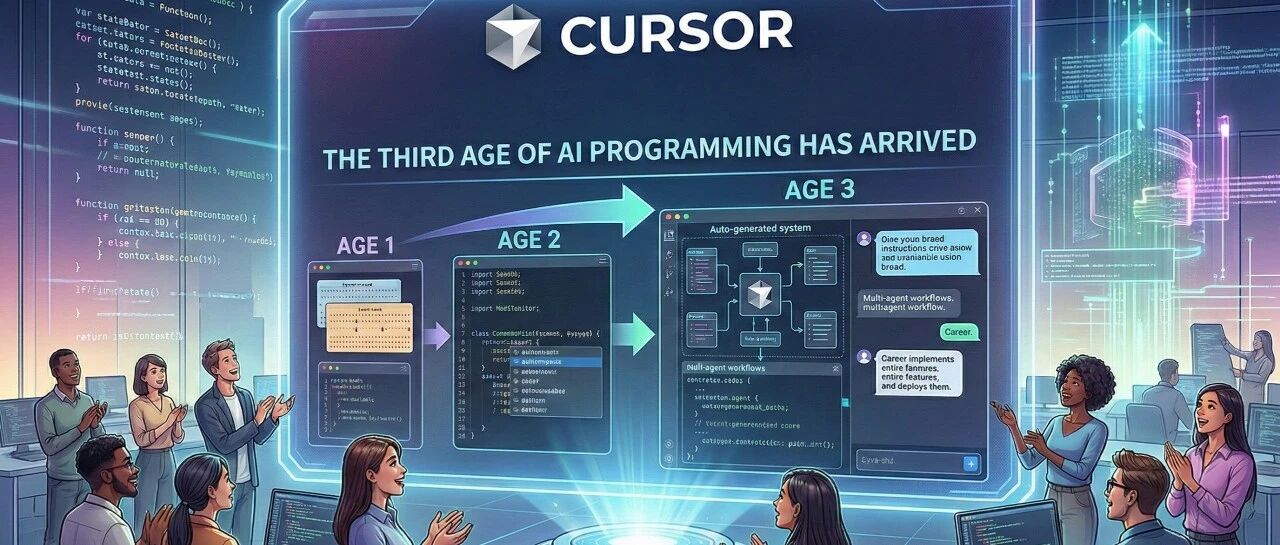
Cursor:AI编程「第三时代」来了
机器之心· 2026-03-02 09:03
Core Viewpoint - The article discusses the transition into the "third era" of AI programming, characterized by agents that can independently complete larger tasks with minimal human intervention [1][3]. Summary by Sections Transition from Tab to Agent - The initial phase of coding involved manual key presses, which was transformed by Tab auto-completion, marking the first era of AI-assisted programming. The introduction of agents allowed developers to interact through a prompt-response cycle, leading to the second era. The current third era features agents capable of working over longer time spans and completing larger tasks independently [3][5][6]. Growth of Agent Usage - As of March 2025, the number of Tab users was approximately 2.5 times that of Agent users. However, this ratio has reversed, with Agent users now being twice that of Tab users, and Agent usage has increased rapidly [8][11]. Cloud Agents and Artifacts - Cloud agents operate independently in virtual machines, allowing developers to delegate tasks and focus on other activities. These agents autonomously iterate and test, returning comprehensive outputs that include logs and previews, thus enabling the management of multiple agents simultaneously [13][14]. Internal Changes at Cursor - Within Cursor, 35% of merged code submissions are generated by cloud-based agents. Developers adopting this new workflow typically focus on problem definition and output review rather than step-by-step guidance [15][17]. Future Considerations - There is a recognition that significant work remains to standardize this new development paradigm. Ensuring agents operate efficiently and have access to necessary tools and context is crucial for broader adoption [16]. The recent updates to Cursor have enhanced agent capabilities, allowing for seamless modifications and improved user experience [16]. Community Perspectives - Some community members suggest that the evolution from Tab to synchronous agents and then to cloud agents is an optimization within the same paradigm, emphasizing that the next leap should involve removing the concept of "source code" entirely [18]. Others highlight the need for robust validation mechanisms as autonomous systems scale up code submissions [18].