Population Growth

Search documents
X @Bloomberg
Bloomberg· 2025-11-17 00:16
New Zealand’s population is growing at the slowest pace in nearly 13 years, excluding the pandemic, further hampering its sluggish economic recovery https://t.co/EaIDQLdYZF ...
X @Bloomberg
Bloomberg· 2025-11-14 15:24
Africa’s young population will make up a quarter of humanity by 2050. To capitalize on it, the continent needs to fix its power problems fast. Read the Big Take: https://t.co/uNE4HTx6t5📷️: Etinosa Yvonne/Bloomberg https://t.co/ZElhRHnOGJ ...
X @Bloomberg
Bloomberg· 2025-11-14 10:14
Africa’s young population will make up a quarter of humanity by 2050. To capitalize on it, the continent needs to fix its power problems fast https://t.co/ui56GSxsd7 ...
X @Nick Szabo
Nick Szabo· 2025-11-10 05:17
RT towelie (@towelie719)even looking at the correlation (r=0.91) between immigrants and housing affordability, they follow the same patterns. if they artificially increase the population, especially unchecked like it is, then demand goes up, causing house prices to go up. same thing with insurance and healthcare cost. we cannot have an inventory of houses, nor insurance and healthcare to meet the growing ARTIFICAL GROWTH of our population without the increase in demand causing unaffordabilityhttps://t.co/3L ...
Fed's Stephen Miran Sees Neutral ‘Quite a Ways Below' Current Policy
Youtube· 2025-11-03 13:04
Core Viewpoint - The Federal Reserve's current monetary policy is considered too restrictive, with a neutral rate that is believed to be significantly lower than the current policy stance [1][2][14]. Group 1: Monetary Policy and Economic Outlook - The argument for maintaining a less restrictive policy is based on a more optimistic view of inflation compared to other committee members, suggesting that prolonged restrictive policies could lead to an economic downturn [2][16]. - The concept of "passive tightening" is introduced, indicating that as neutral rates shift, the existing policy can become tighter without any active changes [14][15]. - The discussion highlights that financial market conditions may appear easier, but this does not necessarily reflect the true stance of monetary policy, as various factors influence market dynamics [4][7][8]. Group 2: Financial Conditions and Market Dynamics - Financial conditions affecting housing and private credit markets are noted to be tighter, contrasting with the perception of easier conditions in stock markets [8][31]. - The impact of alternative data on the labor market is acknowledged, suggesting that it indicates a decline in demand, which aligns with the view that current policy is too tight [28][30]. - Concerns are raised about the potential for unrecognized distress in private markets, which could signal broader issues related to the restrictive stance of monetary policy [31][33].


X @Nick Szabo
Nick Szabo· 2025-11-02 07:01
Population Growth Trends - Half of the world's population gains until 2050 will come from 8 nations: India, Pakistan, Nigeria, Congo, Ethiopia, Bangladesh, Tanzania, and Egypt [1] - Half of the babies born between now and 2050 will be born in just those 8 countries [1]
Trump Fed pick Miran REVEALS what's 'holding up' his colleagues on cuts
Youtube· 2025-09-25 15:30
Core Viewpoint - The Federal Reserve's current policy is considered too restrictive, with calls for more aggressive rate cuts to support economic growth and mitigate potential unemployment risks [2][3][28]. Economic Growth Outlook - Steven Myron expresses a more optimistic view on economic growth compared to some colleagues, citing factors such as tax incentives and deregulation that could enhance the economy's potential output [12][14]. - The expectation for economic growth in 2025 is tempered due to weaknesses observed in the first half of the year, although a rebound is anticipated in the latter half [16][17]. Rate Cut Expectations - Myron advocates for a series of 50 basis point cuts to quickly adjust the monetary policy towards a neutral stance, arguing that the current rates are 150 to 200 basis points too restrictive [27][30]. - The expectation is that as the Fed cuts rates, mortgage rates will also decrease, despite recent trends showing long-term rates rising [24][25]. Inflation and Tariffs - There is skepticism regarding the impact of tariffs on inflation, with Myron noting a lack of evidence for tariff-driven inflation increases [5][32]. - The Congressional Budget Office projects nearly $400 billion in annual tariff revenues, which could influence the supply-demand balance for loanable funds and lower neutral rates [19]. Population Growth and Labor Market - Significant changes in population growth due to immigration policies are highlighted as a critical factor affecting economic outcomes, with potential implications for labor market dynamics [6][8][20]. - Myron suggests that negative net migration could lead to a positive shock in the supply of shelter, impacting rent inflation positively [21][22].
X @Bloomberg
Bloomberg· 2025-09-24 13:36
Population Growth - Canada's immigration-driven population growth has come to a grinding halt [1]
X @The Economist
The Economist· 2025-09-16 02:00
Alarmist predictions of a “population bomb”, trendy in the 1960s, may have made demographers hesitant to predict the opposite: that humanity will soon be shrinking https://t.co/EYXHEwNne9 ...
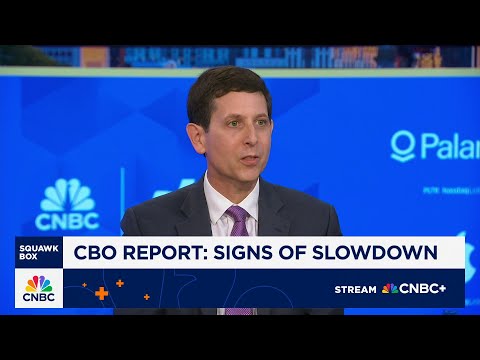
CBO Director Phill Swagel: Seeing a lot of signs that the economy is weakening
CNBC Television· 2025-09-15 12:22
Economic Projections - Congressional Budget Office (CBO) projects higher inflation and unemployment this year with slowing economic growth [1] - Population growth is anticipated to be significantly lower due to immigration changes, impacting jobs numbers [2][3][4] - Labor supply is falling dramatically, with population numbers expected to be several hundred thousand fewer each year over the next 10 years, and approximately 1 million fewer this year alone [4] Impact of Policies - The reconciliation bill is boosting the economy, while slowing immigration and tariffs are having a negative impact [3] - Tariffs are raising inflation and slowing down the economy, affecting both businesses and households [3] - Tariffs put in place since January 20th are projected to reduce the deficit by $4 trillion over the next 10 years, consisting of $33 trillion in revenue and $700 billion in averted debt costs [10][11] Uncertainty and Assumptions - There is a lot of uncertainty in the economy due to changing policies and tariffs [8] - CBO follows the administration's actions day by day and assumes that current policies will continue indefinitely [9] - CBO expects the Federal Reserve (Fed) to cut interest rates by 75 basis points between now and the end of January [14] - CBO updates its forecast a few times a year, and inflation since January has been a bit higher than expected [20]