
Reasoning

Search documents
X @Avi Chawla
Avi Chawla· 2025-10-20 06:31
Finally, researchers have open-sourced a new reasoning approach that actually prevents hallucinations in LLMs.It beats popular techniques like Chain-of-Thought and has a SOTA success rate of 90.2%.Here's the core problem with current techniques that this new approach solves:We have enough research to conclude that LLMs often struggle to assess what truly matters in a particular stage of a long, multi-turn conversation.For instance, when you give Agents a 2,000-word system prompt filled with policies, tone r ...
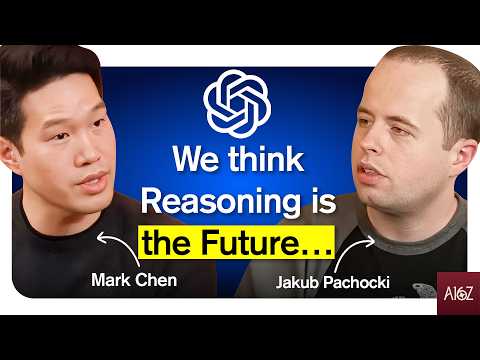
From Vibe Coding to Vibe Researching: OpenAI’s Mark Chen and Jakub Pachocki
a16z· 2025-09-25 13:00
Research & Development Focus - OpenAI is targeting the production of an automated researcher to automate the discovery of new ideas, with a focus on economically relevant advancements [1][3] - The company is extending the reasoning horizon of models, aiming for them to autonomously operate for longer periods, measured by performance in math and programming competitions [3] - OpenAI is working on improving the ability of models to handle more difficult and messy real-world coding environments, focusing on style, proactivity, and latency [12][13] Model Capabilities & Advancements - GPT-5 aims to bring reasoning into the mainstream, improving upon previous models like O3 by delivering reasoning and more agentic behavior by default [1] - The company observed significant progress in models' ability to solve hard science problems, with instances of discovering non-trivial new mathematics [1] - Reinforcement Learning (RL) continues to be a versatile method for continuous improvements, especially when combined with natural language modeling [4][5] Talent & Culture - OpenAI emphasizes fundamental research and innovation, discouraging copying and fostering a culture where researchers are inspired to discover new things [35][36] - The company looks for individuals who have solved hard problems in any field, possessing strong technical fundamentals and the intent to work on ambitious challenges [40] - OpenAI protects fundamental research by delineating researchers focused on algorithmic advances from those focused on product, ensuring space for long-term research questions [46][57] Resource Allocation & Strategy - OpenAI prioritizes core algorithmic advances over product research in compute allocation, but remains flexible to adapt to changing needs [59] - The company believes compute remains a critical resource for advancing AI, not expecting to be data-constrained anytime soon [62][63] - OpenAI acts from a place of strong belief in its long-term research program, not tying it too closely to short-term product reception [70]

X @Avi Chawla
Avi Chawla· 2025-08-29 06:30
AI Agent Evolution - The industry has progressed from simple LLMs to sophisticated Agentic systems with reasoning, memory, and tool use [1] - Early transformer-based chatbots were limited by small context windows, exemplified by ChatGPT's initial 4k token limit [1] - The industry has seen upgrades to handle thousands of tokens, enabling parsing of larger documents and longer conversations [1] - Retrieval-Augmented Generation (RAG) provided access to fresh and external data, enhancing LLM outputs [1] - Multimodal LLMs can process multiple data types (text, images, audio), with memory introducing persistence across interactions [1] Key Components of Advanced AI Agents - Advanced AI Agents are equipped with short-term, long-term, and episodic memory [1] - Tool calling (search, APIs, actions) is a crucial feature of modern AI Agents [1] - Reasoning and ReAct-based decision-making are integral to the current AI Agent era [1]
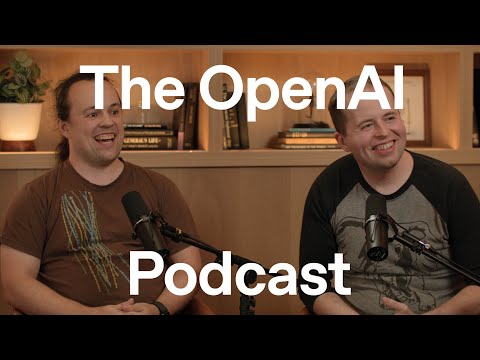
AGI progress, surprising breakthroughs, and the road ahead — the OpenAI Podcast Ep. 5
OpenAI· 2025-08-15 16:01
AI Progress & AGI Definition - OpenAI is setting the research roadmap for the company, deciding on technical paths and long-term research directions [1] - The industry is progressing to a point where AI can converse naturally, solve math problems, and the focus is shifting towards its real-world impact [1] - The potential for automating the discovery and production of new technology is a key consideration for AI's impact [1][2] - OpenAI seeks to create general intelligence, prioritizing the automated researcher concept for significant technological advancements [2] - The industry is seeing incredible results in medicine, combining reasoning with domain knowledge and intuition [2] Benchmarks & Evaluation - Current benchmarks are facing saturation as models reach human-level performance on standardized intelligence measures [3] - The field has developed data-efficient ways to train for specific abilities, making benchmarks less representative of overall intelligence [3] - The industry needs to consider the reward utility of models and their ability to discover new insights, rather than just test-taking abilities [3] - Reasoning models and longer chain of thought are significant advancements, but continuous hard work is needed to make them work [4][5] Future Directions - Scaling remains important, and new directions include extending the horizon for models to plan and reason [5] - The industry should expect progress on interfaces, with AI becoming more persistent and capable of expressing itself in different forms [6] - Learning to code remains a valuable skill, fostering structured intellect and the ability to break down complicated problems [6]
X @Avi Chawla
Avi Chawla· 2025-08-09 06:36
General Overview - The document is a brief post or update, likely from a social media platform, focusing on comparing GPT-5 and Grok 4 on reasoning tasks [1] Author Information - Avi Chawla shares tutorials and insights on DS (Data Science), ML (Machine Learning), LLMs (Large Language Models), and RAGs (Retrieval-Augmented Generation) daily [1] - Avi Chawla can be found on social media platform @_avichawla [1]
X @Anthropic
Anthropic· 2025-08-05 16:27
Product Update - Claude Opus 4.1 is released, representing an upgrade to Claude Opus 4 [1] - The upgrade focuses on improvements in agentic tasks, real-world coding, and reasoning [1]
Supercharging Startups with AI Agents | Mohit Ambani | TEDxSGGSCC Studio
TEDx Talks· 2025-08-01 15:16
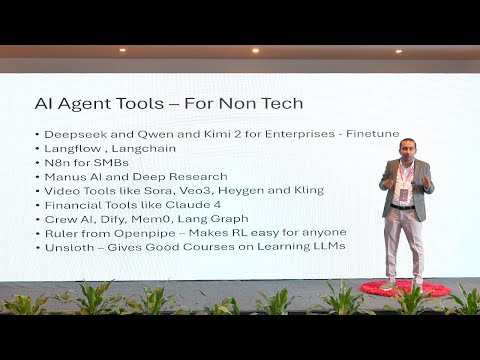
AI Fundamentals - Generative AI works by probabilistically filling in the blanks based on pre-trained data, essentially acting as an advanced autocomplete [5][6] - Pre-training involves feeding massive amounts of unstructured data into large language models (LLMs), requiring significant energy and resources for processing and refinement [7][8][9] - Reinforcement learning and reasoning enhance AI accuracy by implementing strategic action and assigning scores to generated results, reducing hallucinations [11][12] AI Applications in Business - AI agents can automate tasks across various tools and interfaces, acting as digital employees capable of understanding unstructured data and executing actions [13][14] - AI tools can significantly scale business operations, as demonstrated by a cosmetics brand using an AI agent to streamline influencer marketing, reducing the required team size and time [21][22] - AI agents are being used in sales to personalize outreach and automate follow-ups, leading to increased order rates and reduced campaign costs [24] - AI is being applied in operations to automate pricing and quotation processes, monitor safety incidents, and improve response times [25][26] - AI is aiding in financial analysis by enabling rapid screening of stocks based on specific criteria, leveraging open-source tools to retrieve data from millions of PDF files [28] AI's Impact and Future - AI is evolving beyond replacing existing processes to facilitating new inventions, such as a novel use case for magnetic ink in supply chain management [30][31][32][33] - The industry is rapidly advancing towards artificial generalized intelligence (AGI) and artificial super intelligence (ASI), with continuous improvements in AI models and capabilities [34] - The fundamental question is raised about the role of humans in a world where many jobs can be automated, emphasizing the importance of curiosity and relentless questioning [34][35]
Chinese Open-Source DOMINATES Coding (GLM-4.5)
Matthew Berman· 2025-07-30 17:15
Model Performance & Capabilities - ZAI's GLM 4.5% model rivals top closed-source models in reasoning, coding, and agentic capabilities [1] - GLM 4.5% demonstrates advanced problem-solving by successfully simulating and solving Rubik's cubes up to 10x10 [2][3][4][21] - The model can solve the Tower of Hanoi puzzle with up to 10 discs, showcasing its reasoning abilities [5][6][7][24][25] - GLM 4.5% exhibits strong coding skills, creating interactive simulations like Lego building, a 3D solar system, and games like Flappy Bird [8][9][21][22] - Benchmarks show GLM 4.5% outperforming other models in agentic tasks and achieving competitive scores in reasoning and coding [17][18][19] Model Architecture & Variants - GLM 4.5% comes in two versions: a larger 355 billion parameter model with 32 billion active parameters, and a smaller "air" version with 106 billion total parameters and 12 billion active parameters [15] - Both models are hybrid reasoning models, capable of both reasoning and non-reasoning tasks [16] Open Source Landscape - China is at the forefront of open-source AI model development with models like GLM 4.5%, Kimmy K2, and Quen 3 [1][15] - Kimmy K2 is comparable in quality to GLM 4.5% but is 250% larger [20] Tools & Resources - HubSpot offers a free AI decoded guide covering AI models, prompts, and tools [12][13][14]

X @Anthropic
Anthropic· 2025-07-29 17:20
Research Findings - Anthropic Research 发现,在某些情况下,更长的推理时间会导致准确率降低 [1] - 研究表明,简单地增加测试时的计算量可能会无意中加强有问题的推理模式 [1] Implications - 行业应警惕测试时计算的逆向扩展现象,即计算资源增加反而导致性能下降 [1] - 行业需要更深入地研究和理解推理过程,以避免因盲目扩展计算资源而产生负面影响 [1]