
Unemployment

Search documents
X @Bloomberg
Bloomberg· 2025-10-23 22:07
Applications for US unemployment benefits rose last week, according to analyses of unadjusted state-level filings released during the federal government shutdown https://t.co/RiRlBSTyts ...
X @Bloomberg
Bloomberg· 2025-10-23 15:37
RT Bloomberg en Español (@BBGenEspanol)El desempleo en Chile se estanca y podría empeorar con los planes de austeridad de Kast y Matthei, que prometen recortar miles de empleos públicos para reducir el gasto.@CarolinaBGP explica https://t.co/HHdzwWOTFF https://t.co/EDy7G426Ov ...
Tariffs, A.I. and Inflation: Top Concerns Facing Consumers
Youtube· 2025-10-20 12:57
Consumer Concerns - The top concern for US consumers over the past year has been tariffs, with 25 million discussions recorded on the topic, and nearly 40% of mentions being negative, resulting in a 16 to 1 negative to positive ratio [3][4] - Spanish-speaking consumers have specific concerns regarding tariffs, particularly related to soy, beef, and sugar, which account for 15% of their discussions [7] Buying Patterns - Consumers are postponing purchases of appliances and furniture, indicating a shift in buying patterns due to economic pressures [6] - The holiday shopping season is approaching, and there is a mixed outlook; while some consumers may pull back on spending, there is also an increase in discussions about purchasing vehicles, which rose by 12% in the last month [11][12] Inflation and Medical Costs - Inflation is a secondary concern for US consumers, with medical care costs being the top issue related to inflation, closely tied to the tariff discussions [10] Labor Market and AI Concerns - Discussions around AI and its impact on employment are significant among younger adults, with over 12% of discussions from Gen Z and millennials expressing concerns that AI is harming their career prospects [15] - The unemployment rate has been a trending concern, although it has been decreasing since the beginning of the year [15]
WARNING! AI Layoffs Are Coming — Is Your Job Safe?
Coin Bureau· 2025-10-17 14:00
When the next recession hits, millions of jobs will be lost, and most of them won't be coming back. That's because companies will turn to AI to cut costs instead of rehiring people, with recent data suggesting it's already happening. And beneath all the AI hype lies a weakening jobs market that few are talking about.What are you talking about. So that's why today we're breaking down why the labor market isn't as strong as it seems. which jobs are vanishing to AI, what it all means for the markets, and for y ...


Steve Rattner: The job market is clearly getting rough right now
MSNBC· 2025-10-16 13:18
Economic Growth & AI Impact - US economic growth is slowing, decreasing from 25% in 2024 to under 2% [1][2] - AI's contribution to economic growth has increased significantly, rising from approximately 10% to 31% [2] - The actual economic growth filtering down to ordinary Americans is projected to drop to 11% in the first half of 2025 [2] Wage Disparity & Income Inequality - Wage growth for the bottom quartile is lagging behind the top quartile, with the bottom seeing approximately 35% annual growth compared to over 55% for the top [3][4] - Rising income inequality is observed, reversing the trend from 2016 where wages for the bottom quartile were increasing faster [3][4] Stock Market & Wealth Distribution - The stock market has experienced extraordinary growth, with increases of 15% or more in five out of the last six years [5] - The top 20% of Americans have increased their consumption by 50% since the beginning of 2020, while other income groups have only increased by about 25%, matching inflation [6][7] - The top 10% of Americans account for 50% of all consumption in the US [7] Job Market Trends - The job market is showing signs of roughness despite overall economic expansion, influenced by tariffs, economic uncertainty, and AI [8][9] - Small businesses are losing jobs, while large companies are responsible for virtually all job creation in the last four months [10] - Job creation is concentrated in leisure, hospitality, education, and health sectors, while other sectors like finance and IT are experiencing job losses [11][12] Unemployment & Economic Sentiment - Long-term unemployment (27 weeks or more) is rising, with over a quarter of the unemployed now considered long-term unemployed, reaching the highest percentage since 2016 [13] - A significant percentage of Americans believe the economy is getting worse, reflecting the struggles of average, everyday Americans [14]
X @Bloomberg
Bloomberg· 2025-10-16 00:42
Australian unemployment jumped more than expected, and the economy added fewer jobs, signaling the labor market is loosening and adding to the case for the Reserve Bank to resume lowering interest rates as soon as next month https://t.co/ltcJDV0JB1 ...
Fed Chair Powell's surprising words could cause mortgage rates to tumble
Yahoo Finance· 2025-10-14 23:09
Core Insights - The Federal Reserve's interest rate policies are closely monitored by homebuyers affected by high mortgage rates [1][2] - The Fed's recent actions, including a quarter-percentage point cut in the Federal Funds Rate (FFR), have led to a decrease in mortgage rates from approximately 6.5% to 6.3% [4][8] - Fed Chairman Jerome Powell has indicated the possibility of utilizing additional tools to provide relief to borrowers amid conflicting pressures on employment and inflation [5][6] Group 1: Federal Reserve Actions - The Fed does not directly control mortgage rates, but changes in the FFR influence them indirectly through Treasury note yields [2] - After three rate cuts in late 2024 totaling 1%, the Fed was hesitant to make further cuts due to inflation concerns [3][7] - The FFR was reduced to a range of 4% to 4.25% in September, following a rise in unemployment to 4.3%, the highest since 2021 [8] Group 2: Economic Indicators - Inflation increased to 2.9% in August, up from a low of 2.3% in April, influenced by newly enacted tariffs [8] - The jobs market has shown signs of weakening, with independent reports suggesting further deterioration [10]
Fed Officials Are Divided About Interest Rates
Yahoo Finance· 2025-10-14 21:10
Core Viewpoint - The Federal Reserve is experiencing internal divisions regarding the approach to setting interest rates, with differing opinions on how to balance inflation control and employment support [2][10]. Group 1: Federal Reserve's Internal Disagreement - A split is emerging within the Federal Open Market Committee, with one faction concerned about the labor market and advocating for significant rate cuts, while another prioritizes inflation control and favors a cautious approach [3][10]. - Fed officials are facing a dilemma due to conflicting economic indicators, as the economy grapples with both rising inflation and potential job losses [5][6]. Group 2: Market Expectations and Predictions - Investors generally anticipate a 0.25 percentage point cut in interest rates at the next two Federal Reserve meetings, but the outlook beyond that remains uncertain [4]. - The CME Group's FedWatch tool indicates that future rate movements are difficult to predict based on current fed funds futures trading data [4]. Group 3: Economic Implications - The disagreement among Fed officials underscores the challenges posed by tariffs and other economic policies, which have led to higher inflation while risking increased unemployment [5][6]. - Fed officials are tasked with balancing their dual mandate from Congress to maintain low inflation and high employment, but the current economic situation complicates this balance [6][10]. Group 4: Perspectives from Fed Officials - Austan Goolsbee, president of the Chicago Fed, cautioned against rapid rate cuts, emphasizing the need for careful consideration of inflation trends before making decisions [7][9]. - On the other end, Fed Governor Stephen Miran supports aggressive rate cuts, believing that current economic policies will eventually reduce inflation [10].
Fed's Collins: Prudent to normalize policy a bit further
CNBC Television· 2025-10-14 20:22
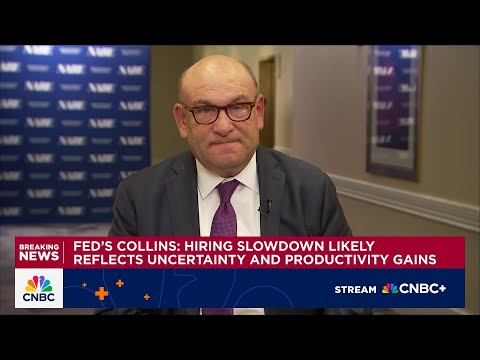
Steve Leeman of course has that for us. Steve. >> Hey Scott.Yeah. Boston Fed President Susan Collins, a voter this year making some doish comments saying it's prudent to normalize policy a bit further. She's also uh saying that uh even if they uh cut a little bit more that the uh Fed will still be mildly restrictive.I'm just looking for these uh these notes here. Uh Scott, she goes on to say that she believes that inflation is a uh uh is is really a matter of tariffs and she sees growth remaining solid desp ...
Fed Chair Powell Keeps Door Open For Interest Rate Cuts
Yahoo Finance· 2025-10-14 18:32
Core Insights - Financial markets anticipate further interest rate cuts by the Federal Reserve, supported by remarks from Fed Chair Jerome Powell [2][3] - Powell indicated that the current inflation and unemployment outlook remains consistent with data from September, prior to the Fed's last rate cut [3][4] - The government shutdown has limited access to crucial economic data, yet Powell remains optimistic about the job market and inflation trends [5][7] Economic Data and Impact - The government shutdown has halted the release of key economic reports, including the Bureau of Labor Statistics' job creation report for September, which could impact Fed decision-making [5][7] - Powell noted that the Fed is relying on alternative data sources, such as private company reports and internal surveys, due to the lack of comprehensive government data [7] - The upcoming Consumer Price Index report for September, scheduled for release on October 24, is a notable exception to the data blackout [5] Interest Rate Strategy - Powell's comments suggest a willingness to cut interest rates to support the job market, which is showing signs of deterioration [8] - The Fed faces a dilemma between stimulating the economy through rate cuts and controlling inflation, which has been influenced by tariffs [9] - Analysts perceive Powell's remarks as leaning towards a dovish stance, indicating potential for more rate cuts in the near future [10]