商业航天产业化

Search documents
商业航天产业化进程加快 产业链企业加速“跑马圈地”
Huan Qiu Wang· 2025-06-10 02:15
Core Viewpoint - The successful launch of the low Earth orbit satellite internet group by China marks a significant advancement in the satellite internet industry, which is crucial for the commercialization of space technology [1][3]. Industry Overview - Satellite internet creates a vast network through space-deployed satellites, enabling global information transmission and communication coverage, characterized by wide coverage, low latency, high bandwidth, and low cost [3]. - The application of satellite internet spans various fields, including the Internet of Things (IoT), smart cities, and emergency communications [3]. - China's satellite internet market is projected to reach 37.6 billion yuan by 2025, driven by policy support and technological advancements [3]. Policy and Market Dynamics - The Chinese government has been actively supporting the satellite internet industry, including its inclusion in the "new infrastructure" category by the National Development and Reform Commission in 2020 [3]. - In 2024, the Ministry of Industry and Information Technology and other departments proposed forward-looking layouts for key technology research, and in 2025, they issued measures to optimize domestic coordination for satellite networks [3]. - The top-level policy framework for the satellite industry in China is becoming increasingly robust, with a growing user base for satellite internet access [3]. Company Developments - Market interest in the satellite internet industry has surged, with eight satellite internet concept stocks undergoing institutional research in the past month [4]. - Companies like Haige Communication, Jinlu Electronics, and Yaguang Technology have disclosed recent advancements, with Haige Communication participating in major national projects and expanding its business scope [4]. - China Orient Red Satellite Co., Ltd. is actively involved in low Earth orbit internet construction, while Yaguang Technology offers various products in the satellite internet and communications sectors [4]. - Experts suggest that listed companies in the industry should increase R&D investment, enhance collaboration, and seize policy opportunities [4].


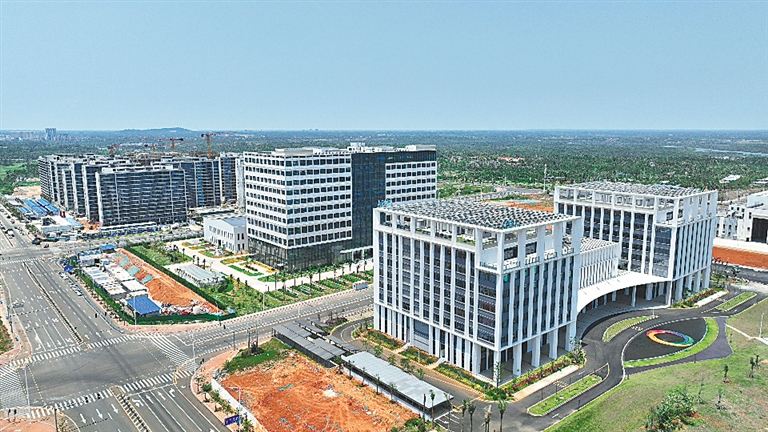
文昌国际航天城:我国商业航天发射场在这里实现“从0到1”
Hai Nan Ri Bao· 2025-04-28 01:36
Core Insights - Wenchang International Space City represents a significant transformation in China's commercial space industry, evolving from a non-existent infrastructure to a thriving hub for space technology and industry within five years [6]. Group 1: Development and Infrastructure - Wenchang International Space City is China's first low-latitude coastal commercial space city, aimed at addressing the challenges of commercial space industrialization and enhancing global competitiveness in space technology [6]. - The area has transitioned from a landscape of coconut trees to a developed urban environment with robust infrastructure and a network of roads [6]. - The commercial space launch site has developed launch capabilities, attracting major aerospace companies to establish operations in Wenchang [6]. Group 2: Industry Growth and Innovation - The rocket industry in Wenchang is leading the way for "Chinese height," while the satellite industry has initiated a new model for mass production of satellites [6]. - Wenchang has also established a satellite data cross-border service pilot zone, indicating a strategic move towards data industry development [6]. - The development strategy focuses on leveraging launch advantages to foster high-quality growth in the commercial space industry, aligning with national strategic needs [6]. Group 3: Future Vision - Wenchang International Space City aims to create a new development pattern characterized by "one city, two zones, and one port," positioning itself as a leading demonstration area for China's commercial space and a model for the new space economy [6]. - The goal is to establish Wenchang as an internationally competitive commercial space port, contributing to China's global competitiveness in the commercial space sector [6].