高性能化

Search documents
全球与中国发泡微球市场现状及未来发展趋势
QYResearch· 2025-06-12 10:16
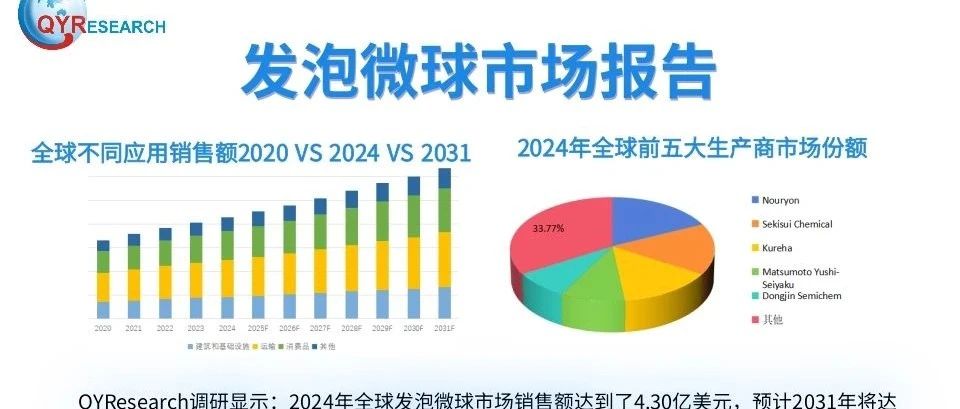
Core Viewpoint - The article discusses the rapid development and market dynamics of the expandable microsphere industry, highlighting its applications, growth trends, and regional market shares. Industry Current Status Analysis - The expandable microsphere industry has formed a complete system from raw material supply to microsphere preparation and application development, with significant disparities in development levels across different segments [3]. - Developed regions like North America and Europe dominate the market due to technological advantages, focusing on high-end applications, while the Asia-Pacific region, particularly China, is emerging as the fastest-growing market driven by demand in construction materials and consumer goods [3]. Development Trends - The market is shifting towards high-performance and multifunctional products, with a focus on directed expansion and integrated functionalities such as thermal insulation, flame retardancy, shock absorption, and flexibility [4]. - There is a movement towards green and sustainable manufacturing, promoting low VOC content, non-toxic, and recyclable microspheres for use in green building materials and eco-friendly coatings [5]. Global Market Scale Analysis - In 2024, the global expandable microsphere market is projected to reach USD 430 million, with an expected growth to USD 637 million by 2031, reflecting a compound annual growth rate (CAGR) of 5.84% from 2025 to 2031 [8]. - The market is fragmented, with major companies like Nouryon, Sekisui Chemical, and Kureha accounting for 66.23% of the global revenue in 2024 [10]. - The largest market share in 2024 is held by North America at 29.44%, followed by Europe at 26.18%, and China at 18.39% [10]. - Expandable microspheres are categorized by particle size, with those ≤ 25 μm representing the largest consumption market, accounting for 76.55% of sales revenue in 2024 [10]. - The transportation sector is the largest application market, capturing 35.90% of the sales market share in 2024 [11]. New Demand Drivers - The increasing focus on energy consumption control and green building standards globally is driving demand for expandable microspheres in insulation mortar, thermal coatings, and other building materials [11]. - The automotive industry's push for lightweight materials, especially in the context of electrification and low-carbon transitions, is leading to a surge in demand for lightweight, high-performance materials [11]. - The electronics sector is emerging as a new frontier for expandable microspheres, with applications in thermal insulation layers and electronic encapsulation materials [11].

全球与中国发泡微球市场现状及未来发展趋势
QYResearch· 2025-06-12 10:16
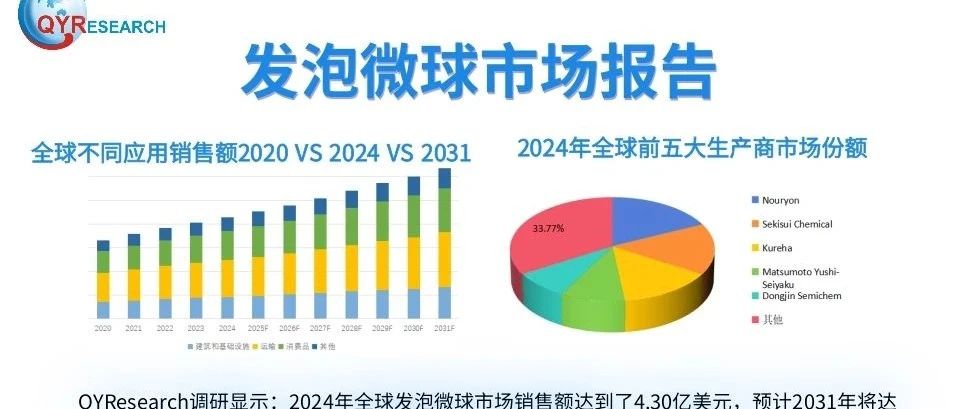
Core Viewpoint - The article discusses the rapid development and market dynamics of the foamed microsphere industry, highlighting its applications, regional market distribution, and future trends in performance and sustainability [3][4][5]. Group 1: Current Status of the Foamed Microsphere Industry - Foamed microspheres are a unique polymer functional material that has seen rapid global growth, with a complete industry chain from raw material supply to application development [3]. - Developed regions like North America and Europe dominate the market due to technological advantages, while the Asia-Pacific region, particularly China, is emerging as the fastest-growing market driven by demand in construction and consumer goods [4]. Group 2: Development Trends - The market is shifting towards high-performance and multifunctional foamed microspheres, with a focus on directed expansion and integrated functionalities such as thermal insulation, flame retardancy, and shock absorption [5]. - There is a movement towards green and sustainable manufacturing, promoting low VOC content and recyclable microspheres for use in green building materials and eco-friendly coatings [6]. Group 3: Global Market Scale Analysis - The global foamed microsphere market is fragmented, with major companies like Nouryon, Sekisui Chemical, and Kureha accounting for 66.23% of the market share by 2024 [9]. - North America holds the largest sales share at 29.44% in 2024, followed by Europe at 26.18% and China at 18.39% [10]. - The largest consumer market segment is for microspheres with a particle size of less than or equal to 25 μm, which is expected to account for 76.55% of sales revenue in 2024 [11]. Group 4: Industry Opportunities and Driving Factors - The demand for green building materials and energy-efficient construction is increasing, with foamed microspheres being widely used in insulation mortar, thermal coatings, and prefabricated building systems [13]. - The automotive industry's push for lightweight materials, especially in the context of electrification and low-carbon transitions, is driving demand for foamed microspheres in various applications [13]. - The electronics sector presents new opportunities for foamed microspheres in thermal insulation layers and electronic encapsulation materials [13].
研判2025!中国转移胶带行业相关概述、产业链、发展现状、企业格局及未来前景分析:电子信息行业的持续恢复,驱动行业市场规模增长至383亿元[图]
Chan Ye Xin Xi Wang· 2025-06-12 01:24
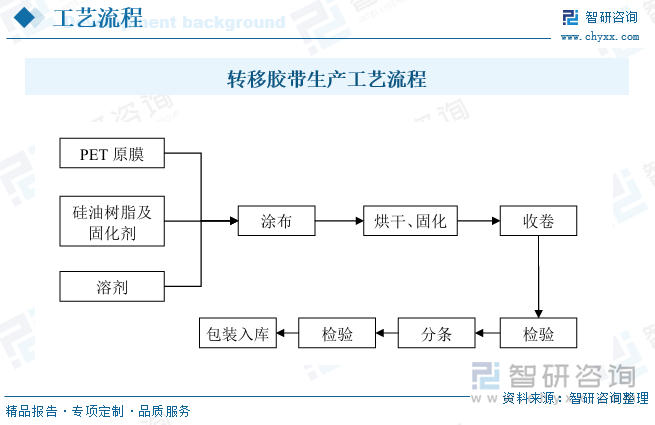
Core Viewpoint - The demand for transfer tape is rapidly increasing due to the growth of industries such as electronics, optics, and automotive, indicating significant market potential. The market size of China's transfer tape industry is projected to grow from 24.583 billion yuan in 2017 to 38.257 billion yuan in 2024, with a compound annual growth rate (CAGR) of 6.52% [1][10]. Industry Overview - Transfer tape is a specialized adhesive tape used to transfer materials or patterns from one surface to another, featuring properties such as adhesion, durability, and ease of use. It is composed of a substrate and adhesive material, making it suitable for various applications in both daily life and industrial production [2]. - The production process of transfer tape includes raw material procurement, coating, drying and curing, slitting, inspection, and packaging [2]. Industry Chain - The upstream raw materials for the transfer tape industry include substrates like polyester film and polyethylene film, and adhesives such as acrylic and rubber, which determine the tape's key performance characteristics [4]. - The downstream applications of transfer tape span across electronics, automotive, optics, and medical sectors, where it is used for tasks such as component fixation, protection, and ensuring product quality [4]. Market Size and Growth - The market size of the polyester film industry, a key component in transfer tape, is expected to grow from 32.15 billion yuan in 2021 to 50.17 billion yuan in 2024, with a CAGR of 7.7%, supporting the growth of the transfer tape industry [6]. - The electronic information manufacturing sector in China is projected to see a significant increase, with a year-on-year growth of 11.80% in 2024, further driving the demand for transfer tape [8]. Competitive Landscape - The transfer tape industry in China exhibits a concentrated market structure, with leading companies like Jiemai Technology and Leike Co., Ltd. dominating the market through innovation and product development [12]. Development Trends - The industry is moving towards environmentally friendly products, focusing on recyclable materials and reducing harmful emissions to meet regulatory requirements and consumer demand for green products [17]. - High performance is becoming a critical trend, with increasing demands for stronger adhesion, better insulation, and durability in various applications [18]. - Globalization is influencing the industry, with production shifting towards emerging markets like Southeast Asia and India, while companies adapt their strategies to meet local market needs [20].



研判2025!中国阻燃ABS原料行业产业链、发展现状、竞争格局及发展趋势分析:以旧换新推动行业规模增长,环保化是其未来发展的重要趋势[图]
Chan Ye Xin Xi Wang· 2025-05-30 01:43
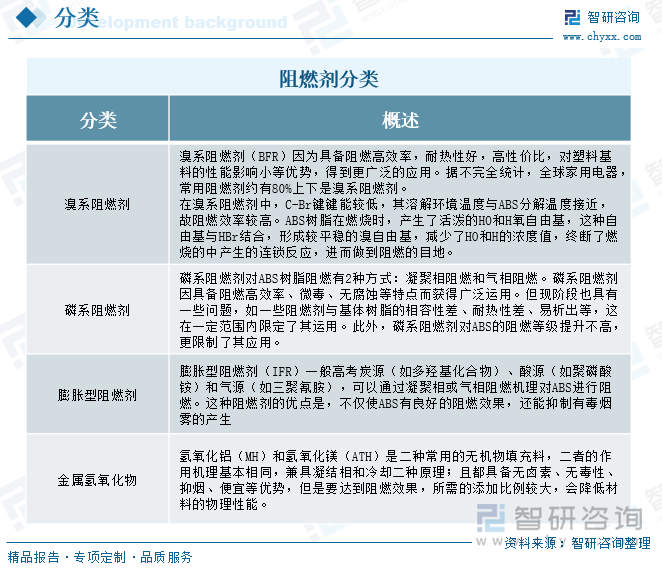
Core Viewpoint - The demand for flame-retardant ABS materials is increasing due to government policies promoting the replacement of old appliances and vehicles, leading to a projected market size of 6.75 billion yuan in China by 2024, a year-on-year increase of 5.63% [1][16]. Industry Overview - Flame-retardant ABS materials are engineered plastics with excellent flame-retardant properties, widely used in electronics, automotive, and construction industries [1][16]. - The market for flame-retardant ABS materials in China has shown a continuous upward trend, with a market size expected to reach 6.75 billion yuan in 2024 [1][16]. - The production process of flame-retardant ABS involves adding flame retardants to ABS resin, which is derived from styrene, acrylonitrile, and butadiene [3][12]. Industry Chain - The upstream of the flame-retardant ABS industry includes the production of ABS resin and various flame retardants [7]. - The midstream involves the manufacturing of flame-retardant ABS materials, while the downstream applications span electronics, automotive, construction, and medical sectors [7]. Market Dynamics - The automotive sector is a significant consumer of flame-retardant ABS, used in interior components to enhance safety [9]. - Government policies, such as the promotion of vehicle replacement, have led to increased production and sales in the automotive industry, with a reported 14.5% and 11.2% year-on-year growth in production and sales in early 2025 [9]. Competitive Landscape - The flame-retardant ABS market features competition among various brands and specifications, with both international and domestic players [18]. - Key domestic companies include Kingfa Technology, Shanghai Pulite, and Guangzhou Jusa Long, which have established significant market shares [19][21]. Development Trends - The industry is moving towards greener practices, with an increasing use of halogen-free and lead-free flame retardants [23]. - There is a growing demand for high-performance materials in electronics and automotive sectors, necessitating improvements in flame-retardant properties and other material characteristics [24]. - The adoption of smart manufacturing technologies is expected to enhance production efficiency and customization in response to diverse customer needs [25].