Economic slowdown

Search documents
Take the Zacks Approach to Beat the Markets: WisdomTree, SkyWest & PepsiCo in Focus
ZACKS· 2025-08-25 15:21
Economic Overview - The U.S. economy faced significant volatility with mixed signals, as major indexes like the S&P 500 and Dow Jones increased by 0.28% and 1.60%, while the Nasdaq Composite decreased by 0.62% [1] - The Federal Reserve Chair Jerome Powell suggested the possibility of an interest rate cut as early as September during the Jackson Hole symposium [1] Labor Market Concerns - A slowing labor market is a primary concern for the Federal Reserve, with recent data showing a downward revision of job growth in May and June, and only 73,000 jobs added in July [2] - Despite strong Q2 GDP numbers, labor market and manufacturing data indicate a potential economic slowdown, presenting a dilemma for the Fed between supporting the job market and combating inflation [2] Zacks Research Performance - WisdomTree, Inc. shares increased by 28% since being upgraded to Zacks Rank 2 (Buy) on June 23, outperforming the S&P 500's 8.7% gain [4] - Hafnia Limited shares rose by 14.1% after a Zacks Rank 2 upgrade on June 25, also surpassing the S&P 500's 6.4% increase [5] - A hypothetical portfolio of Zacks Rank 1 stocks returned +20.65% in 2023, compared to +24.83% for the S&P 500 index [6] Focus List and Model Portfolios - The Zacks Focus List portfolio returned +10.91% in 2025 (through July 31) compared to +8.59% for the S&P 500 index [12] - The Top 10 portfolio has delivered a cumulative return of +2,220.4% since 2012, significantly outperforming the S&P 500 index's +517.8% return [24] Sector-Specific Performance - Johnson & Johnson and The Hershey Company, part of the Earnings Certain Dividend Portfolio, returned 17.2% and 16.8% respectively over the past 12 weeks, driven by investor interest in quality dividend stocks amid market volatility [19] - Mettler-Toledo International Inc. and PepsiCo, part of the Earnings Certain Admiral Portfolio, saw returns of 18.6% and 15.7% over the past 12 weeks [15]








FX Market Lining Up to Overreact to Data: SocGen’s Juckes
Bloomberg Television· 2025-08-19 13:21
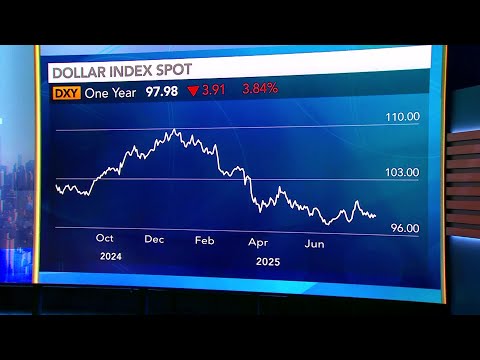
FX Market Drivers - The FX market in the first half of the year was driven by perceived capital flows [1] - The market is uncertain but aware of the significant investment in US equities and treasuries, making returns vulnerable if the economy slows [2] - The market is confused about the short-term rate story, focusing on whether the US economy is slowing slightly or facing a more significant slowdown [2] US Dollar and Economic Data - The market is overreacting to macroeconomic data, anticipating overreactions to data releases in September [3] - The "sell dollar, sell the United States" trade has plateaued, shifting towards a landscape of nuanced reactions to each data point [4] - The data will determine if the US economy is slowing significantly [4] Currency Movements and Economic Impact - Rapid currency movements, like the Euro-Dollar increase from 102 to 118, trigger reactions from inflation-targeting central banks and the economy [5] - The future Euro-Dollar rate, potentially reaching 125 or remaining at current levels, depends on the extent of the US economic slowdown in the next three months [6] - A repeat of soft payroll numbers could lead to a further 5-10% dollar weakness [6][7] - A gentle easing in US growth may not justify significant dollar weakness if the inflation impact from tariffs is limited [7]
Gladstone Investment(GAIN) - 2026 Q1 - Earnings Call Transcript
2025-08-13 13:30
Financial Data and Key Metrics Changes - For Q1 2026, the company reported adjusted net investment income (NII) of $0.24 per share, down from $0.26 per share in the prior quarter [6][15] - Total investment income decreased to $23.5 million from $27.5 million in the previous quarter, primarily due to the absence of a one-time success fee and dividend income [13] - Net investment income for the quarter was $9.1 million compared to $7.2 million in the prior quarter [15] - The net asset value (NAV) decreased to $12.99 per share from $13.55 per share, influenced by distributions to shareholders and unrealized depreciation [16][17] Business Line Data and Key Metrics Changes - The company invested approximately $130 million in three new portfolio companies during the first quarter, compared to $221 million for the entire fiscal year 2025 [7] - The portfolio currently consists of 28 operating businesses, with a total investment of about $2.1 billion across 64 buyout portfolio companies since inception [9] Market Data and Key Metrics Changes - The company noted a competitive environment in the M&A market, with liquidity present but valuations remaining challenging [10] - Some consumer-focused portfolio companies have shown good results, although there are concerns regarding supply chain disruptions and tariff impacts on margins [11] Company Strategy and Development Direction - The company aims to grow its portfolio through acquisitions at attractive valuations, utilizing a combination of equity and debt investments [7] - The strategy includes generating capital gains and maintaining monthly distributions to shareholders, with a focus on liquidity and flexibility to support portfolio growth [18] Management's Comments on Operating Environment and Future Outlook - Management expressed optimism about new buyout activity for the remainder of the fiscal year, despite uncertainties in the economic landscape [10] - The company is cautious about potential impacts from tariffs and supply chain issues but remains confident in the overall health of its portfolio [11] Other Important Information - The company maintained a monthly distribution of $0.08 per share, with a supplemental distribution of $0.54 per share paid in June [8][18] - The asset coverage ratio stood at 189%, providing a cushion above the required 150% coverage ratio [18] Q&A Session Summary Question: Is the recent acquisition pace indicative of better deal flow? - Management indicated that while the M&A market is competitive, they are seeing good quality deal flow and are actively pursuing acquisitions [23][24] Question: Are there signs of weakening performance across portfolio companies? - Management noted that while there is caution, overall activity levels remain stable, with some consumer companies even experiencing increased activity despite tariff impacts [26][27] Question: What is the current level of undistributed taxable income (UTI)? - Management confirmed comfort with the current UTI level and continues to monitor it on a quarterly basis [28][29] Question: Can you provide insights on Diligent Delivery Systems? - Management stated they are continuing to manage the investment and are working on restructuring, with no immediate dramatic changes planned [34][35] Question: What drove the increase in yield on interest-bearing investments? - The yield increase was primarily due to the collection of past due interest, with the underlying yield remaining consistent with previous quarters [40][41] Question: Are there changes in deal structures among competitors? - Management indicated that while competition exists, their unique strategy allows them to maintain strong underwriting standards without significant changes in structure [44][45]

Big political loser? Trump's 'reverse Robin Hood budget' will cause 'economic slowdown'
MSNBC· 2025-07-02 20:45
Political & Economic Analysis - The new bill is perceived as a reverse Robin Hood budget, transferring wealth from the poor to the rich [1][2] - Soft stagflation is anticipated, with rising inflation and a potentially softening labor market due to an economic slowdown [4] - Public opinion, even according to Fox News polls, is largely against the bill by 20 points, even before its effects are felt [7] - Democrats have an opportunity to capitalize on the bill's unpopularity and the Republican party's perceived lack of fiscal responsibility [8][10] - Economic populism is suggested as a counter-narrative to cultural populism, using the bill as an example [10] Midterm Elections & Political Strategy - The White House acknowledges potential blowback in the midterm elections, historically challenging for a president's first term [12][13] - The administration aims to fulfill campaign promises, including tax cuts, despite midterm election concerns [11][12] - Democrats are considering making JD Vance the face of the bill, particularly looking ahead to the 2028 presidential election, though focusing on Donald Trump and the Republican party as a whole may be more effective in the midterms [14][15][16] - The Republican party may struggle to credibly advocate for fiscal responsibility after Donald Trump's first term, during which the debt increased [8] - A past attempt to privatize social security under George Bush is cited as a cautionary tale of pursuing unpopular policies [17][18]

Why Caterpillar Stock Is Volatile Today
The Motley Fool· 2025-04-30 19:51
Core Viewpoint - Caterpillar reported weaker-than-expected first-quarter results and lowered its full-year guidance, but the market had anticipated this, limiting the downside post-announcement [1][5] Financial Performance - The company earned $4.25 per share on revenue of $14.25 billion, missing Wall Street's consensus estimates of $4.35 per share and $14.6 billion in sales [3] - Sales declined by 10% year-over-year, with construction equipment sales down 19% from the previous year [3][4] - Caterpillar warned that margins could be at the lower end of the previous 16% to 20% range for 2025 due to rising costs [3] Market Conditions - The decline in sales was attributed to weaker dealer restocking trends and pricing pressures [4] - Economic uncertainty is expected to hinder the recovery of Caterpillar's business and stock performance in the near term [7] Company Resilience - Despite the challenges, Caterpillar's scale and strong balance sheet provide a cushion, with the company generating $1.3 billion in operating cash flow during the quarter [6] - The company returned $4.3 billion to shareholders through share repurchases and dividends, indicating a commitment to returning value to investors [6]


BPG(BRX) - 2025 Q1 - Earnings Call Transcript
2025-04-29 14:00
Financial Data and Key Metrics Changes - The company reported NAREIT FFO of $0.56 per share in Q1 2025, driven by same property NOI growth of 2.8% despite a 160 basis point drag from tenant disruption [15][16] - The debt to EBITDA ratio was reduced to 5.5 times, with $1.4 billion in available liquidity and no remaining debt maturities until June 2026 [10][17] - The signed but not yet commenced pool totaled $60 million, which includes $52 million of net new rent [16][17] Business Line Data and Key Metrics Changes - The company executed 1.3 million square feet of new and renewal leases at a blended cash spread of 21%, with new leases at 48% and renewals at 14% [12] - The occupancy rate declined to 94.1% due to the recapture of space from bankrupt tenants, but the company expects to address this with better tenants at higher rents [12][13] - The reinvestment pipeline reached $391 million with a weighted average return of 10%, and the company stabilized $28 million of reinvestment projects during the quarter [13] Market Data and Key Metrics Changes - The company continues to capture a significant share of new store openings in core categories such as grocery and specialty grocery, with strong tenant demand [8][9] - The traffic in the company's centers showed year-over-year growth, reflecting the positive impact of reinvestment and tenant performance [8] Company Strategy and Development Direction - The company is focused on capitalizing on tenant disruption to bring in better tenants at higher rents, which is part of its all-weather value-added plan [6][7] - The management expressed confidence in the ability to outperform in 2025 and 2026, supported by a robust leasing pipeline and low rent basis [9][10] - The company is well-positioned to navigate potential disruptions and capitalize on growth opportunities in the current volatile market [10][11] Management's Comments on Operating Environment and Future Outlook - Management acknowledged the looming tariff uncertainty and potential economic slowdown but emphasized strong tenant demand and the ability to generate robust leasing activity [6][9] - The management remains optimistic about the growth visibility provided by the signed but not commenced pipeline and the ongoing leasing efforts [17][18] - The company expects base rent to accelerate in the second half of the year as new leases commence [17] Other Important Information - The company has maintained a conservative approach to guidance, allowing for additional tenant disruption while still expecting to meet its financial targets [19][20] - The management highlighted the importance of maintaining a strong credit profile and the resilience of its tenant base in the face of economic challenges [86][87] Q&A Session Summary Question: What is the exposure to Big Lots or Party City at quarter end? - The company experienced a 140 basis point impact from bankruptcies, primarily from Big Lots and Party City spaces [21][22] Question: What is the outlook for same store growth and potential risks? - Management expressed confidence in achieving growth targets, with a strong pipeline and tenant demand, while acknowledging potential risks from economic conditions [26][28] Question: How has leasing activity trended post tariff announcements? - Management noted that leasing discussions remain strong, with tenants focused on growth despite tariff concerns [31][33] Question: What are the expectations for occupancy and leasing activity related to Joann's? - The company expects to recapture Joann's spaces in May, with strong leasing activity anticipated [95][96] Question: How is the transaction market responding to current volatility? - The market has slowed slightly, but there remains strong demand for open-air retail, and the company is positioned to capitalize on opportunities [42][44]

Verizon Is Losing Subscribers Again
The Motley Fool· 2025-04-23 09:10
Core Viewpoint - Verizon's recent performance indicates a troubling trend in subscriber growth, with significant losses in the first quarter of 2025 following a brief gain at the end of 2024 [1][8] Subscriber Performance - In the first quarter of 2025, Verizon added 1.7 million consumer wireless retail postpaid phone subscribers on a gross basis, but this represents a 1% decline year over year, resulting in a net loss of 356,000 subscribers [2] - The company lost 194,000 net consumer retail postpaid phone subscribers in the first quarter of 2024, despite gaining 367,000 subscribers in the fourth quarter of 2024, indicating a volatile subscriber base [3] Revenue Trends - Total wireless service revenue for Verizon rose by 2.7% year over year, despite the ongoing subscriber losses [3] Customer Retention Strategies - Verizon introduced a three-year price lock on wireless plans to improve customer retention, although this excludes fees and perks associated with the plans [4] - The company also guarantees that existing customers can access the same promotions on new phones with trade-ins as new customers, which may increase costs but aims to reduce churn [5] Competitive Landscape - Competitors like AT&T are also implementing customer-friendly policies, such as bill credits for service outages, which may limit the effectiveness of Verizon's new strategies [6] - The industry is seeing a trend towards customer-first policies, which could dilute the impact of Verizon's initiatives on subscriber growth [6] Economic Considerations - The potential impact of tariffs on smartphones could increase costs for Verizon's free phone offers, and an economic slowdown may lead consumers to downgrade plans or seek cheaper alternatives [7] - Verizon's position in a potentially slowing economy, combined with its need to catch up with competitors, presents challenges for future subscriber growth [8]


BlackRock's Larry Fink says U.S. is very close to a recession and may be in one now
CNBC· 2025-04-11 13:46
Economic Outlook - BlackRock CEO Larry Fink indicated that the U.S. economy has weakened significantly, suggesting that growth may turn negative and stating, "I think we're very close, if not in, a recession now" [1] - Fink expressed concerns about rising fears of an economic slowdown following President Trump's announcement of widespread tariffs, which led to a stock market sell-off [1][2] - The temporary pause on some tariffs for 90 days has not restored confidence in the economy, according to Fink, who anticipates a continued slowdown due to prolonged uncertainty [2] Consumer and Business Sentiment - Surveys indicate a decline in sentiment among consumers and business leaders, although some economic indicators like job growth and retail sales have remained relatively stable [3] - Fink noted that consumers may have stockpiled goods in anticipation of tariffs, potentially obscuring underlying economic weaknesses [3] BlackRock's Financial Performance - BlackRock's first-quarter financial results were mixed, with adjusted earnings per share of $11.30 exceeding Wall Street's expectation of $10.14, while revenue of $5.28 billion fell short of the $5.34 billion consensus [4] - The company reported $84 billion in net inflows during the quarter, bringing total assets under management to nearly $11.6 trillion [5] - Following the earnings report, BlackRock's shares experienced a slight increase of less than 1% in morning trading [5]


3 Sector ETFs & Stocks to Gain Amid Upbeat March Jobs Data
ZACKS· 2025-04-09 13:01
Employment Data Overview - The March 2025 U.S. jobs report showed a robust addition of 228,000 jobs, exceeding economists' expectations of 140,000 and the 12-month average of 158,000 [1] - Average hourly earnings increased by 0.3% month-over-month, with an annual rate of 3.8%, the lowest since July 2024 [1] Sector Performance Healthcare - The healthcare sector added 54,000 jobs in March, consistent with the average monthly gain of 52,000 over the previous year [4] - Employment growth was noted in ambulatory health care services (+20,000), hospitals (+17,000), and nursing and residential care facilities (+17,000) [4] - The Health Care Select Sector SPDR ETF (XLV) is highlighted for its 30% exposure to the pharma industry and 22.32% to healthcare providers & services [5] - HCA Healthcare (HCA), a major player in acute care hospitals, has a trailing four-quarter earnings surprise of 5.86% on average [6] Transportation - Employment in transportation and warehousing rose by 23,000, significantly above the prior 12-month average gain of 12,000 [7] - Job gains were primarily in couriers and messengers (+16,000) and truck transportation (+10,000), with a slight offset from warehousing and storage (-9,000) [7] - The SPDR S&P Transportation ETF (XTN) is noted for its potential, yielding 1.19% annually [7] - FedEx (FDX), a leader in global express delivery services, is identified as a strong stock pick in this sector [8] Retail - The retail sector saw an increase of 24,000 jobs in March, with food and beverage retailers contributing significantly due to workers returning from a strike (+21,000) [9] - The Invesco Food & Beverage ETF (PBJ) includes stocks from 30 U.S. food and beverage companies, charging 62 bps in fees and yielding 1.51% annually [10] - Sprouts Farmers Market (SFM), ranked 2 (Buy), operates in a fragmented grocery store industry with a focus on fresh produce and wellness [11]


JPMorgan CEO Jamie Dimon says Trump tariffs will boost inflation, slow an already weakening U.S. economy
CNBC· 2025-04-07 10:15
Core Viewpoint - JPMorgan Chase CEO Jamie Dimon highlighted that the tariffs announced by President Trump are likely to increase prices on both domestic and imported goods, which could further slow down an already weakening U.S. economy [1][2]. Group 1: Tariff Impact - The newly announced tariffs are expected to have significant short-term inflationary effects on both imported and domestic goods due to rising input costs and increased demand for domestic products [2]. - Dimon expressed uncertainty about whether the tariffs will lead to a recession, but he confirmed that they will slow down economic growth [2]. Group 2: Market Reaction - Dimon is the first major Wall Street bank CEO to publicly comment on Trump's tariff policy during a time of significant market volatility, with U.S. equities experiencing their worst week since the onset of the Covid pandemic [3]. - The announcement of tariffs has caused a shock in global markets, leading to a notable decline in stock prices [3]. Group 3: Uncertainties and Recommendations - Dimon noted that Trump's tariff policy has introduced numerous uncertainties, including effects on global capital flows, the dollar, corporate profits, and responses from trading partners [4]. - He emphasized the importance of resolving tariff issues quickly to mitigate cumulative negative effects that could be difficult to reverse over time [5].