
Manufacturing PMI

Search documents
Dollar Pressured by Weaker-Than-Expected US CPI Report
Yahoo Finance· 2025-10-24 19:58
Economic Indicators - The September US CPI report showed a monthly increase of +0.3% and a yearly increase of +3.0%, which was slightly below market expectations of +0.4% m/m and +3.1% y/y [2] - The core CPI for September also rose by +0.2% m/m and +3.0% y/y, again slightly weaker than the expected +0.3% m/m and +3.1% y/y [2] - The final-August University of Michigan US consumer sentiment index fell by -1.4 points to 53.6, weaker than the expected drop to 54.5 [3] Market Reactions - The dollar index ended the day little changed, influenced by the weaker-than-expected CPI report and a -0.6 basis point decline in the US 10-year T-note yield [1] - The markets are pricing in a 97% chance of a -25 basis point rate cut at the next FOMC meeting on October 28-29 due to the ongoing US government shutdown [4] Eurozone Indicators - The preliminary-October HCOB Eurozone manufacturing PMI rose by +0.2 points to 50.0, exceeding expectations for no change at 49.8 [5] - The preliminary-October HCOB Eurozone services PMI increased by +1.3 points to 52.6, stronger than the anticipated decline to 51.2 [5]
Forget Airlines—These Trucking Stocks Are Shifting Into High Gear
MarketBeat· 2025-10-03 21:23
Core Insights - A significant divide has emerged in the transportation sector, with airlines performing well while trucking companies are struggling in bear market territory [1][2] - Investors are encouraged to consider trucking companies like SAIA Inc., J.B. Hunt Transport Services Inc., and RXO Inc. for potential rebounds as market conditions improve [2] Group 1: Trucking Industry Overview - Trucking companies are currently trading well into bear market territory, affected by tariff fears and consumption issues [2] - The Manufacturing PMI is a key macroeconomic indicator for the trucking industry, which has been weakening recently [3][4] - A potential rebound in the PMI could set the stage for recovery in the trucking sector, especially with the Federal Reserve cutting interest rates [4] Group 2: SAIA Inc. Analysis - SAIA's stock is forecasted to have a 12-month price target of $349.89, indicating a 17.89% upside from its current price of $296.80 [3][5] - SAIA delivered $2.67 in earnings per share (EPS) in the most recent quarter, beating the consensus estimate of $2.39, suggesting strong near-term potential [6] - The company operates a hub-and-spoke model that is expected to outperform during a PMI recovery [5] Group 3: J.B. Hunt Transport Services Inc. Analysis - J.B. Hunt's stock has a 12-month price forecast of $160.62, representing a 16.49% upside from its current price of $137.88 [8] - The company has a strong presence in diversified logistics and intermodal trucking services, which helps cushion against cyclicality [8] - Institutional investors are showing confidence in J.B. Hunt, with Corient Private Wealth increasing its holdings by 3.7% [9] Group 4: RXO Inc. Analysis - RXO's stock forecast indicates a 12-month price target of $17.08, with a modest 2.62% upside from its current price of $16.64 [11] - The company benefits from a digital broker marketplace, allowing for increased leverage with minimal capital investment [11] - RXO reported an EPS of four cents, exceeding the two-cent consensus, indicating potential for growth despite bearish market conditions [12]





Manufacturing "Mixed Picture" & Pulling Back Curtain of ADP Employment
Youtube· 2025-10-01 15:29
Core Insights - The ISM manufacturing report indicates a mixed economic outlook, with the manufacturing PMI at 49.1%, slightly better than expectations but still in contraction territory [2][5] - The prices component remains elevated at 61.9%, indicating rising prices but showing signs of deceleration compared to previous months [3][4] - New orders fell to 48.9%, missing expectations and indicating contraction, which is a concerning sign for future manufacturing activity [4][9] Manufacturing Sector Analysis - The manufacturing sector constitutes about 30-35% of the total economy, and the ISM services index carries more weight in overall economic assessments [5] - The S&P manufacturing PMI came in at 52, matching expectations but lower than the previous month, suggesting a stable but cautious outlook [8] - Overall, the manufacturing data presents a murky picture, with no signs of a significant downturn or rapid price increases, but the decline in new orders raises concerns [9][10] Labor Market Insights - The ADP report showed a surprising decline of 32,000 jobs, significantly below the expected increase of over 50,000, indicating potential weaknesses in the labor market [11][19] - The Midwest region experienced a notable job loss of 63,000, which may be an outlier but highlights regional disparities in employment trends [16] - There are concerns regarding the reliability of the ADP data due to missing information from the federal government, which could affect the accuracy of labor market assessments moving forward [18]

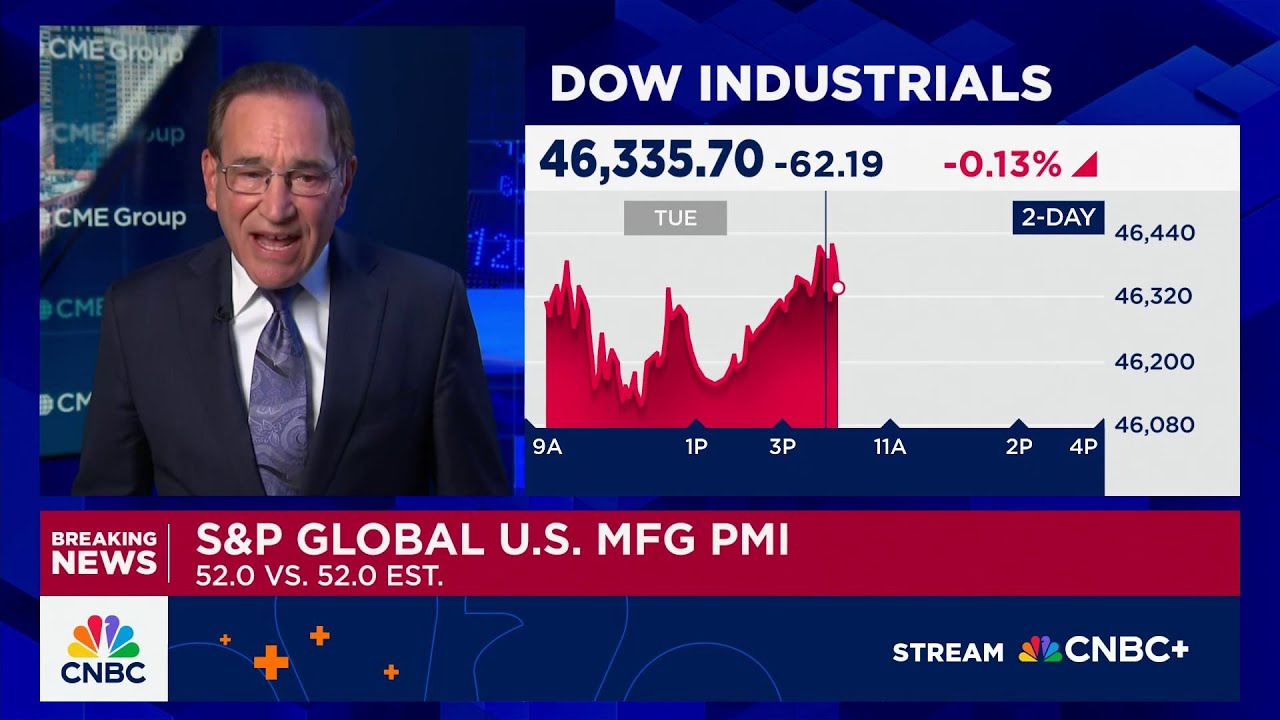
S&P Global U.S. manufacturing PMI comes in as expected
Youtube· 2025-10-01 14:13
Group 1 - The final reading for S&P Global's manufacturing PMIs for September remains at 52, indicating stability in the manufacturing sector [1] - The mid-month reading for September was also 52, marking the lightest reading since July, which was slightly below 50 [1] - July is noted as the only month this year with a PMI below 50, suggesting a contraction in manufacturing activity [2] Group 2 - ADP reported a decrease of 32,000 jobs, the lightest figure since March 2023, which has influenced interest rates to decline [2] - Interest rates have decreased by six basis points for the 10-year and eight basis points for the 2-year [2]
China No Longer 'Uninvestable'? | Bloomberg: Insight with Haslinda Amin, 9/29/25
Bloomberg Television· 2025-09-29 06:28
China's Economic Trends - China's industrial profits surged 20% year-on-year in August, partly due to a low base effect from a 17% decline a year ago [4][5] - Campaigns to tackle overcapacity and excessive competition are showing results, particularly in large equipment manufacturing, shipbuilding, and aerospace sectors [4][6] - Official manufacturing PMI is expected to contract for the sixth consecutive month, while non-manufacturing is expected to expand at a slower pace [7][8] - Ministry of Transport forecasts about 27 billion travels during the Golden Week, with a 130% increase in holiday bookings [9][10] - Analysts caution to watch per capita spending during Golden Week to assess consumption downgrading [10] Market and Investment Strategies - Global money managers are venturing back into China, with foreign inflows rising across asset classes [1][3] - Liquidity from savings, money markets, and fixed income is driving decoupling of macro from markets in China [14] - Optimism surrounds Chinese stocks due to policy tailwinds and the push for AI chip substitution [15] - International capital investment to China is expected to increase in the coming months, driven by diversification from crowded U S assets [16] - Domestic developed chips are making progress but still lag in performance and energy efficiency compared to established leaders like NVIDIA [18] - Retail investors account for 90% of daily trading volume in the Chinese market, compared to 20% in the U S [26] Geopolitical and Trade Relations - India refused to accept the Asia Cup trophy due to ongoing political conflict with Pakistan [2][46][47][48] - India views Pakistan's closer relationship with the U S with concern, particularly regarding trade deals and the purchase of Russian crude [50][51][52] - The U S has agreed to help develop Pakistan's untapped oil reserves, a move viewed with concern by India [60][61] Hong Kong's Economic Challenges - New World Development posted a second straight year of losses, exceeding $2 billion, due to weak property demand and debt pressures [78][79] - New World's strategy focuses on selling residential properties for cash to pay down debt and seeking outside investors [82][83] - Beijing's tightening grip on Hong Kong's economy and politics is reducing the power of tycoon families [84]

Dollar Gains on Concerns about Less-Dovish Fed
Yahoo Finance· 2025-09-24 14:47
Core Insights - The dollar index (DXY) has risen by +0.63%, reaching a 1.5-week high, driven by signals from Fed Chair Powell indicating a less dovish stance than market expectations [1] - US new home sales in August surged by +20.5% month-over-month to 800,000, marking a 3.5-year high, contrary to expectations of a decline [2] - The euro is under pressure due to a decline in German business confidence, with the IFO business climate survey falling to a 4-month low [3][4] Group 1: Dollar Strength and Economic Indicators - The dollar's strength is supported by a 93% market expectation of a -25 basis point rate cut by the Fed at the upcoming FOMC meeting [3] - The unexpected jump in US new home sales to 800,000 contrasts sharply with the anticipated decline to 650,000, indicating robust housing market activity [2] - The euro's weakness is compounded by the German IFO business climate survey dropping -1.2 points to 87.7, below the expected increase to 89.4 [4] Group 2: Central Bank Divergence - The European Central Bank (ECB) is perceived to be nearing the end of its rate-cutting cycle, while the Fed is expected to implement two more rate cuts by year-end [4] - ECB Executive Board member Cipollone noted that inflation risks in the Eurozone are balanced, with a minimal chance of a rate cut at the upcoming ECB meeting [5] Group 3: Japanese Economic Activity - The USD/JPY exchange rate increased by +0.77%, with the yen falling to a 2.5-week low due to weak manufacturing activity in Japan, as indicated by a contraction in the S&P manufacturing PMI [6] - Japan's August machine tool orders were revised upward to +8.5% year-over-year, the largest increase in five months, suggesting some positive momentum in the manufacturing sector [7]
Dollar Slips and Gold Soars as T-note Yields Fall
Yahoo Finance· 2025-09-23 19:34
Core Points - The dollar index (DXY00) fell by -0.08% as T-note yields decreased following dovish comments from Fed Governor Michelle Bowman, indicating a need for decisive action to lower interest rates due to a weakening labor market [1] - The US Q2 current account deficit was reported at -$251.3 billion, which was smaller than the expected deficit of -$256.6 billion, providing initial support for the dollar [2][3] - Concerns over Fed independence and potential political interference are leading to fears that foreign investors may sell dollar assets [3] Economic Indicators - The US September S&P manufacturing PMI fell by -1.0 to 52.0, which was weaker than the expected 52.2 [4] - The Richmond Fed manufacturing sentiment survey unexpectedly dropped by -10 to -17, contrasting with expectations of an increase to -5 [4] - Fed Chair Powell noted that near-term inflation risks are tilted to the upside while employment risks are to the downside, indicating a challenging economic environment [4] Federal Reserve Commentary - Chicago Fed President Austan Goolsbee stated that the Fed is currently mildly restrictive, with the neutral policy rate estimated to be 100-125 basis points below the current rate [5] - Fed Governor Michelle Bowman emphasized the need for the FOMC to act decisively in response to deteriorating labor market conditions [5] - Markets are pricing in a 91% chance of a -25 basis point rate cut at the upcoming FOMC meeting on October 28-29 [5]
S&P global manufacturing PMI comes in weaker than expected
CNBC Television· 2025-09-23 15:24
Market Trends - Flash PMIs data indicates weaker than expected performance in manufacturing, service, and composite sectors [1] - Equities are moving higher while rates are slipping lower, potentially impacting Fed policy [1] Economic Indicators - Headline PMI at 520%, representing the weakest level since July [2] - Services PMI at 539%, marking the weakest level since June [2] - Composite PMI at 536%, also the weakest level since June [2] - All three PMIs (manufacturing, services, composite) are above 50, indicating expansion, but are sequentially lower than previous periods [2] Upcoming Data - Richmond Fed manufacturing and service indices are expected [3] - Interest rates are slightly lower, down three basis points on the 10-year [3]

X @Crypto.com
Crypto.com· 2025-09-23 00:01
Economic Indicators - Manufacturing PMI data release on September 23 [1] - Gross Domestic Product QoQ data release on September 25 [1] - Core PCE Price Index MoM data release on September 26 [1]
中国 -RatingDog:中国 8 月制造业采购经理指数(PMI)显著上升-China_ RatingDog China manufacturing PMI rose notably in August
2025-09-02 14:24
Summary of the Conference Call Transcript Industry Overview - The report focuses on the **China manufacturing sector**, specifically the **RatingDog China manufacturing PMI** which is a key indicator of manufacturing activity in the country. Key Points 1. **PMI Increase**: The RatingDog China manufacturing PMI rose to **50.5 in August** from **49.5 in July**, significantly exceeding market expectations. This indicates a shift from contraction to expansion in the manufacturing sector [3][9]. 2. **Sub-Indexes Performance**: - The **output sub-index** increased sharply to **50.5** from **48.5**. - The **new order sub-index** rose to **50.7** from **50.1**. - The **employment sub-index** inched up to **49.3** from **49.1**. - The **suppliers' delivery times sub-index** edged up to **49.9** from **49.7** [3][4]. 3. **Demand Conditions**: Surveyed companies reported that improved underlying demand conditions and successful promotional efforts contributed to the rise in new orders, which in turn supported a renewed expansion of manufacturing output in August [3][4]. 4. **Trade-Related Sub-Indexes**: - The **new export orders sub-index** increased to **49.4** from **47.9**. - The **raw materials inventory sub-index** rose to **52.3** from **50.1**. - The **finished goods inventory sub-index** increased to **50.7** from **49.1**. Companies noted that the increase in finished goods was due to both production growth and delays in outbound shipments [4][9]. 5. **Price Indicators**: - The **input price index** rose to **51.5** (up from **50.9** in July). - The **output price index** increased to **50.0** (up from **48.6** in July). - These indicators suggest that disinflationary pressures eased in August, with some manufacturers raising output charges to cope with rising costs, while others faced constraints due to intense competition [4][9]. Additional Insights - The **NBS manufacturing PMI** also increased from July to August but remained below 50, indicating a divergence in the performance of the two PMIs, potentially due to the RatingDog survey covering more export-oriented sectors [3][9]. - The report emphasizes that investors should consider this data as one of many factors in their investment decisions [5]. This summary encapsulates the critical insights from the conference call regarding the current state of the manufacturing sector in China, highlighting key performance indicators and underlying economic conditions.