Oil price surge

Search documents
Oil shatters $100 ceiling, hitting levels not seen since 2022 as Iran conflict escalates
MarketWatch· 2026-03-09 08:40
Core Viewpoint - Crude prices are experiencing a significant increase due to ongoing tensions in the Iran conflict and production cuts by major oil producers [1] Group 1: Market Dynamics - Crude prices surged on Monday, indicating a strong market reaction to geopolitical tensions [1] - The Iran conflict shows no signs of de-escalation, contributing to the upward pressure on oil prices [1] - Reports suggest that some major oil producers are being compelled to reduce their production levels, further tightening supply [1]

Governments scramble to limit fallout of Iran war as oil prices surge
Reuters· 2026-03-09 06:10
Group 1 - Governments in Asia are taking measures to mitigate the economic impact of the Iran war, which has led to a record surge in oil prices, with Brent crude jumping 25% [1][2] - South Korea is capping fuel prices for the first time in nearly 30 years, highlighting the economic burden due to high dependency on Middle Eastern oil [1][2] - Japan is preparing for a possible release of its national oil reserves, which can cover 354 days of consumption, as it imports around 95% of its oil from the Middle East [1][2] Group 2 - Oil production cuts by key producers like Iraq and Kuwait, along with the closure of the Strait of Hormuz, are contributing to fears of prolonged energy supply disruptions [1][2] - Iraq has reduced oil production from its main southern oilfields by 70% to 1.3 million barrels per day, while Kuwait has also begun cutting output [1][2] - Analysts predict that the United Arab Emirates and Saudi Arabia may need to cut output soon due to limited oil storage capacity caused by the Strait of Hormuz closure [1][2]
U.S. orders staff to leave Saudi Arabia as Iran war spreads and oil surges above $110
CNBC· 2026-03-09 03:29
Group 1 - The U.S. government ordered non-emergency government employees and their families to leave Saudi Arabia due to heightened risks from armed conflict and terrorism, marking the first such departure order since the war began [2] - Oil prices surged above $110 per barrel, with West Texas Intermediate increasing by approximately 30% to $117 per barrel and Brent crude rising over 25% to $118 per barrel, reflecting market reactions to the escalating conflict [4][5] - The conflict in Iran has led to significant geopolitical tensions, with the appointment of Mojtaba Khamenei as a new authority consolidating control over hardline groups, raising concerns about potential military actions from the U.S. [3] Group 2 - The U.S. is considering deploying special forces to seize Iran's near-bomb-grade uranium, indicating a potential escalation in military involvement in the region [4] - The last time oil prices exceeded $110 per barrel was following Russia's invasion of Ukraine in 2022, highlighting the historical context of current price movements [5]
Japan's Nikkei set to plunge over 7% as oil breaches $100 mark
CNBC· 2026-03-08 23:55
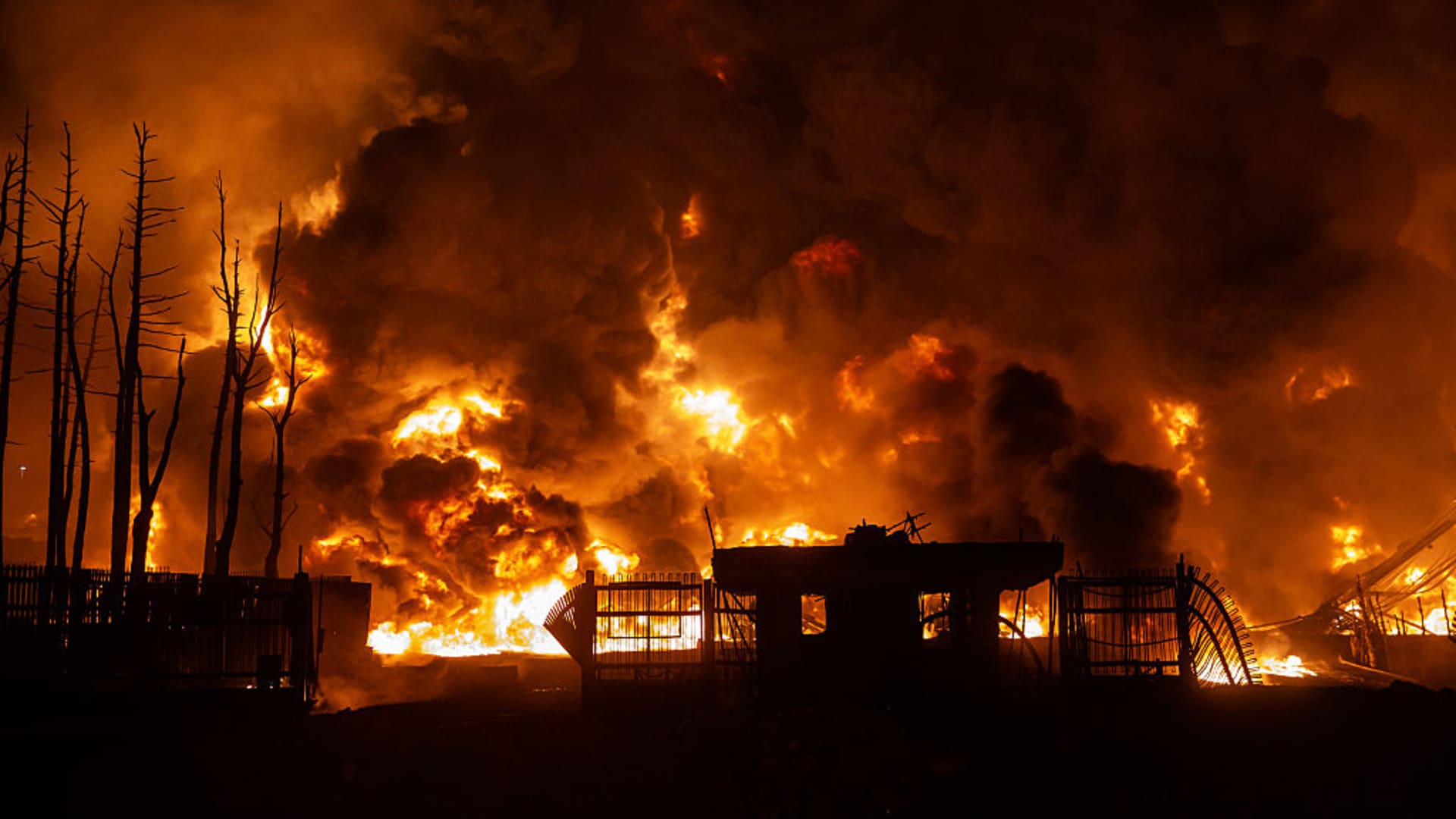
Fire breaks out at the Shahran oil depot after U.S. and Israeli attacks, leaving numerous fuel tankers and vehicles in the area unusable in Tehran, Iran, on March 8, 2026.South Korea's Kospi triggered its second circuit breaker in four sessions on Monday, leading a broader regional sell-off as oil prices neared $120 per barrel for the first time since 2022. The index plunged over 8%, triggering a 20 minute suspension in trading from 10.31 a.m. local time. Heavyweight Samsung Electronics plunged more than 10 ...
Stock market today: Dow, S&P 500, Nasdaq futures sell off as oil prices surge to over $110 a barrel
Yahoo Finance· 2026-03-08 22:41
US stock futures tumbled on Monday as oil prices surged past the $100-a-barrel mark and investors braced for the next development in a still-escalating Middle East war. Dow Jones Industrial Average futures (YM=F) were down 1.5% after plunging 1,000 points overnight. Contracts on the S&P 500 (ES=F) and the Nasdaq 100 (NQ=F) sank roughly 1.3% and 1.5%, respectively. All three indexes were recovering slightly from deeper losses above 2% in earlier hours. Oil prices were coming off earlier highs after spiki ...
Oil prices hit $100 per barrel as big Middle East producers cut output amid Iran war
CNBC· 2026-03-08 22:03
Group 1: Oil Price Surge - Crude oil prices surged above $100 per barrel due to output cuts by major Middle East producers and the closure of the Strait of Hormuz amid the Iran war, with West Texas Intermediate rising 14.33% to $103.93 per barrel and Brent increasing 11.34% to $103.20 [1][2] - U.S. crude oil experienced a significant increase of approximately 35% last week, marking the largest gain in futures trading history since 1983 [1] Group 2: Production Cuts by OPEC Members - Kuwait, the fifth-largest OPEC producer, announced precautionary cuts to its oil production and refinery output due to threats against safe passage through the Strait of Hormuz, although the specific size of the cuts was not disclosed [2] - Iraq's oil production has collapsed, with output from its three main southern oilfields falling 70% to 1.3 million barrels per day, down from 4.3 million bpd prior to the Iran war [3] - The United Arab Emirates is managing offshore production levels carefully to address storage requirements, while onshore operations continue normally [4] Group 3: Storage and Transportation Issues - Gulf Arab states are cutting production due to a lack of storage space as oil barrels accumulate because of the Strait's closure, with tankers hesitant to transit the area due to potential Iranian attacks [5] - Approximately 20% of the world's oil consumption is exported through the Strait of Hormuz, highlighting its critical importance to global oil supply [5] Group 4: Outlook on Shipping Traffic - The ongoing war shows little signs of easing, with U.S. Energy Secretary Chris Wright indicating that traffic through the Strait will resume once the U.S. neutralizes Iran's threat to tankers [6] - Wright suggested that a return to normal shipping traffic through the Strait of Hormuz could occur within a few weeks, although it may take time to reach pre-war levels [7]

Qatar energy minister sends strong message on $150 crude
Yahoo Finance· 2026-03-07 14:33
Core Viewpoint - Crude oil prices are experiencing significant increases due to geopolitical tensions in the Persian Gulf, with warnings from Qatar's energy minister indicating potential prices could reach $150 a barrel if the situation escalates further [2]. Group 1: Oil Price Movements - Crude oil prices have risen for five consecutive days, with light sweet crude peaking at $92.61 a barrel, marking its highest level since summer 2022, before settling at $90.44, an increase of 11.6% on the day [3]. - Brent crude reached a high of $94.64 a barrel, the highest since August 2022, before falling back to $92.30, reflecting an 8% increase on the day and a 52% rise year-to-date [4]. Group 2: Impact on Gasoline Prices - Retail gasoline prices in the U.S. have surged, with the national average reaching $3.32 a gallon, up 11.3% for the week and nearly 17% for the year [4]. Group 3: Production and Supply Concerns - The blockage of the Strait of Hormuz is causing oil producers to consider shutting down production due to limited storage capacity, with Kuwait already beginning to cut output [4][5]. - The situation in the Persian Gulf is critical, as Iranian naval forces are actively targeting ships, leading to maritime insurers refusing coverage for potential losses [2].
US oil prices rise to the biggest weekly surge since 1985. 📈🛢️
Youtube· 2026-03-06 22:00
Core Viewpoint - Further action to reduce pressure on oil is imminent, and the oil market appears to have stabilized [1] Group 1 - The current state of the oil market indicates a stabilization, suggesting that previous volatility may be subsiding [1]
Oil surge sparks Treasury market's worst weekly rout since ‘liberation day' chaos
MarketWatch· 2026-03-06 21:53
Core Insights - Global government bonds experienced significant declines due to rising oil prices, exacerbated by the ongoing conflict in Iran [1] Group 1 - The surge in oil prices has negatively impacted the bond market, leading to increased yields and decreased bond prices [1] - The conflict in Iran is contributing to market volatility, influencing investor sentiment and economic outlook [1] - Analysts are closely monitoring the situation as it unfolds, given its potential implications for inflation and interest rates [1]

Why Are Carnival Shares Falling Friday? - Carnival (NYSE:CCL)
Benzinga· 2026-03-06 13:16
Group 1: Market Impact - Carnival Corporation's stock fell to $26.48, a decrease of 2.50% in premarket trading, following a closing price of $27.16 [1][6] - The decline in Carnival's stock is attributed to rising oil prices, with WTI crude nearing $85 per barrel and Brent crude reaching $88, marking a 20% increase for the week, the largest since early 2022 [1][2] Group 2: Industry Context - The surge in oil prices is driven by disruptions in the Strait of Hormuz due to the U.S.–Israel–Iran conflict, affecting the transit of approximately 20 million barrels of oil daily [2] - The current geopolitical tensions have led to a significant spike in oil prices, with Brent crude experiencing a rise exceeding 7%, compared to a 2% increase during the onset of the Ukraine conflict in February 2022 [2] Group 3: Earnings Outlook - Carnival is scheduled to report earnings on March 20, with an estimated EPS of 18 cents, up from 13 cents year-over-year [5][6] - Revenue is projected at $6.12 billion, an increase from $5.81 billion year-over-year, indicating positive growth [6] - The company's valuation stands at a P/E ratio of 13.4x, suggesting a potential value opportunity for investors [6]