Patent cliff

Search documents
Novartis: A Mispriced Hedge In A Crowded Equity Market
Seeking Alpha· 2025-12-28 09:09
Group 1 - Capital is increasingly directed towards high-growth AI companies, leading to a neglect of other investment opportunities due to the prevailing AI trend in the markets [1] - There is a concern regarding a potential patent cliff, which refers to the loss of revenue from drugs that are going off-patent, impacting pharmaceutical companies [1] Group 2 - The article emphasizes the importance of combining top-down macro analysis with bottom-up stock selection to identify mispriced opportunities in the market [1] - It highlights the focus on earnings, technological disruption, policy shifts, and capital flows as key factors in investment decision-making [1]



Patent cliffhanger: will China biotech throw Big Pharma a lifeline?
Yahoo Finance· 2025-12-20 09:30
Core Insights - The biopharma industry is facing a significant "loss of exclusivity" wave, with estimates indicating a potential revenue loss of between US$17 billion and US$18 billion for Pfizer alone, starting gradually in 2026 and peaking in 2028 [2][12][28] - Morgan Stanley projects that US$171 billion of revenue from large-cap biopharma companies will go off-patent by the end of 2030, prompting a race to replace aging blockbusters [3][28] - The patent cliff is expected to be one of the largest since 2010, with a substantial impact on pricing power as generics and biosimilars enter the market [6][11] Industry Dynamics - The Biosecure Act is adding uncertainty to the industry, as US drug makers navigate a tougher political environment and seek to refill their pipelines [4][21] - The impending patent expirations are creating a competitive landscape where generics and biosimilars can enter at significant discounts, leading to rapid price erosion [7][12] - Drug prices have historically decreased by 30% to 82% over eight years following patent expiration, with the US experiencing the steepest declines [12][17] Chinese Biotech Opportunities - Chinese biotech firms are positioned to capitalize on the patent expirations, offering lower costs and faster clinical execution, making them attractive partners for global pharmaceutical companies [9][28] - The trend of in-licensing assets from Chinese companies is growing, with Chinese firms accounting for 32% of out-licensing deals to multinationals by value in the first half of 2025, up from 21% in previous years [15][27] - Upfront payments to Chinese biotech companies are estimated to be 60% to 70% lower, with timelines for development being accelerated by 30% to 50% [16][28] Strategic Shifts in Big Pharma - As timelines tighten, pharmaceutical companies are increasingly willing to license earlier-stage candidates rather than only late-stage assets, reflecting a shift in strategy to mitigate the impact of patent expirations [10][11] - Major companies like Merck have invested US$40 billion over the past five years in acquisitions and collaborations, particularly with Chinese biotech firms specializing in cancer therapies [14][28] - The urgency to rebuild pipelines before pricing power diminishes is driving Big Pharma to seek innovative solutions, including partnerships with Chinese biotech [28][29]
Pfizer Issues Soft 2026 View: What Does It Mean for the Stock's Future?
ZACKS· 2025-12-17 16:01
Core Viewpoint - Pfizer's financial outlook for 2026 has disappointed investors, leading to a more than 3% drop in shares, primarily due to declining demand for COVID-19 products and increasing loss of exclusivity across its portfolio [2][10]. Financial Outlook - Pfizer expects total revenues for 2026 to be between $59.5 billion and $62.5 billion, including $5 billion from COVID-19 product sales, which indicates modest growth compared to the revised 2025 revenue expectation of around $62 billion [3]. - The adjusted EPS guidance for 2026 is set at $2.80-$3.00, falling short of the Zacks Consensus Estimate of $3.08 per share [4]. - Adjusted R&D expenses are projected to be between $10.5 billion and $11.5 billion, while adjusted selling, informational, and administrative (SI&A) spending is targeted between $12.5 billion and $13.5 billion [4]. Cost Management - Pfizer has exceeded its cost-saving targets for 2025 and aims for cumulative cost reductions of $7.2 billion by 2027, with most savings expected in 2026 [5]. Growth Projections - Beyond 2026, Pfizer does not anticipate a return to robust growth until late in the decade, with COVID-19 product sales expected to decline by approximately $1.5 billion in 2026 [7]. - The company faces a significant patent cliff, with projected revenue losses exceeding $3 billion in 2027 and more than $6 billion in 2028 due to loss of exclusivity [8]. Strategic Focus - Pfizer is concentrating on two key growth areas: obesity and oncology, with the recent acquisition of Metsera aimed at building an early-stage obesity pipeline [11]. - In oncology, Pfizer is prioritizing the development of a PD-1×VEGF bispecific antibody, although competition in this area is intensifying [13]. Valuation and Market Performance - Pfizer's shares have underperformed the industry year to date, trading at a price/earnings ratio of 8.19 times forward earnings, which is lower than the industry average of 17.18 and its own 5-year mean of 10.41 [16]. - EPS estimates for 2025 and 2026 have declined over the past 30 days, indicating a downward trend in market expectations [18].

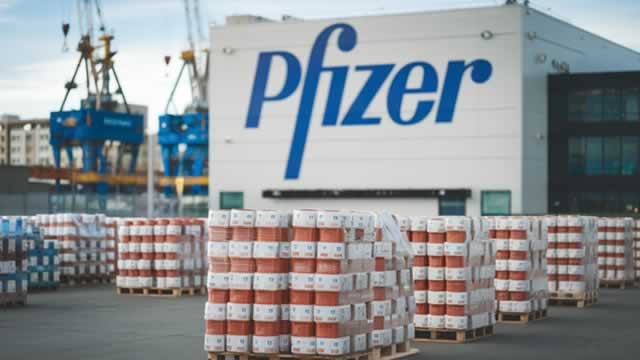
Pfizer trims 2026 profit forecast amid Covid headwinds and patent cliff pressures
Yahoo Finance· 2025-12-16 18:39
Core Viewpoint - Pfizer has lowered its FY2026 profit forecast due to declining Covid vaccine sales and impending patent expirations on key products, projecting profits between $2.80 and $3 per share, below analyst expectations of $3.05 per share [1] Financial Projections - The company anticipates FY2026 revenue to be between $59.5 billion and $62.5 billion, compared to analyst estimates of $61.59 billion [2] - Pfizer's FY2025 profit forecast has also been reduced to $62 billion, which is at the lower end of its previous guidance of $61 billion to $64 billion [6] Research and Development - R&D expenses are expected to range from $10.5 billion to $11.5 billion as Pfizer focuses on advancing its newly licensed PD-1xVEGF oncology asset and various clinical programs from the Metsera acquisition [3] Impact of Covid Vaccine Sales - Projected profits from Covid vaccine sales are expected to decline by $1.5 billion in 2026 compared to 2025 forecasts, reflecting a broader trend affecting other pharmaceutical companies [4] Patent Expirations - Pfizer estimates a loss of $1.5 billion in profit due to the expiration of market exclusivity for certain products, including the JAK inhibitor Xeljanz, blood thinner Eliquis, and cancer drug Ibrance [5] Cost-Cutting Measures - The company has initiated a cost-cutting strategy aimed at reducing spending by $7.7 billion by 2027, which includes cutting 230 jobs in Switzerland as part of a broader operational downsizing [7] Strategic Focus - Pfizer is targeting the weight loss market while implementing stringent cost-cutting measures and pursuing pipeline-enhancing deals [8]
High-value oncology deals drive China’s drug licensing boom
Yahoo Finance· 2025-12-16 10:30
Core Insights - The global interest in China's biopharma sector is driven by the lower costs of early clinical programs compared to the US and Europe, with expectations for increased dealmaking between China and the West as 2026 approaches [1][2] Group 1: Deal Trends and Values - There has been a significant rise in high-value deals between the West and China, with 20 transactions exceeding $500 million in 2023 alone [2] - Major deals in 2025 include Novartis's $5.36 billion agreement with Argo Biopharmaceutical, AstraZeneca's $5.3 billion deal with CSPC Pharmaceutical, and Zenas Biopharma's $2 billion agreement with InnoCare Pharma [2] - Chinese innovator drug licensing deals accounted for 28% of the innovator deals signed by large pharma in 2024, totaling $41.5 billion in value [3] Group 2: R&D and Therapeutic Focus - Western companies are increasingly seeking partnerships with Chinese biotech firms to enhance their pipelines with cost-effective therapies, particularly in oncology, immunology, and cardiometabolic health [4] - The rapid growth of China's clinical trial ecosystem has positioned the country as a leader in global study initiations in 2024 [5] - China is shifting from a reputation for generic drug manufacturing to developing innovative therapies, capturing global pharmaceutical attention [6] Group 3: Oncology and Innovative Therapies - Oncology remains a focal point for licensing agreements, with significant deals from companies like AbbVie, Pfizer, and GSK [9] - Antibody-drug conjugates (ADCs) developed in China are particularly appealing to Western dealmakers due to their innovative potential [10] - Next-generation biologics, including ADCs, bispecifics, and cell and gene therapies, are driving interest from investors and large pharmaceutical companies [11] Group 4: Future Outlook and Strategic Shifts - Immunology is expected to remain a key area of focus in 2026, alongside a rise in cardiometabolic deals targeting the obesity market [13] - The BIOSECURE Act could impact interactions between Western and Chinese companies, but industry leaders express confidence in the resilience of innovation-driven strategies [14][16] - Some Chinese companies are exploring self-commercialization strategies, although most will likely continue to rely on licensing deals in the near term due to a lack of global market experience [18][19]
Where Will Eli Lilly Be in 10 Years?
The Motley Fool· 2025-12-16 10:15
Core Viewpoint - Eli Lilly is currently performing well, driven by the success of its GLP-1 drugs, but faces potential risks in the long term due to patent expirations and competition from other pharmaceutical companies [1][10]. Group 1: Company Performance - Eli Lilly's stock has a P/E ratio of 50, which is below its five-year average of 54 but high compared to the S&P 500's P/E of 28.5 [1]. - The company's GLP-1 drugs, Mounjaro and Zepbound, are leading the market, with Mounjaro's sales increasing by 109% year-over-year and Zepbound's sales rising by 185% in Q3 2025 [2]. - Overall sales for Eli Lilly increased by 54%, indicating strong demand for weight loss and related drugs in the pharmaceutical sector [4]. Group 2: Competitive Landscape - Eli Lilly was not the first to market with GLP-1 medications, as Novo Nordisk initially led the space, but Lilly's products have gained popularity, allowing it to surpass Novo Nordisk [5]. - Pfizer is actively working to catch up in the GLP-1 niche, having acquired a company with a strong GLP-1 candidate and signed a distribution deal with another company [6]. Group 3: Patent and Future Risks - Eli Lilly's patent protections for Mounjaro and Zepbound are expected to last about ten years, after which generic competition could significantly reduce revenue [7]. - Currently, Mounjaro and Zepbound account for over 50% of Eli Lilly's top-line income, highlighting the potential impact of patent expirations on future earnings [10]. - Investors are advised to consider the high valuation of Eli Lilly, as any loss of market leadership in the GLP-1 space could lead to a contraction in its valuation [12].


生物制药 - 2026 年展望:政策退居幕后,基本面主导行情-Biopharma-2026 Outlook Policy in the rearview, fundamentals in the driver's seat
2025-12-15 01:55
Summary of Biopharma Industry Conference Call Industry Overview - The focus for 2026 in the Biopharma sector is shifting back to fundamentals as policy overhangs diminish, particularly regarding drug pricing dynamics [1][2][23] - Key players in the industry include major biopharma companies such as Pfizer (PFE), AstraZeneca (AZN), Eli Lilly (LLY), and Novo Nordisk [2][24] Core Insights - **Policy Changes**: The most-favored nation (MFN) drug pricing agreements signed by five biopharma companies have significantly reduced policy overhangs, leading to an expansion in P/E multiples [2][23] - **Healthcare Sector Upgrade**: The US Equity Strategists upgraded the Healthcare sector to overweight, anticipating benefits from rate cuts, supportive earnings momentum, and M&A tailwinds [3] - **M&A Environment**: An estimated $150 billion in revenue from large-cap biopharma companies will go off patent by the end of the decade, creating favorable conditions for M&A activity [10] Key Products and Pipelines - **New Product Cycles**: Focus on new products such as LLY's Orforglipron for diabesity, GILD's Yeztugo for HIV PREP, and JNJ/PTGX's Ico for psoriasis [5] - **Pipeline Catalysts**: Significant upcoming data releases include LLY's obesity and T2D data, Novo's obesity data, and various trials across therapeutic areas such as Alzheimer's, oncology, immunology, and cardiology [6][12] Financial Metrics - **Valuation Context**: The relative valuation for the Healthcare sector remains in the bottom 6th percentile of historical levels over the last 30 years, indicating potential for growth [3] - **Earnings Projections**: Companies like LLY and GILD are projected to see significant earnings growth, with LLY's EPS expected to rise by 10% [13][19] Additional Considerations - **Legal Landscape**: The SCOTUS ruling on IEEPA tariffs and ongoing investigations could impact future policy and pricing strategies [2][25][30] - **FDA Uncertainty**: Changes in FDA leadership and potential delays in drug approvals due to workforce reductions are areas of concern as the industry moves into 2026 [33][34] - **CMS Pilot Programs**: Proposed drug pricing pilot programs by CMS could influence market dynamics, particularly for companies that have signed MFN deals [32] Conclusion - The Biopharma industry is poised for a shift towards fundamentals in 2026, with significant opportunities arising from new product launches, M&A activity, and favorable policy changes. However, ongoing legal and regulatory uncertainties remain critical factors to monitor.
The Best Turnaround Stock to Invest $1,000 in Right Now
The Motley Fool· 2025-12-12 15:15
Core Viewpoint - Pfizer and Bristol Myers Squibb are currently out of favor in the market, but Pfizer may present a better turnaround opportunity for long-term investors [1] Company Comparisons - Comparing companies is essential for understanding their relative value; for instance, Eli Lilly's P/E ratio is nearly 50, while Bristol Myers Squibb's is just over 17 and Pfizer's is under 15 [4] - Eli Lilly's strong performance is attributed to its leading position in the GLP-1 weight loss market, while Pfizer has faced setbacks and has had to pursue acquisitions to enhance its drug pipeline [5][6] Patent Cliffs - Both Pfizer and Bristol Myers Squibb are facing upcoming patent cliffs, which raises investor concerns about potential revenue declines; in contrast, Eli Lilly may not face a significant patent cliff for over a decade [9] Investment Considerations - Bristol Myers Squibb offers a safer investment profile with a dividend yield of nearly 4.8% and a payout ratio of approximately 85%, while Pfizer's yield is 6.6% with a 100% payout ratio, indicating higher risk [11][14] - For contrarian income investors, Bristol Myers Squibb may be more attractive, but for those seeking a turnaround opportunity, Pfizer presents a better choice due to its 55% decline from 2021 highs compared to Bristol Myers Squibb's 35% decline from 2022 highs [12][15] Market Performance - Pfizer's stock is currently trading at $25.88 with a market cap of $147 billion, while Bristol Myers Squibb is at $52.73 with a market cap of $104 billion [10][13]

2 Pharmaceutical Stocks to Buy at a Discount
The Motley Fool· 2025-12-10 15:00
Core Viewpoint - The pharmaceutical industry is currently overly focused on GLP-1 weight loss drugs, leading to irrational stock prices for companies not in this spotlight [1][12]. Group 1: Eli Lilly (LLY) - Eli Lilly is the leader in the GLP-1 drug market with products like Mounjaro and Zepbound, significantly boosting its performance [3]. - The company's price-to-earnings (P/E) ratio is nearly 50, slightly below its five-year average of 53, indicating a high valuation [5]. - Over 50% of Eli Lilly's revenue comes from its GLP-1 drugs, raising concerns about the sustainability of its market dominance [6]. Group 2: Merck (MRK) - Merck focuses on cardiovascular conditions, cancer, and infectious diseases, positioning itself outside the GLP-1 competition [7]. - The current P/E ratio for Merck is 13, significantly lower than its five-year average of 21, suggesting a more attractive valuation [8]. - Merck offers a dividend yield of 3.4%, appealing to dividend investors [8][10]. Group 3: Bristol Myers Squibb (BMY) - Bristol Myers Squibb also operates in areas like cardiovascular, cancer, and immune disorders, not competing directly with Eli Lilly [7]. - The P/E ratio for Bristol Myers Squibb is 17.5, which is still lower than Eli Lilly's, despite recent losses affecting its five-year average [8]. - The company has a dividend yield of 4.9%, which is attractive for conservative investors [10]. Group 4: Industry Insights - The pharmaceutical sector is characterized by the patent cliff phenomenon, where drugmakers must continually seek new drugs to maintain profitability [6]. - Merck and Bristol Myers Squibb are established companies with a history of long-term success, indicating they remain viable investment options despite current market trends [11].


Do These 3 Healthcare Stocks Need a Checkup?
The Motley Fool· 2025-12-05 21:05
Core Insights - The pharmaceutical industry is currently facing challenges, particularly for companies like Pfizer, Bristol Myers Squibb, and Merck, which are lagging behind in the development of new weight loss drugs compared to Eli Lilly [1][3][5] - Eli Lilly is leading the market, primarily due to its weight loss drugs Zepbound and Mounjaro, which contribute over 50% of its revenue [1][3] - The expiration of patents for key drugs in the coming years poses a significant risk to Pfizer, Bristol Myers Squibb, and Merck, potentially leading to revenue declines [4][5] Company Summaries Pfizer - Pfizer's stock is down nearly 60% from its 2021 highs, currently priced at $26.02 with a market cap of $146 billion [6][8] - The company has a gross margin of 69.12% and a dividend yield of 6.69%, but it has a 100% dividend payout ratio, making it a higher-risk option for investors [12] - Pfizer is working to enhance its drug pipeline by acquiring Metsera, which has promising weight-loss drugs [8] Bristol Myers Squibb - Bristol Myers Squibb's stock is down nearly 40% from its 2023 highs, currently priced at $52.15 with a market cap of $106 billion [6][10] - The company has a gross margin of 64.33% and a dividend yield of 4.77%, with an 80% payout ratio, which may deter conservative investors [12] - Despite current challenges, Bristol Myers Squibb is also focused on developing new drugs to mitigate the impact of patent expirations [10] Merck - Merck's stock is 20% below its 2024 highs, currently priced at $99.72 with a market cap of $250 billion [6][11] - The company boasts a gross margin of 75.81% and a dividend yield of 3.21%, with a more secure payout ratio of around 40% [12] - Merck is actively working on new drug developments to counteract the effects of upcoming patent cliffs [10] Industry Trends - The pharmaceutical sector is characterized by intense competition, with a tendency for investors to favor innovative companies like Eli Lilly over established players [3][7] - Patent cliffs are a common occurrence in the industry, and while they present challenges, historically successful companies like Pfizer, Bristol Myers Squibb, and Merck are expected to navigate these issues [7][13] - The current market dynamics suggest that while Eli Lilly is performing well, the potential for new drug developments from Pfizer, Bristol Myers Squibb, and Merck could lead to future growth opportunities [10][13]