
绿电制氢

Search documents
甘肃谋划新增特高压送出通道,输送能力将达4800万千瓦
Zhong Guo Dian Li Bao· 2025-06-03 02:57
Core Insights - Gansu Province aims to become a significant national hub for renewable energy and equipment manufacturing, with ambitious targets for installed capacity and production value by 2030 [1][2]. Group 1: Renewable Energy Capacity - As of April 2023, Gansu's installed renewable energy capacity reached 67.2 million kilowatts, accounting for 64.7% of the total installed capacity, ranking second in the country [1]. - By 2024, Gansu plans to generate 80.6 billion kilowatt-hours of renewable energy, which will represent 35.4% of the total power generation, also ranking second nationally [1]. - The province aims to increase its installed renewable energy capacity to 80 million kilowatts by the end of 2025 and to 160 million kilowatts by the end of 2030 [1]. Group 2: Economic Impact and Production Goals - The action plan targets a production value exceeding 100 billion yuan for renewable energy and equipment manufacturing by 2025, and over 200 billion yuan by 2030 [1]. - Gansu has significant wind and solar resources, with a potential wind energy capacity of 56 million kilowatts (fourth in the country) and solar energy capacity of 95 million kilowatts (fifth in the country) [1]. Group 3: Infrastructure and Market Development - Gansu is a key hub for the Northwest power grid and has four high-voltage direct current (HVDC) transmission lines, ranking second in the country for construction scale [3]. - The province plans to enhance its power transmission capacity, aiming for an annual power transmission of 32 million kilowatts and over 140 billion kilowatt-hours by the mid-point of the 14th Five-Year Plan [3]. - By 2030, Gansu aims to have six operational HVDC transmission lines with a total transmission capacity of 48 million kilowatts [3]. Group 4: Strategic Initiatives - Gansu will focus on improving energy consumption levels, developing zero-carbon parks, and integrating renewable energy projects [2]. - The province plans to cultivate a green hydrogen industry and expand international markets for green investments and technology exports [2].
填补辽宁风电发电机产业空白 新民市打造新能源全产业链
Zhong Guo Xin Wen Wang· 2025-05-27 10:30
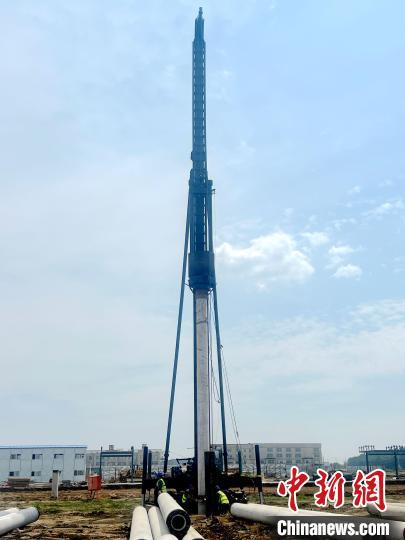
Group 1 - The core viewpoint of the article highlights the development of a wind power generator and related supporting industry demonstration project by Goldwind Technology in Xinmin City, Shenyang, which is expected to fill the gap in the wind power generator industry in Liaoning Province and support the establishment of a significant wind power equipment center in Northeast China [1][3] - The project is part of a broader initiative to build an energy supply base in the Shenyang metropolitan area, focusing on a complete industrial chain from renewable energy equipment manufacturing to wind and solar power generation, energy storage, and green low-carbon circular economy [3][4] - Additional projects include a 2.1 billion yuan investment in a new tower manufacturing base and gearbox production base by China Power Construction, which will produce 500 tower units and 750 gearboxes annually upon completion [3][4] Group 2 - Xinmin City is developing wind power projects in the wind-rich Hexi area, with three centralized wind power projects totaling 6 billion yuan and a total installed capacity of 600,000 kilowatts; one project has been completed, providing 410 million kilowatt-hours of green electricity annually [4][6] - The city is also advancing distributed photovoltaic projects, aiming for 1,757 distributed photovoltaic users and a grid-connected capacity of 122.7 megavolt-amperes by the end of 2024 [6][8] - A 1.01 billion yuan investment in a 100-megawatt new energy storage station project has been approved as a provincial demonstration project, while a 5 billion yuan biomass energy recycling project is set to consume 233,600 tons of crop straw annually, producing 19 million cubic meters of natural gas and reducing carbon dioxide emissions by 350,000 tons each year [8]



基本面改善与风格切换共振,重视布局机会
GOLDEN SUN SECURITIES· 2025-03-16 08:26
Investment Rating - The report maintains an "Overweight" rating for the electricity sector [4] Core Viewpoints - The electricity sector is experiencing fundamental improvements alongside a shift in market style, highlighting the importance of strategic positioning opportunities [10][16] - Coal prices have rapidly declined to around 692 CNY/ton, creating excess opportunities in thermal power generation [3][16] - The average coal price for the year to date (as of March 14) is 745 CNY/ton, down 174 CNY/ton compared to the same period last year [16] - The report emphasizes the significance of the recent cross-regional green electricity trading achievement, marking a milestone in the establishment of a unified national electricity market [16] - The National Development and Reform Commission is accelerating the construction of the electricity spot market, aiming to establish a comprehensive national electricity market system [16] Summary by Sections Industry Trends - The electricity sector index rose by 1.86%, outperforming the CSI 300 index by 0.27 percentage points [1][51] - The report notes a significant increase in inflow and outflow at the Three Gorges reservoir, with inflow up 54.55% and outflow up 12.94% year-on-year [16][31] Key Recommendations - Focus on undervalued thermal power stocks such as Huadian International, Anhui Energy, and Huaneng International, as well as leading thermal power renovation equipment manufacturers like Qingda Environmental Protection [3] - Emphasize investments in undervalued green electricity sectors, particularly in Hong Kong-listed green electricity and wind power operators [3] - Suggested stocks include New天绿色能源 (H), Longyuan Power (H), and China Nuclear Power [3] Market Performance - The report highlights that the electricity sector has adjusted significantly, suggesting a favorable environment for investment due to market style shifts and fundamental support [16] - The report provides a detailed analysis of stock performance, with specific recommendations for companies based on their earnings per share (EPS) and price-to-earnings (PE) ratios [7]