
Interest Rate Cut

Search documents
The Economy Looks Shaky. So, Why Is The Stock Market Surging?
Yahoo Finance· 2025-09-10 19:28
Economic Indicators vs. Stock Market Performance - There is a significant disconnect between economic indicators and stock market performance, with employment and inflation showing negative trends while financial markets, particularly the S&P 500, are reaching record highs [1][2][8] - The S&P 500 has increased by over 11% this year, contrasting with a downward revision of job growth estimates by the Bureau of Labor Statistics, which was the largest in the agency's history [2][3] Factors Influencing Stock Market Resilience - Poor job growth may lead the Federal Reserve to lower interest rates, which typically benefits stock prices by reducing borrowing costs [5] - The adoption of AI technology by companies could be contributing to job stagnation, which may positively impact shareholders of AI-related firms [6] - A weak U.S. dollar, which has depreciated by approximately 10% since January, is benefiting exporters and improving corporate earnings for S&P 500 companies [9][10] Impact of Tariffs and Economic Sentiment - Companies are finding ways to adapt to President Trump's tariffs, which has contributed to the stock market's performance despite negative economic signals [8] - Economists suggest that the weak dollar reflects a loss of confidence in the U.S. economy, yet it has simultaneously aided companies with significant international sales exposure [9][11]
Altseason Incoming? A 50 bps Interest Rate Cut is Now on Table
Yahoo Finance· 2025-09-10 19:20
With one week remaining until the Fed’s Federal Open Market Committee (FOMC) meeting on September 17, a 50 basis-point (bps) interest rate cut is now on the table, according to prediction markets. The repricing was fueled on September 10, following compounded data that increased the chances of a more aggressive cut, bringing crypto bulls back to the surface. In particular, the FedWatch tool by the CME Group shows a nearly 10% chance for a new target rate of 375-400 bps post-meeting. CME’s FedWatch is one ...
Wholesale inflation unexpectedly fell in August, teeing up Fed for interest rate cut next week
New York Post· 2025-09-10 16:03
Group 1: Wholesale Price Trends - The Producer Price Index (PPI) declined by 0.1% in August, contrary to expectations of a 0.3% increase, indicating that businesses are absorbing tariff costs [1][6] - Core PPI, excluding food and energy, also fell by 0.1% month-over-month, with a year-over-year increase of 2.8% [2] - Companies are reportedly holding off on price hikes due to factors such as foreign suppliers discounting, weak domestic demand, and uncertainty regarding future tariff rates [7] Group 2: Impact of Tariffs - Some imported goods, like tobacco and coffee, showed significant price increases, with tobacco rising by 2.3% in August and coffee prices increasing by 6.9%, marking a 33.3% rise over the past year [3] - Overall, wholesalers and retailers have been slow to pass tariff costs onto consumers, as they are aware of consumer inflation concerns [4] Group 3: Economic Indicators and Federal Reserve Response - Services prices dropped by 0.2% in August, contributing to the overall decline in the PPI, with trade services experiencing a 1.7% drop, the largest since 2009 [10] - The Federal Reserve is expected to cut interest rates, with traders placing 100% odds on a cut at the upcoming meeting, driven by tame inflation data [8][10] - The labor market shows signs of weakness, with average payroll growth at just 29,000 over the past three months, below the breakeven level needed to maintain steady unemployment [12]


Should You Buy Barrick Mining Stock After a 28% Rally in a Month?
ZACKS· 2025-09-10 15:15
Core Viewpoint - Barrick Mining Corporation's shares have increased by 27.6% in the past month, primarily due to rising gold prices amid geopolitical and trade uncertainties [1][6] Performance Comparison - Barrick has outperformed the Zacks Mining – Gold industry's increase of 14.3% and the S&P 500's rise of 2.5% in the same period [2] - Competitors such as Newmont Corporation, Kinross Gold Corporation, and Agnico Eagle Mines Limited have seen gains of 10.2%, 17%, and 12.7%, respectively [2] Technical Analysis - Barrick's stock has surpassed its 50-day simple moving average (SMA) and is trading above its 200-day SMA, indicating a long-term uptrend [3][4] Growth Projects - Key growth projects, including Goldrush, Pueblo Viejo plant expansion, Fourmile, Lumwana Super Pit, and Reko Diq, are on track to enhance production [9] - The Goldrush mine aims for 400,000 ounces of annual production by 2028, while the Fourmile project is expected to yield double the grades of Goldrush [10] - The Reko Diq project in Pakistan is projected to produce 460,000 tons of copper and 520,000 ounces of gold annually by the end of 2028 [10] Financial Position - Barrick maintains a strong liquidity position with cash and cash equivalents around $4.8 billion and operating cash flows of approximately $1.3 billion, up 15% year over year [12] - The company returned $1.2 billion to shareholders in 2024 through dividends and repurchases, with a new share repurchase program authorized for up to $1 billion [12] Gold Price Dynamics - Gold prices have surged 39% this year, driven by trade tensions, expectations of a Federal Reserve rate cut, and increased central bank purchases [14] - Current gold prices have exceeded $3,600 per ton for the first time, contributing to strong profit margins for Barrick [14] Dividend and Valuation - Barrick offers a dividend yield of 2.1% with a payout ratio of 25%, indicating sustainability [15] - The stock is trading at a forward price/earnings ratio of 12.84X, which is a 15.6% discount to the industry average [20] Production Outlook - Barrick expects attributable gold production of 3.15-3.5 million ounces for 2025, a decline from 3.91 million ounces in 2024, primarily due to the suspension of operations at the Loulo-Gounkoto mine [18] - Higher production costs, with cash costs per ounce increasing by 17% and all-in-sustaining costs (AISC) rising by 12% year over year, may impact margins [16][17] Earnings Estimates - Earnings estimates for Barrick have been revised upward, with a projected year-over-year rise of 56.4% for 2025 and 21.8% for 2026 [19] Investment Case - Barrick presents a strong investment case with a solid pipeline of growth projects, healthy financials, and rising gold prices, although high costs and a downbeat production outlook warrant caution [23]

X @Bloomberg
Bloomberg· 2025-09-10 13:48
Stocks rallied Wednesday morning after a cooler-than-expected producer inflation report fueled interest rate cut bets and strategists across Wall Street raised their outlooks on the US stock market https://t.co/ZjRceTpeW7 ...
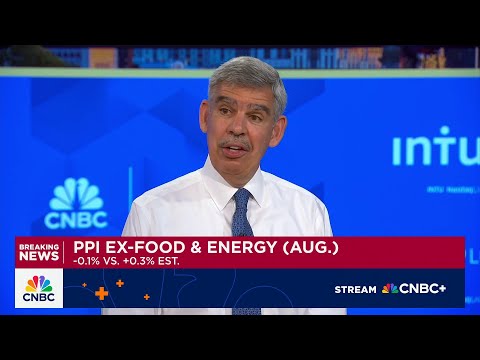
Companies can't pass through as much of the price increase as they want, says Mohamed El-Erian
CNBC Television· 2025-09-10 13:28
Economic Outlook & Consumer Behavior - Companies are struggling to pass price increases to consumers, especially those selling to lower-income demographics [2] - Consumers have absorbed price increases for the past five years since COVID, but are now resistant due to diminished cash reserves [3][4] - Lower-income consumers are depleting their cash balances and increasing debt, excluding mortgage debt [8][9][10] - There's concern that economic weakness among lower-income consumers could spread to other segments [11] Monetary Policy & Market Dynamics - The market is currently in a "bad news is good news" situation, but there's a risk of "bad news is bad news" scenario [6] - Risk-on assets (equities, credit spreads) and risk-off assets (gold, government bonds) are both performing well [6] - The employment side is much weaker than expected, while the latest inflation print is much better than expected [5] - A potential 50 basis point cut by the Federal Reserve should be considered, given the data [12] Productivity & Future Growth - Deregulation is needed to improve supply-side response [13] - Optimism exists regarding productivity gains in the coming years due to AI, life sciences, and robotics [13]
Cooler US producer inflation hints at softening demand
Yahoo Finance· 2025-09-10 12:45
Core Insights - U.S. producer prices unexpectedly fell in August, indicating that domestic firms may be absorbing some of the tariffs on imports [1][2] - The lack of strong producer price pressures suggests softening domestic demand amid a struggling labor market, leading to expectations of an interest rate cut by the Federal Reserve [2][3] Producer Price Index (PPI) Trends - The Producer Price Index for final demand decreased by 0.1% in August, following a downwardly revised increase of 0.7% in July, contrary to economists' expectations of a 0.3% rise [3][4] - A 0.2% drop in services prices contributed to the PPI decline, primarily due to a 1.7% decrease in margins for trade services [4] Retailer Pricing Strategies - Retailers appear to be absorbing tariff costs, as indicated by commentary from second-quarter earnings reports, although they may need to start selectively increasing prices in the future [5] - The cost of services excluding trade, transportation, and warehousing rose by 0.3%, while transportation and warehousing services prices increased by 0.9% [5] Goods Price Movements - Goods prices edged up by 0.1% after a 0.6% increase in the previous month, with food prices also gaining 0.1% [7] - Significant price increases were noted in wholesale beef (up 6.0% month-over-month and 21.1% year-over-year) and coffee (up 6.9% month-over-month and 33.3% year-over-year) [7]
Investors: Should You Be Worried About the Stock Market Right Now?
Yahoo Finance· 2025-09-10 00:00
Market Performance - The S&P 500 has increased by nearly 31% since April, while the Nasdaq Composite has risen by 43% during the same period [1] - Despite the market surge, approximately 43% of investors express pessimism about the next six months according to a survey by the American Association of Individual Investors [1] Economic Outlook - The Federal Reserve is anticipated to cut interest rates due to an uncertain labor market, raising concerns among Americans about future investment conditions [2] - There is uncertainty regarding the timing and severity of the next recession, with Goldman Sachs estimating a 30% probability of a recession occurring within the next 12 months, down from 45% in April [5] Historical Context - Recessions and market corrections are a normal part of the stock market cycle, with the average bear market lasting around 286 days and bull markets exceeding 1,000 days [7] - Historical data shows that the market has consistently recovered from all past recessions and downturns, achieving positive total returns over time [9]
Where Will Home Depot Be in 5 Years?
Yahoo Finance· 2025-09-09 11:00
Company Overview - Home Depot has a trailing 12-month revenue of $165 billion and holds a leading position in the home improvement industry with over 2,000 stores across the U.S. [1] Financial Performance - Home Depot's shares have generated a total return of 67% over the past five years, which is significantly lower than the S&P 500's performance [2] - The company experienced a sales surge of 19.9% in fiscal 2020 and 14.4% in fiscal 2021 due to the COVID-19 pandemic, but revenue growth has slowed, with fiscal 2024 revenue only 5.5% higher than three years prior [3] - For fiscal 2025, management anticipates same-store sales growth of only 1%, indicating a lack of excitement among investors [3] Market Conditions - Economic uncertainty is the primary reason for customers delaying renovation projects, as noted by CEO Ted Decker [4] - Elevated interest rates have led households to be more cautious about large projects that may require debt financing [5] Industry Outlook - The home improvement industry is estimated to be worth $1 trillion and is fragmented, providing Home Depot with a competitive advantage due to its brand recognition and product availability [6] - Home Depot plans to add 13 new stores in fiscal 2025, although expanding physical presence is not a key growth strategy [8] Future Prospects - A potential decline in interest rates could boost Home Depot's sales, and consistent profits have allowed the company to maintain dividend payments [7] - Despite current challenges, there is confidence that Home Depot's revenue will be higher in five years, although growth may not match historical trends [8]
