劳动者权益保障

Search documents
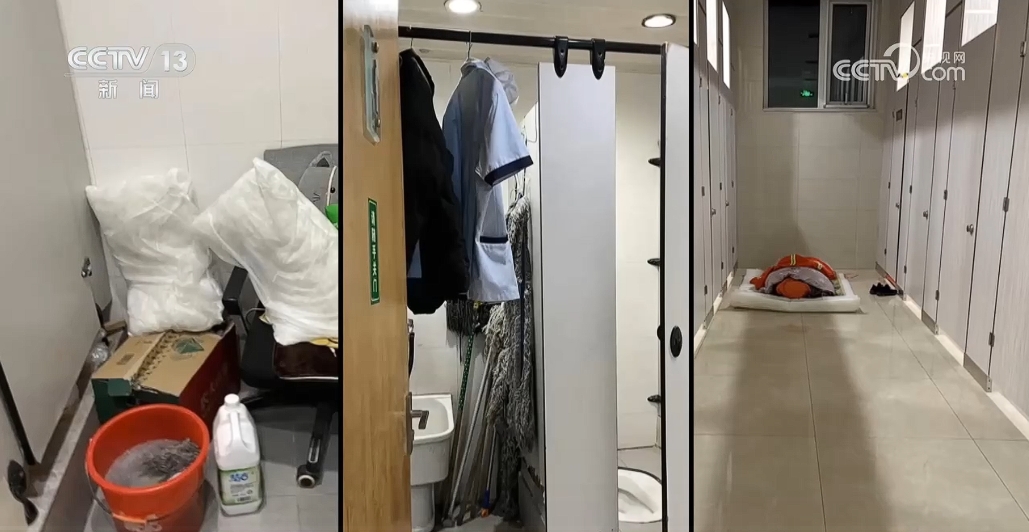
本周视点|保洁员的“休息室”如何落地
Yang Shi Wang· 2025-04-19 21:46
Core Viewpoint - The issue of inadequate rest facilities for cleaning staff has gained significant public attention, highlighting the need for better working conditions and respect for their rights [1][6][20]. Group 1: Public Awareness and Action - A recent photo shared online showing a cleaning staff member resting in a public restroom has sparked widespread discussion and prompted individuals to investigate similar situations in their workplaces [1][3]. - Many cleaning staff lack designated rest areas, often resorting to using storage spaces or restroom stalls for breaks, which has been documented by various individuals across different locations [1][3][5]. - The public discourse has led to tangible actions, such as students at a university advocating for the establishment of a dedicated rest area for cleaning staff, resulting in the creation of a facility equipped with necessary amenities [6][12]. Group 2: Government and Institutional Initiatives - In Shanghai's Minhang District, a dedicated rest area for cleaning staff has been established in public restrooms, measuring 15 square meters and equipped with essential facilities [8][10]. - Over 270 outdoor public toilets in Minhang have been retrofitted to include rest areas for cleaning staff, addressing their psychological and physiological needs [10][15]. - The initiative to create rest areas for cleaning staff is part of a broader movement supported by labor unions and local government, aiming to improve working conditions across various sectors [15][17]. Group 3: Legal and Social Considerations - The lack of designated rest areas for cleaning staff raises concerns regarding compliance with the Labor Law of the People's Republic of China, which mandates safe and hygienic working conditions [17][18]. - Many cleaning staff are employed under labor dispatch contracts, leading to weaker labor rights and protections, which complicates the establishment of rest areas [20][22]. - The ongoing discussions and initiatives reflect a growing recognition of the need for basic rights and dignified working conditions for cleaning staff, emphasizing the importance of social support systems [20][22].

为新就业形态劳动者夯实保障
Jing Ji Ri Bao· 2025-04-03 21:53
Core Viewpoint - The government emphasizes the need to strengthen the rights protection of flexible and new employment forms, particularly for workers in the gig economy, and to expand occupational injury insurance trials [1] Group 1: New Employment Forms - New employment forms refer to job types organized through internet platforms using technologies like big data and AI, enabling direct connections between workers and consumers [1] - The total number of new employment workers in the country has reached 84 million [1] Group 2: Challenges Faced by New Employment Workers - New employment workers face significant issues regarding rights protection and service support, including unclear labor relationships with platform companies, inadequate salary systems, and insufficient social security coverage [2] - These challenges negatively impact their sense of belonging, happiness, and work motivation [2] Group 3: Management and Legal Framework - Strengthening institutional frameworks and regulatory guidance is crucial for solidifying rights protection for new employment workers [3] - There is a need to improve legal regulations to clearly define labor relationships and enhance the recognition process for occupational injuries [3] - Increased regulatory oversight of platform companies is necessary to ensure compliance with labor laws and fair labor practices [3] Group 4: Service Improvement - Enhancing service capabilities and support levels for new employment workers is urgent, including improving job service quality and providing precise job matching services [4] - Establishing targeted vocational training programs to enhance workers' skills and employability is essential [4] - Expanding the occupational injury insurance pilot program and simplifying the enrollment process for flexible employment workers are critical steps [4] - Creating supportive service environments, such as worker rest areas, is important for providing basic amenities to new employment workers [4] - Establishing specialized legal aid mechanisms to assist workers in labor disputes is necessary for protecting their rights [4]
专访最高人民检察院民事检察厅厅长蓝向东
21世纪经济报道· 2025-03-04 06:51
Core Viewpoint - The article emphasizes the significant progress made by the civil prosecution system in China, particularly in protecting the rights of workers, especially those in flexible and new employment forms, as part of broader efforts to enhance social justice and legal supervision [1][4][5]. Group 1: Achievements in Labor Rights Protection - The civil prosecution system has focused on safeguarding the rights of workers, particularly in new employment forms, as a key area of judicial support for people's livelihoods [4][5]. - In 2024, nearly 5,400 cases related to labor disputes were handled by national prosecution agencies, with around 800 suggestions for retrial and protest submitted [6]. - The prosecution agencies supported over 82,000 civil support lawsuits, with more than 60,000 cases approved, including nearly 40,000 cases for migrant workers, accounting for 65.7% of the total [7]. Group 2: Enhancements in Re-examination Prosecution Suggestions - In 2024, over 7,600 re-examination prosecution suggestions were submitted, with a change rate of 91.6%, indicating a significant improvement in the effectiveness of these suggestions [10]. - The prosecution agencies have strengthened communication and collaboration with local courts to enhance the quality of judicial supervision [11]. Group 3: Addressing Execution Challenges - In 2024, over 60,000 civil execution supervision cases were accepted, with more than 50,000 prosecution suggestions made, achieving a court adoption rate exceeding 97% [19]. - The prosecution agencies are working on improving the supervision mechanisms for civil execution activities to ensure effective oversight [18]. Group 4: Combating False Litigation - The prosecution agencies have focused on key areas of false litigation, including loan disputes and labor disputes, and have supervised approximately 46,000 cases of false litigation from 2020 to 2024 [21]. - A collaborative defense system has been established among various legal entities to combat false litigation effectively [22].