医保支付方式改革

Search documents
医保支付方式改革进入关键期,如何兼顾创新医药技术使用
Nan Fang Du Shi Bao· 2025-04-22 11:38
"通过目前改革扩面的形势看,整体上改革效果日益显现,但是还存在着一些不均衡问题,比如说宏观 层面的医疗费用增速还是比较快的。"国家医保局医药服务管理司副司长徐娜说。该发言出现在近期举 行的2025年医保支付方式改革蓝皮书发布会暨趋势交流会上。 徐娜给出的数据显示,2024年全国医疗总费用增长率为11.2%,但医保基金收入增幅仅是4.36%。"这种 收支增速的矛盾也对我们基金整体保安全和保运转造成了一定的压力。"她说。 2025年医保支付方式改革蓝皮书。 通过支付方式改革,收支形势明显好转 作为最大的支付方,由医保系统发起和推动的一系列改革正在重塑医疗行业。这其中的支付方式改革, 旨在保障参保人权益、规范医疗服务行为、引导医疗资源合理配置、控制医疗费用不合理增长,进而引 导医疗机构从规模扩张转向内涵式发展。当前正值改革关键期,改革效果与矛盾相继显现。 据介绍,当前基本实现了按病种付费全覆盖,病种覆盖率达到95%,医保基金支付覆盖率达到了80%。 去年发布的2.0分组方案,已经平稳落地,2025年将全面启动,进入实质付费阶段。徐娜还提到,去年 特别优化的特例单议、预付金、意见收集、谈判协商和数据工作组等配套机制也 ...


蓝皮书:医保支付方式改革基本覆盖所有统筹地区
Xin Jing Bao· 2025-04-18 10:13
Core Insights - The report highlights the progress and effectiveness of China's medical insurance payment reform, emphasizing the establishment of a multi-faceted payment system primarily based on disease-specific payments [1][2] - The reform has led to a reduction in patients' out-of-pocket expenses and improved the efficiency of medical insurance fund usage, benefiting both medical institutions and patients [1][2] Group 1: Reform Progress - As of now, 191 out of 393 regions have implemented Disease-Related Group (DRG) payment, and 200 regions have adopted Disease Indicator Point (DIP) payment, achieving a coverage rate of 95% for disease types and 80% for insurance funds [2] - The payment reform has resulted in a balanced operation of medical insurance funds, improved internal revenue structures for medical institutions, and reduced economic burdens for patients [2] Group 2: Future Outlook and Challenges - The report outlines ongoing challenges in the reform process, including imbalances in insurance funding, benefit guarantees, and medical costs, as well as increased regulatory difficulties [2] - Continuous improvement and exploration in theory, policy, technology, and methods are necessary to enhance the quality of disease-specific payment implementation and promote coordinated development in the medical, insurance, and patient sectors [2]
四川完善日间手术医保支付管理 纳入医保的日间手术费用按住院待遇结算
Si Chuan Ri Bao· 2025-04-14 07:07
日间手术是指患者按照诊疗计划在1日(24小时)内入、出院完成的手术或操作(不包括门诊手 术),因病情需要延期住院的特殊病例,住院时间不超过48小时。通知明确,纳入基本医疗保险的日间 手术费用按住院待遇结算,包括日间手术住院期间医疗费用和住院前的门诊医疗费用。其中,门诊医疗 费用是指在同一定点医院发生的与本次日间手术直接相关的术前7个工作日门诊检查和检验费用。门诊 检查后经医师评估发现无手术指征,不适宜手术治疗或因各种原因未进行手术的,其门诊医疗费用不纳 入当次住院支付范围,按门诊医保待遇结算。实行日间手术后,因各种原因退出日间手术转入住院管理 的,其符合上述规定的日间手术费用与住院费用一并按住院待遇结算。 此次省医保局完善的日间手术医保支付管理政策,适用于全省城镇职工医疗保险、城乡居民医疗保 险参保人员。省医保局要求各定点医疗机构按照《医疗机构日间医疗质量管理暂行规定》的要求,优化 术前检查和日间手术门诊服务(预住院)流程,做好患者入院前后衔接,减少不必要的检查和检验,在 有效时间内安排患者住院进行手术治疗。(记者 刘春华) 4月13日,记者从省医保局获悉,为进一步深化医保支付方式改革,提高医疗服务效率,该局 ...
康缘药业2024年业绩承压背后:两大核心品种销量下滑、新并表亏损子公司
Bei Jing Shang Bao· 2025-04-07 11:27
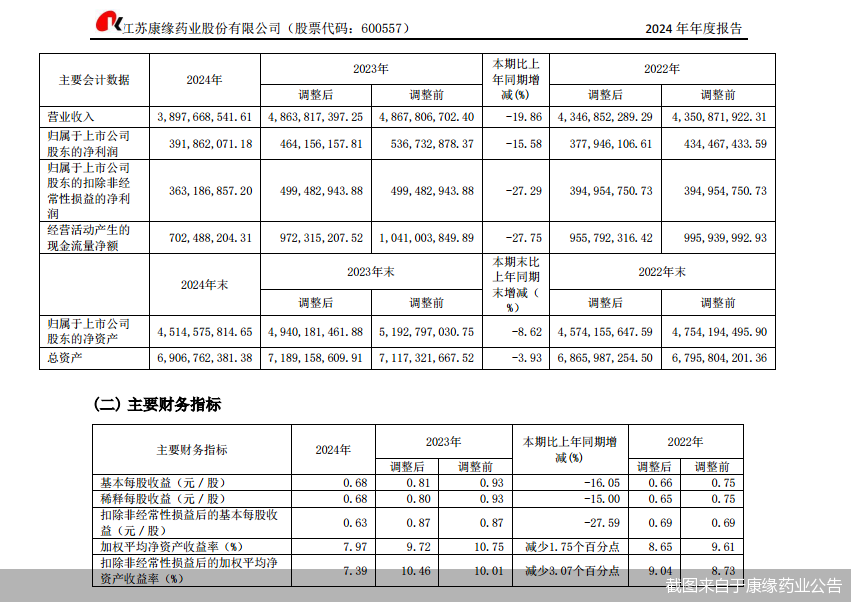
Core Viewpoint - In 2024, Kangyuan Pharmaceutical (600557) reported a decline in both revenue and net profit, primarily due to the underperformance of its core products, namely Rendu Ning Injection and Ginkgo Biloba Terpene Lactone Injection [1][5][8] Financial Performance - The company's revenue for 2024 was approximately 3.90 billion yuan, a year-on-year decrease of 19.86% [2][5] - The net profit attributable to shareholders was about 391.86 million yuan, down 15.58% from the previous year [2][5] - Quarterly revenue and net profit showed a downward trend throughout 2024, with Q4 revenue declining by 42.38% and net profit by 69.71% year-on-year [5][6] Product Performance - The main revenue source, injections, generated approximately 1.34 billion yuan in 2024, a decrease of 38.33% year-on-year, largely due to falling sales of Rendu Ning Injection and Ginkgo Biloba Terpene Lactone Injection [8][9] - Rendu Ning Injection's production decreased by 10.24%, with sales down 30.98%, leading to a significant increase in inventory [8][9] - Ginkgo Biloba Terpene Lactone Injection saw a production drop of 33.9% and a sales decline of 47.86% [8][9] Strategic Initiatives - In response to declining sales, the company is expanding its product lineup with new offerings such as Jinzhen Oral Liquid and Xingbei Cough Granules [1][9] - The company completed the acquisition of Jiangsu Zhongxin Pharmaceutical Co., Ltd. in 2024, although this acquisition has not yet turned profitable and is expected to impact short-term performance [1][10][11] Industry Context - The pharmaceutical manufacturing industry is facing external pressures such as healthcare payment reforms, drug price governance, and centralized procurement, leading to a decline in profit margins [6][9] - The company plans to forgo cash dividends for 2024, instead opting for a share buyback strategy, which is viewed as a form of returning value to shareholders [6][10]