
新时代党的治疆方略

Search documents
一面旗,一盘棋,一家亲
Ren Min Ri Bao· 2025-09-26 02:46
Core Insights - The article highlights the significant transformation of Xinjiang over the past 70 years, showcasing its economic growth and development achievements, including a rise in per capita grain consumption and GDP growth from 1.231 billion yuan in 1955 to over 2 trillion yuan in 2024 [1] - It emphasizes the importance of unity and collaboration among various ethnic groups in Xinjiang, reflecting a broader narrative of national rejuvenation and development [5] Economic Development - Xinjiang's grain yield has become the highest in the country, with per capita grain consumption increasing to over 200 kilograms [1] - The region's import and export value is projected to surpass 400 billion yuan in 2024, marking a significant increase from 200 billion yuan in 2022 and 300 billion yuan in 2023 [2] - The establishment of a green protective belt around the second-largest moving desert has contributed to ecological stability and agricultural productivity [2] Technological Innovation - Xinjiang is advancing in energy technology, with the first "Shagehuang" renewable energy base commencing operations and leading in solar energy technology [3] - The region is also making strides in oil extraction, with the Tarim Oilfield achieving a record for deep drilling in Asia [3] Social Development - The article discusses the successful implementation of poverty alleviation and rural revitalization policies, leading to the emergence of new industries such as aquaculture in various counties [2] - It highlights the role of educational and medical support in enhancing local communities, with professionals from other regions contributing to development efforts in Xinjiang [4][5] National Strategy - The article underscores the strategic positioning of Xinjiang as a core area and hub for national development, moving from a remote region to a pivotal economic zone [2] - It stresses the importance of the Party's policies in promoting ethnic unity and regional stability, which are essential for Xinjiang's high-quality development [5]
国际锐评丨70年沧桑巨变,新疆这样走出现代化之路
Yang Shi Xin Wen Ke Hu Duan· 2025-09-26 01:54
Core Viewpoint - The 70th anniversary celebration of the Xinjiang Uyghur Autonomous Region highlights significant historical achievements and showcases the effectiveness of China's ethnic regional autonomy system and governance strategies under the Communist Party's leadership [1][4]. Economic Development - Xinjiang's GDP is projected to exceed 2 trillion RMB in 2024, marking an increase of over 1600 times from 12.31 million RMB in 1955 [3]. - By the end of 2020, all rural poverty in Xinjiang was eradicated, contributing to the nationwide goal of building a moderately prosperous society [3]. - Urban and rural residents' income has increased over a hundredfold since 1978, and life expectancy has risen from 30 years at the beginning of liberation to 77 years in 2024 [3]. Infrastructure and Connectivity - Xinjiang has become the province with the most airports in China, and the total length of highways has reached 230,000 kilometers, with all cities and prefectures connected by expressways [6]. - The Tianshan Victory Tunnel, the world's longest highway tunnel, is set to be fully operational by the end of 2024 [6]. Trade and Global Integration - From 2022 to 2024, Xinjiang's import and export value increased significantly, with trade relations established with over 220 countries and regions [7]. - The efficient operation of the China-Europe Railway Express and the development of cross-border e-commerce are enhancing Xinjiang's role as a bridge for trade between China and Eurasia [7]. Future Development - The region aims to pursue high-quality development by leveraging its unique advantages, promoting new productive forces, and enhancing cultural and ecological integration [7]. - A recent global survey indicated that 63.8% of respondents expressed confidence in Xinjiang's future development [7].

(砥砺奋进七十载 天山南北谱华章)中央代表团赴新疆多地看望慰问各族干部群众 王沪宁参加活动
Zhong Guo Xin Wen Wang· 2025-09-26 01:25
Group 1 - The central delegation visited various regions in Xinjiang to convey the care of the central government and emphasize the importance of social stability and long-term peace in the region [1][2] - The delegation highlighted the need to enhance education, particularly in basic education and the promotion of the national common language, to foster a sense of national identity among the youth [1] - The delegation also focused on improving healthcare services and promoting rural revitalization to increase the income and well-being of local communities [1] Group 2 - The delegation explored the development of the China (Xinjiang) Free Trade Zone in Kashgar, assessing its planning, construction, and operational status [2] - The delegation examined urban development in Urumqi, including education, grassroots governance, and religious affairs management [2] - The delegation visited various enterprises and educational institutions to understand the local industrial development and educational initiatives [2]
中共中央 全国人大常委会 国务院 全国政协 中央军委关于庆祝新疆维吾尔自治区成立七十周年的贺电
Xin Hua She· 2025-09-26 00:46
Core Points - The 70th anniversary of the Xinjiang Uyghur Autonomous Region is celebrated, highlighting the region's historical significance and its integration into China [1][2] - The achievements in Xinjiang over the past 70 years are attributed to the leadership of the Communist Party and the collective efforts of various ethnic groups [3][4] - The central government emphasizes the importance of social stability and long-term peace in Xinjiang, which has seen significant improvements in infrastructure and living standards [2][3] Summary by Sections Historical Context - Xinjiang has been an inseparable part of China since ancient times, with its establishment as an autonomous region in 1955 marking a significant milestone in national unity [1] - The region has undergone transformative changes under the leadership of the Communist Party, leading to a prosperous and united society [3] Achievements and Developments - Since the 18th National Congress, the central government has prioritized Xinjiang's development, resulting in historical achievements in poverty alleviation and social stability [2] - Infrastructure development and social progress have significantly enhanced the quality of life for residents, increasing their sense of security and happiness [2][3] Future Directions - The focus for the future includes maintaining social stability, promoting high-quality development, and strengthening the sense of community among various ethnic groups [4] - The military and law enforcement are recognized as crucial forces in maintaining national unity and stability in the region [4][5]
砥砺奋进七十载 天山南北谱华丨奋力谱写豫新合作新篇章
He Nan Ri Bao· 2025-09-25 23:55
Group 1 - The 70th anniversary of the Xinjiang Uyghur Autonomous Region was celebrated, highlighting the historical achievements and transformations in the region over the past seven decades [1] - The central government, under Xi Jinping's leadership, has established a new strategy for governing Xinjiang, which has led to significant progress and changes in various sectors [1] - The achievements in Xinjiang are attributed to the strong leadership of the central government and the collective efforts of the local population, showcasing the advantages of the socialist system and the effectiveness of China's approach to ethnic issues [1] Group 2 - The cooperation between Henan and Xinjiang is framed as a national strategy, focusing on enhancing the sense of a shared Chinese national identity and ensuring high-quality development in aid efforts [2] - Various collaborative initiatives have been established, including energy projects, healthcare support, and cultural exchanges, benefiting over a million people from both regions [2] - The partnership aims to strengthen ties and foster mutual understanding between the people of Henan and Xinjiang, reinforcing the concept of a unified Chinese community [2] Group 3 - Xinjiang's role in the new development framework is becoming increasingly prominent, with the region being positioned as a frontier for openness and cooperation [3] - The collaboration between Henan and Xinjiang is set to expand across multiple sectors, including energy, logistics, and cultural initiatives, leveraging the strengths of both regions [3] - The ongoing efforts aim to create new models of cooperation and enhance the overall development of the aid initiatives, contributing to a deeper integration of the two regions [3]
自治区成立七十周年,实现前所未有发展,大美新疆正拥抱历史最好时期
Huan Qiu Shi Bao· 2025-09-25 23:36
Core Points - The 70th anniversary of the Xinjiang Uyghur Autonomous Region was celebrated with significant emphasis on unity, development, and modernization under the leadership of Xi Jinping [2][3][4] - The Central Government's strategy for Xinjiang is highlighted as a crucial part of China's long-term development and stability goals, focusing on social stability and the construction of a harmonious society [2][6][9] Group 1: Celebration and Leadership - Xi Jinping's attendance at the anniversary celebration marks a historic first for a leader of the Central Government, indicating the importance of Xinjiang in national strategy [2][4] - The celebration included speeches emphasizing the achievements of the region under the leadership of the Communist Party, showcasing the unity among various ethnic groups [4][5] Group 2: Economic Development - Xinjiang's GDP has dramatically increased from 1.23 billion RMB in 1955 to over 2 trillion RMB in 2024, reflecting significant economic growth [7][8] - The region has become a vital agricultural area and a major energy supplier, with over 70% of fiscal spending directed towards improving people's livelihoods [8][9] Group 3: Strategic Importance - Xinjiang is positioned as a key hub in the Silk Road Economic Belt, enhancing its role in national and international trade [7][9] - The region's development is seen as a model for multi-ethnic governance and a contributor to global governance, with its strategic positioning expected to grow in importance [9]
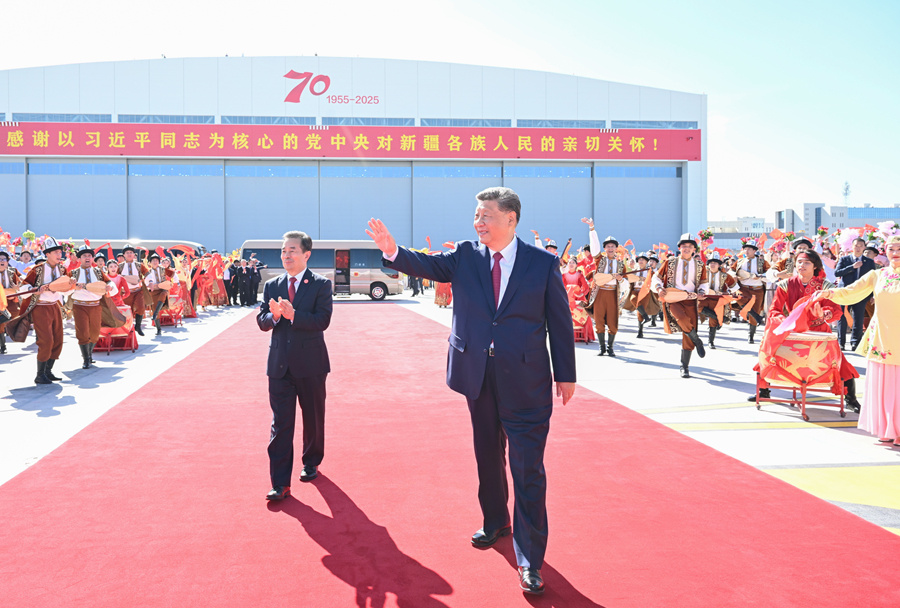
新疆维吾尔自治区成立70周年庆祝大会隆重举行 中共中央全国人大常委会国务院全国政协中央军委致电祝贺 习近平出席大会 王沪宁出席并讲话 蔡奇出席
Zheng Quan Shi Bao· 2025-09-25 22:16
Core Points - The 70th anniversary celebration of the Xinjiang Uyghur Autonomous Region was held, highlighting the achievements and progress made under the leadership of the Communist Party of China [1][2] - Key leaders, including Xi Jinping and Wang Huning, emphasized the importance of unity among ethnic groups and the historical successes achieved in poverty alleviation and modernization [2][3] Group 1 - The establishment of the Xinjiang Uyghur Autonomous Region 70 years ago was marked by the care of the Party and its ethnic policies, leading to significant victories in socialist revolution and reform [2] - The leadership of the Communist Party has been pivotal in achieving historical accomplishments in Xinjiang, including the successful fight against poverty and the establishment of a moderately prosperous society [2][3] - The celebration showcased the strong sense of community among various ethnic groups, symbolized by the metaphor of people being like pomegranate seeds tightly held together [2] Group 2 - The modern development of Xinjiang is positioned at a new historical starting point, guided by Xi Jinping's thoughts and the spirit of the Party's recent congresses [3] - The focus will be on implementing the Party's strategies for Xinjiang, enhancing regional autonomy, and fostering a strong sense of the Chinese national community [3] - Various representatives, including ethnic leaders and government officials, participated in the celebration, reflecting the inclusive approach to governance in the region [3]
绘写天山南北壮美画卷(今日谈)
Ren Min Ri Bao· 2025-09-25 22:12
Core Points - The article highlights the significant achievements of Xinjiang over the past 70 years, emphasizing its role in the historical process of the great rejuvenation of the Chinese nation [1] - Xinjiang has transitioned into a crucial area for national development, serving as a bridge for westward openness and a core region of the Silk Road Economic Belt [1] - The unity and collective effort of over 26 million people from various ethnic groups in Xinjiang are underscored as key to the region's progress and future [1] Development Achievements - Xinjiang has experienced its best development period in history since the new era, marked by high-quality growth initiatives such as "Electricity Export from Xinjiang" and "Data Transfer to Chongqing" [1] - The region's strategic location in northwest China has been pivotal in its transformation from an inland area to an open frontier [1] Ethnic Unity and Social Cohesion - The article emphasizes the importance of ethnic unity, comparing it to the interconnectedness of the roots of a poplar tree and the seeds of a pomegranate, symbolizing solidarity among the diverse populations [1] - The narrative reinforces the belief that a united China, with its various ethnic groups working together, is destined for success and a bright future [1]
关于庆祝新疆维吾尔自治区成立70周年的贺电
Ren Min Ri Bao· 2025-09-25 22:12
Core Points - The 70th anniversary of the Xinjiang Uyghur Autonomous Region is celebrated, highlighting the region's integration into China and the unity of its diverse ethnic groups [1] - The central government emphasizes the historical achievements and progress made in Xinjiang under the leadership of the Communist Party, including social stability and economic development [2][3] - The importance of maintaining social stability and promoting high-quality development in Xinjiang is reiterated, with a focus on the implementation of national policies and the enhancement of ethnic unity [2][4] Summary by Sections Historical Context - Xinjiang has been an inseparable part of China, with its establishment as an autonomous region in 1955 marking a significant milestone in national unity and development [1] - The region has undergone transformative changes over the past 70 years, attributed to the leadership of the Communist Party and the successful practice of the ethnic regional autonomy system [3] Achievements and Developments - Since the 18th National Congress, the central government has prioritized Xinjiang's development, leading to historic achievements in poverty alleviation and social stability [2] - Infrastructure improvements and social progress have significantly enhanced the living standards of the people in Xinjiang, increasing their sense of security and happiness [2] Future Directions - The focus for the future includes strengthening the sense of community among ethnic groups, promoting cultural integration, and ensuring sustainable development in Xinjiang [4] - The military and law enforcement agencies are recognized as crucial forces in maintaining national unity and stability in the region [4]
一面旗,一盘棋,一家亲(评论员观察)
Ren Min Ri Bao· 2025-09-25 22:12
Core Viewpoint - The development of Xinjiang is highlighted as a significant part of China's modernization efforts, showcasing historical progress and future potential through unity and strategic planning [1][2][3]. Group 1: Economic Development - Xinjiang's GDP is projected to exceed 2 trillion yuan by 2024, marking a significant increase from 12.31 billion yuan in 1955 [1]. - The region's import and export values are set to rise from 200 billion yuan in 2022 to 400 billion yuan in 2024, indicating robust economic growth [3]. - The establishment of the world's first ±1100 kV ultra-high voltage direct current transmission project enhances Xinjiang's role in energy distribution [2]. Group 2: Agricultural and Technological Advancements - Grain production per capita has increased significantly, with Xinjiang achieving the highest grain yield in the country [1]. - The region is witnessing a transformation in agriculture, with new industries emerging, such as the cultivation of rainbow trout and Australian freshwater shrimp [2]. - Technological innovations in energy, including the first "Shagehuang" renewable energy base and advancements in solar and wind energy technologies, are positioning Xinjiang as a leader in energy resources [3]. Group 3: Social and Cultural Unity - The narrative emphasizes the importance of ethnic unity and collaboration among various groups in Xinjiang, likening the people to pomegranate seeds tightly bound together [4][5]. - The support from various regions, including educational and medical assistance, is crucial for fostering development and stability in Xinjiang [5]. - The commitment to the Party's policies and the promotion of national unity are seen as essential for the region's long-term success [5].