
正风肃纪反腐

Search documents
唐仁健忏悔:真不要侥幸,现在悔之晚矣!
券商中国· 2026-01-11 02:12
党的作风就是党的形象,关系人心向背,关系党的生死存亡。风腐交织是现阶段党风廉政建设和反腐败斗争要 着力解决的突出问题。要坚持正风肃纪反腐相贯通,深入推进风腐同查同治,以"同查"严惩风腐交织问题, 以"同治"铲除风腐共性根源,以"查""治"贯通阻断风腐演变。 电视专题片《一步不停歇 半步不退让》第一集《纠风治乱为民》,讲述纪检监察机关不断加大风腐同查同治 力度,锲而不舍落实中央八项规定精神,严肃查处违规吃喝背后的团团伙伙、请托办事和利益输送,集中整治 群众身边不正之风和腐败问题,让群众真切感到正风反腐加力度、清风正气在身边。总台央视综合频道1月11 日晚8点档播出,央视新闻新媒体平台同步播发。 不正之风是滋生腐败的温床。有的干部就是在作风问题上失守,逐渐走上腐化堕落的道路。 其中,专题片将披露农业农村部原党组书记、部长唐仁健案。 唐仁健(农业农村部原党组书记、部长):纪律和规矩,要真当回事,真不要侥幸,但现在都是成为悔之晚矣 的事情。 中央纪委国家监委第八监督检查室副主任周典:唐仁健案的行贿人主要来自于唐仁健的日常吃喝玩乐圈,(唐 仁健的问题)也是腐败问题和作风问题相伴相生、相互传染的恶性循环。 来源:央视新闻 ...

严查群众身边“蝇贪蚁腐”
Xin Lang Cai Jing· 2026-01-06 22:38
Core Viewpoint - The article emphasizes the importance of addressing corruption and improper conduct at the grassroots level, highlighting the commitment of local governments to enhance accountability and integrity in public service [1] Group 1: Anti-Corruption Efforts - Since 2025, the provincial authorities have focused on rectifying prominent issues reported by the public, extending anti-corruption efforts to grassroots levels [1] - The provincial disciplinary inspection and supervision agencies have targeted specific areas such as "campus meals," rural collective "three funds," and the supervision of rural revitalization fund usage [1] - A total of 21,943 individuals were investigated and prosecuted for corruption-related offenses from January to November 2025, with 980 individuals detained and 15,171 receiving party disciplinary and administrative penalties [1] Group 2: High-Profile Cases - Several high-ranking officials, including county party secretaries and mayors, have been severely punished, creating a strong deterrent effect against corruption [1] - Notable cases include the former county party secretaries of Xifeng, Shibing, Longli, and Dushan, who were all held accountable for their actions [1]
水利部党组召开会议,坚决拥护党中央对田学斌进行纪律审查和监察调查的决定
Xin Lang Cai Jing· 2026-01-05 14:33
Group 1 - The Ministry of Water Resources is undergoing a disciplinary review and investigation regarding serious violations of discipline and law by Tian Xuebin, highlighting the central government's commitment to strict governance and anti-corruption efforts [1] - The meeting emphasized the importance of political loyalty and adherence to the core values of the Communist Party, urging all party members to align their thoughts and actions with the central government's directives [2] - The meeting called for a continuous and deep advancement of strict party governance, maintaining a high-pressure stance against corruption, and ensuring a clean political environment to support high-quality development in the water resources sector [3] Group 2 - The meeting stressed the need for a clear understanding of political responsibilities and the importance of self-discipline among party members, advocating for a culture of integrity and accountability [2][3] - It was highlighted that the mechanisms for addressing corruption should be integrated and persistent, with a focus on both prevention and punishment to maintain a robust anti-corruption framework [3] - The Ministry aims to contribute significantly to the realization of socialist modernization through effective governance and management in the water resources sector [3]
奋进开局之年丨以实干笃行书写时代答卷
Zhong Yang Ji Wei Guo Jia Jian Wei Wang Zhan· 2026-01-04 01:09
Group 1 - The core message emphasizes the importance of high-quality development and the need for effective supervision to ensure the implementation of the Party's decisions [1] - The focus on enhancing the effectiveness of supervision and problem rectification is highlighted as a key responsibility in the new year [1] - The commitment to maintaining political integrity and accountability in various sectors, including rural governance and transportation, is reiterated by multiple officials [2][3][4] Group 2 - The emphasis on the political nature of case handling and the importance of maintaining high standards in case quality is noted [5] - The ongoing efforts to standardize and legalize the supervision process are underscored, with a focus on continuous improvement and responsibility [6] - The commitment to advancing the goals of the "three transformations" in supervision and law enforcement is expressed, indicating a proactive approach to governance [6]
又一国有大行浙江省分行原行长落马
第一财经· 2025-12-31 13:18
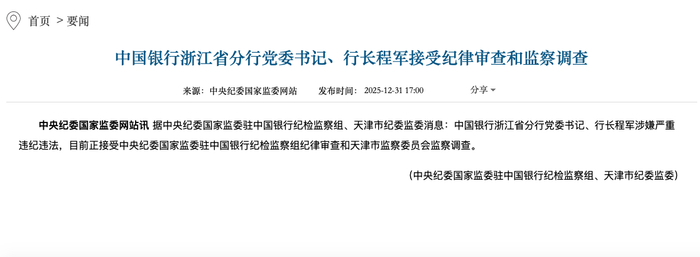
Core Viewpoint - The article discusses the ongoing anti-corruption efforts within China's financial sector, highlighting the recent investigation of Cheng Jun, the president of Bank of China Zhejiang Branch, for serious violations of discipline and law, marking a significant trend in the scrutiny of high-ranking officials in state-owned banks [3][4]. Group 1: Investigations and Trends - Cheng Jun is the 211th central-level official investigated in 2025, a decrease from 257 in 2024, indicating a tightening of scrutiny on high-ranking officials [3]. - Cheng is the fifth former president of a state-owned bank's Zhejiang branch to be investigated in recent years, following several others who faced similar allegations of serious violations [4]. - In 2025, a total of 65 central management officials were investigated, surpassing the 58 from the previous year, while 722 provincial management officials were also scrutinized [5]. Group 2: Broader Anti-Corruption Efforts - The 20th Central Commission for Discipline Inspection's fourth plenary session emphasized the importance of deepening anti-corruption efforts in 2025, which is seen as a crucial year for the completion of the 14th Five-Year Plan [5]. - In 2024, disciplinary bodies across the country investigated 73 provincial-level and above officials, 4,348 bureau-level officials, 35,000 county-level officials, and 121,000 township-level officials, reflecting a comprehensive approach to tackling corruption [5].




又一国有大行浙江省分行行长落马
第一财经网· 2025-12-31 13:14
Core Insights - In 2025, a total of 65 central management cadres were investigated, an increase from 58 in the previous year, indicating a continued focus on anti-corruption efforts [4] - The investigation of Cheng Jun, the Party Secretary and President of the Bank of China Zhejiang Branch, marks him as the 211th central-level cadre under investigation in 2025 [1] - The trend shows a decrease in the number of investigations of central-level cadres from 257 in 2024 to 211 in 2025, reflecting a tightening of scrutiny [1] Group 1 - Cheng Jun is the fifth former president of a state-owned bank's Zhejiang branch to be investigated in the past year, following several high-profile cases [3] - Other notable figures investigated include former senior experts and deputy directors from financial regulatory bodies, highlighting a broader crackdown on financial misconduct [4] - The Central Commission for Discipline Inspection emphasized the importance of deepening anti-corruption efforts as part of the "14th Five-Year Plan" [4] Group 2 - In 2024, national disciplinary inspection agencies reported investigations involving 73 provincial-level and above cadres, 4,348 departmental-level cadres, and 35,000 county-level cadres [4] - The disciplinary actions taken included 73 provincial-level and above cadres, and 38,38 departmental-level cadres were punished, indicating a robust enforcement of regulations [4] - The ongoing efforts aim to provide strong support for the modernization of China through strict governance [4]
又一国有大行浙江省分行原行长落马
Di Yi Cai Jing· 2025-12-31 13:13
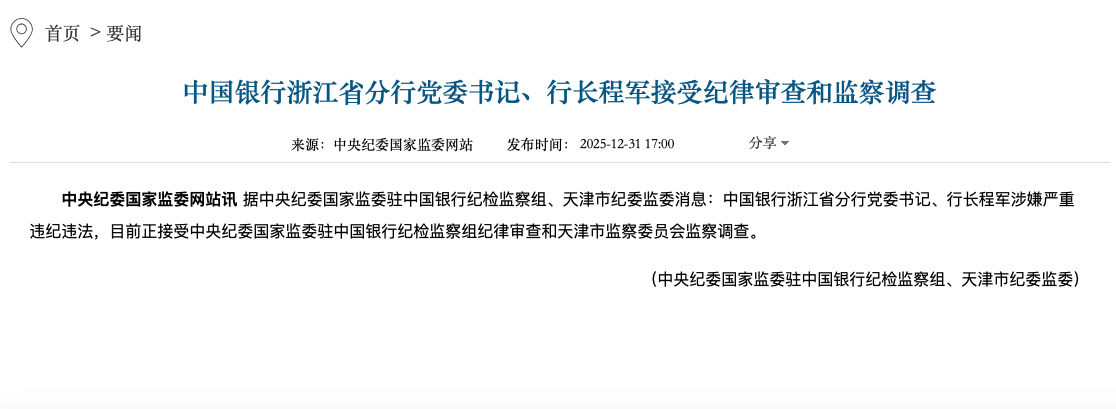
Core Insights - In 2025, a total of 65 central management cadres were investigated, an increase from 58 in the previous year, indicating a continued focus on anti-corruption efforts [2][4] - The investigation of Cheng Jun, the Party Secretary and President of Bank of China Zhejiang Branch, marks him as the 211th central-level cadre under investigation in 2025 [1][2] - The trend shows a decrease in the number of investigations of central-level cadres compared to 2024, where 257 were investigated, reflecting a potential shift in enforcement focus [1][2] Group 1 - Cheng Jun is the fifth former president of a state-owned bank's Zhejiang branch to be investigated in the past year, highlighting ongoing scrutiny in this sector [3] - Other notable figures investigated include former leaders from China Construction Bank, Agricultural Bank of China, and Industrial and Commercial Bank of China, all for "serious violations of discipline and law" [3] - The Central Commission for Discipline Inspection emphasized the need for high-quality development in disciplinary inspection and supervision work to support the modernization of China [2][3] Group 2 - In 2024, national disciplinary inspection agencies filed cases against 73 provincial-level and above cadres, 4,348 departmental-level cadres, 35,000 county-level cadres, and 121,000 township-level cadres [4] - Disciplinary actions taken included 73 provincial-level and above cadres, 3,838 departmental-level cadres, 31,000 county-level cadres, and 112,000 township-level cadres [4]
节前敲警钟:吉安市通报4起党员干部、公职人员酒驾典型问题
Xin Lang Cai Jing· 2025-12-30 00:53
Core Viewpoint - The article highlights the serious issue of drunk driving among party members and public officials in Ji'an City, emphasizing the need for strict adherence to regulations and the consequences of violating them [4]. Group 1: Specific Cases of Drunk Driving - Case 1: He Guohua, a judge, was caught drunk driving with a blood alcohol content of 36mg/100ml, resulting in a 6-month license suspension and a fine of 1500 yuan [1]. - Case 2: Chen Genping, an agricultural official, was found driving an electric scooter with a blood alcohol content of 72mg/100ml, leading to a 2000 yuan fine [2]. - Case 3: Lai Kefeng, a village party secretary, had a blood alcohol content of 78mg/100ml while driving, receiving a 6-month license suspension and a 1500 yuan fine [3]. - Case 4: Kang Shuisheng, a former village deputy secretary, was caught with a blood alcohol content of 55mg/100ml, facing a 6-month license suspension and a 1500 yuan fine [3]. Group 2: Implications and Recommendations - The reported cases reflect a lack of respect for discipline and law among some party members and public officials, highlighting the need for increased awareness of the political and social consequences of drunk driving [4]. - The article calls for all party members and public officials to learn from these cases and maintain a strong awareness of regulations, emphasizing the importance of upholding the spirit of the central eight regulations [4]. - It stresses the responsibility of party organizations to enforce strict management and supervision of officials, particularly regarding their behavior outside of work hours, to prevent minor issues from escalating into major problems [5].
持之以恒抓好自身建设
Zhong Yang Ji Wei Guo Jia Jian Wei Wang Zhan· 2025-12-25 01:04
Core Viewpoint - The 20th Central Committee's Fourth Plenary Session emphasizes that effective party governance strengthens economic and social development, highlighting the importance of the discipline inspection and supervision organs in maintaining the party's advanced nature and purity [1] Group 1: Strengthening Political Loyalty - The discipline inspection and supervision team must prioritize loyalty to the party as a fundamental political quality, enhancing political consciousness and action to support the "two establishments" and "two safeguards" [2] - Continuous theoretical education is essential, utilizing various platforms to deepen understanding of Xi Jinping's thoughts on socialism with Chinese characteristics for a new era [2] - Regular political assessments and adherence to party discipline are crucial for maintaining the integrity of ideals and beliefs [2] Group 2: Enhancing Professional Competence - New challenges require discipline inspection personnel to improve their professional skills, focusing on practical training and capability building to support the anti-corruption fight [3] - A comprehensive training system for legal and disciplinary knowledge is necessary, alongside the integration of digital technology in supervision and case handling [3] - Talent development should focus on a balanced age and knowledge structure, ensuring a robust pipeline of capable personnel [3] Group 3: Upholding Strict Work Ethos - A strong work ethic is vital for the discipline inspection organs, which must confront major political principles and combat corruption decisively [4][5] - Emphasizing a pragmatic approach, the focus should be on accurately identifying and resolving issues while avoiding formalism and bureaucratism [5] - The commitment to serving the public and addressing corruption at the grassroots level is essential for maintaining public trust [5] Group 4: Maintaining Integrity and Cleanliness - Integrity is fundamental for discipline inspection personnel, necessitating strict management and supervision mechanisms to prevent misconduct [6] - Regular education on party discipline and legal requirements is crucial to foster a culture of compliance and accountability [6] - A zero-tolerance policy towards violations of discipline and law is essential to ensure that power is not abused and to uphold the integrity of the party [6]
悟规律 明方向 学方法 增智慧丨正风肃纪反腐相贯通
Zhong Yang Ji Wei Guo Jia Jian Wei Wang Zhan· 2025-12-23 00:14
Core Viewpoint - The article emphasizes the importance of integrating discipline, anti-corruption, and ethical governance as a systematic approach to enhance the effectiveness of the anti-corruption campaign in China, highlighting the interconnectedness of these elements in addressing corruption and misconduct [4][5][6][7]. Group 1: Integration of Governance Elements - The integration of ethical governance, discipline enforcement, and anti-corruption efforts is crucial for a comprehensive approach to party self-reform, as these elements support and reinforce each other [5][6][7]. - The article discusses the phenomenon of intertwined misconduct and corruption, indicating that addressing these issues separately would be ineffective, as they often feed into one another [5][6][7]. - A systematic view is necessary to break down functional silos and enhance the overall governance framework, aiming for a synergistic effect where combined efforts yield greater results than isolated actions [7][12]. Group 2: Practical Implementation Strategies - Local governance bodies are encouraged to adopt a systematic approach in their operations, ensuring that ethical governance, discipline enforcement, and anti-corruption measures are implemented in a coordinated manner [8][10][11]. - The use of data analytics and technology is highlighted as a means to enhance the effectiveness of supervision and investigation, allowing for better identification of misconduct and corruption [11][15]. - Continuous education and awareness programs are essential to instill a culture of compliance and integrity among party members, focusing on the importance of adhering to regulations and ethical standards [11][19]. Group 3: Challenges and Responses - The article acknowledges the persistent challenges in the anti-corruption landscape, emphasizing the need for a robust response that combines strict enforcement with proactive measures to prevent misconduct [6][12][14]. - It stresses the importance of maintaining a high-pressure environment for corruption deterrence while simultaneously fostering a positive atmosphere for ethical behavior among party members [6][14]. - The need for a comprehensive evaluation mechanism to assess the effectiveness of anti-corruption measures and ensure accountability is also discussed [13][14].
