纪检监察工作规范化法治化正规化建设

Search documents
中管高校纪检监察机构加强规范化法治化正规化建设以更高标准更严要求打造铁军
Zhong Yang Ji Wei Guo Jia Jian Wei Wang Zhan· 2026-02-26 23:49
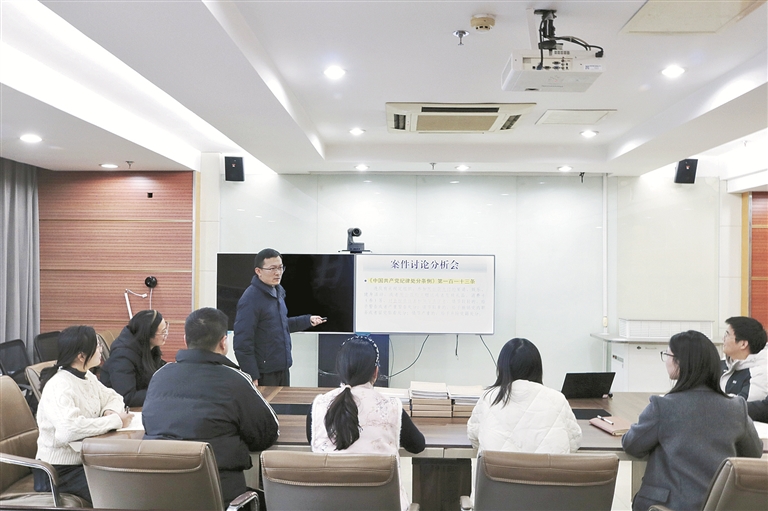
Core Viewpoint - The article emphasizes the importance of strengthening the internal mechanisms and capabilities of disciplinary inspection and supervision institutions in Chinese universities to ensure effective governance and adherence to the rule of law. Group 1: Strengthening Political and Theoretical Foundations - The disciplinary inspection institutions in central-managed universities are focusing on enhancing political construction, capability building, and integrity through a three-year action plan and a year dedicated to standardizing and legalizing their work [1] - The China People's University emphasizes theoretical training as a primary political task, aligning actions with the central leadership's directives and enhancing political loyalty among inspection teams [2] - Beijing Institute of Technology has implemented a three-tiered learning mechanism to promote theoretical education among its disciplinary inspection staff, fostering loyalty through collective learning [3] Group 2: Capacity Building through Training - Wuhan University has organized training sessions for disciplinary inspection staff, focusing on enhancing their professional capabilities and understanding of legal issues relevant to their work [4] - Northwest A&F University combines internal and external training approaches, ensuring that all young staff participate in practical training sessions to improve their skills [5] - The China Agricultural University has established a learning mechanism that includes case reviews and practical exercises to enhance the political and legal competencies of its staff [5] Group 3: Improving Internal Mechanisms and Quality Control - Sun Yat-sen University has conducted a comprehensive self-inspection of completed cases to identify common issues and improve the effectiveness of its disciplinary inspection processes [6] - The article highlights the importance of a robust internal mechanism to ensure that disciplinary inspection powers operate within the legal framework, with a focus on standardizing procedures and enhancing governance effectiveness [6] - The China People's University and other institutions are working to strengthen the construction of secondary disciplinary organizations to enhance the supervisory chain and improve case handling efficiency [7]
中国共产党海南省第八届纪律检查委员会第五次全体会议决议
Hai Nan Ri Bao· 2026-02-02 04:19
Core Viewpoint - The fifth plenary session of the Eighth Discipline Inspection Commission of the Hainan Provincial Committee emphasizes the importance of deepening the comprehensive and strict governance of the Party, aligning with the strategic deployment of the Central Commission for Discipline Inspection, and ensuring the high-quality development of discipline inspection and supervision work to support the construction of the Hainan Free Trade Port [3][4][6]. Group 1: Meeting Overview - The plenary session was held from January 31 to February 1, 2026, in Haikou, attended by 35 provincial discipline inspection committee members and 351 attendees [2]. - The session was presided over by the Standing Committee of the Hainan Provincial Discipline Inspection Commission, with key speeches from provincial leaders including Secretary Feng Fei [3]. Group 2: Key Themes and Directions - The session highlighted the need to implement Xi Jinping's thoughts on socialism with Chinese characteristics for a new era and to fully carry out the spirit of the 20th National Congress and subsequent plenary sessions [4][6]. - It was noted that 2026 marks the beginning of the "14th Five-Year Plan" and the full closure of the island, necessitating a strong commitment to political supervision and the eradication of corruption [6][7]. Group 3: Focus Areas for 2026 - The session outlined several key areas for focus, including enhancing political supervision, maintaining strict discipline, and addressing corruption in key sectors such as finance, state-owned enterprises, and education [8][9]. - There is a strong emphasis on the integration of digital tools in discipline inspection to combat new forms of corruption and improve transparency [9]. Group 4: Community Engagement and Supervision - The session called for a concentrated effort to address corruption and misconduct affecting the public, with specific initiatives aimed at improving rural management and public service integrity [10]. - It stressed the importance of community involvement in supervision and the need for effective mechanisms to address public grievances [10]. Group 5: Strengthening Discipline Inspection Mechanisms - The session emphasized the need for ongoing efforts in the "Year of Standardization, Legalization, and Regularization of Discipline Inspection Work," aiming to enhance the capabilities and integrity of the discipline inspection workforce [11]. - It highlighted the importance of political education and the establishment of a robust internal control system to prevent corruption within the ranks [11][12].
落实五次全会精神见行动丨锻造纯度更高、成色更足的纪检监察铁军
Zhong Yang Ji Wei Guo Jia Jian Wei Wang Zhan· 2026-01-28 23:32
Core Viewpoint - The central theme emphasizes the need for strengthening the discipline inspection and supervision system in China, focusing on the "four hard" requirements: political integrity, capability, work style, and cleanliness, as articulated by General Secretary Xi Jinping during the fifth plenary session of the 20th Central Commission for Discipline Inspection [2]. Group 1: Key Points from Heilongjiang - The Heilongjiang Provincial Discipline Inspection Commission's fifth plenary session highlighted the importance of self-revolution and setting higher standards for the discipline inspection workforce, aiming to enhance political construction and loyalty [3]. - The meeting called for a focus on practical training and strict adherence to legal procedures to ensure quality case management and a disciplined work style [3]. - It emphasized the need for institutional reform and a robust management system to prevent corruption within the ranks [3]. Group 2: Key Points from Sichuan - The Sichuan Provincial Discipline Inspection Commission's fifth plenary session stressed the importance of fighting spirit and capability in safeguarding the interests of the Party and the people [4]. - The meeting aimed to deepen the standardization and legalization of discipline inspection work, enhancing the effectiveness of anti-corruption efforts through digital empowerment [4]. - It also focused on the need for institutional reform and improving case quality standards to elevate the overall effectiveness of supervision and case handling [5]. Group 3: Key Points from Shaanxi - The Shaanxi Provincial Discipline Inspection Commission's fifth plenary session underscored the role of discipline inspection in the Party's self-revolution, emphasizing the need for a loyal and capable workforce [6]. - The meeting called for strict internal management and supervision mechanisms to ensure discipline and integrity among inspectors [6]. - It highlighted the importance of political education and training to enhance the capabilities and awareness of inspectors regarding legal procedures and evidence [6].
总结经验做法 加强培训交流深度关注丨多措并举提升审查调查工作本领
Zhong Yang Ji Wei Guo Jia Jian Wei Wang Zhan· 2026-01-28 00:20
Core Insights - The articles emphasize the importance of enhancing the quality and efficiency of investigation and supervision work within the disciplinary inspection and supervision agencies in China, highlighting various methods and mechanisms being implemented to achieve these goals. Group 1: Strengthening Investigation Quality - The Anhui Province and County Discipline Inspection Commission is focusing on improving the professional skills and capabilities of personnel involved in case handling through systematic reviews and training [2] - The Ma'anshan City Discipline Inspection Commission has established a "three-three" joint review mechanism to ensure precise management and handling of problem clues, which enhances the value and efficiency of case handling [3][4] - The initial case-to-closure rate in Ma'anshan City has improved by 7.2% since 2025, indicating a more effective filtering process for problem clues [4] Group 2: Case Quality Evaluation - Various local disciplinary inspection agencies are conducting regular case quality evaluations to ensure high standards in case handling, with a focus on a five-level quality review mechanism in Chongqing's Kaizhou District [5] - The mechanism includes self-checks, internal reviews, and collective scrutiny to ensure clarity of facts and appropriateness of handling [5] - In Hainan Province, a "dissection-style" review process is being implemented to analyze cases by categorizing them into specific fields, which aids in summarizing best practices and identifying shortcomings [6] Group 3: Training and Capacity Building - Continuous training and exchanges among investigation teams are crucial for enhancing the quality of investigation work, with various regions implementing business training and experience-sharing sessions [7] - The Heilongjiang Province's Youyi County has initiated "Qingfeng Classroom" sessions for sharing case handling experiences, which helps in practical learning [8] - Observing court trials has been recognized as an effective method for improving the capabilities of investigation personnel, with New Zheng City conducting numerous trial observation sessions for practical learning [8]

中央纪委国家监委通报
中国基金报· 2026-01-22 02:18
Group 1 - The article emphasizes the importance of the Xi Jinping Thought on Socialism with Chinese Characteristics for a New Era as a guiding principle for the work of disciplinary inspection and supervision agencies in 2025 [2] - It highlights the commitment to deepen the implementation of the Central Eight Regulations and to promote the standardization, legalization, and normalization of disciplinary inspection and supervision work [2] - The article reports that over 40,200 cases related to disciplinary inspection and supervision personnel were received, with more than 35,000 cases processed, including 4,119 formal investigations and 3,763 disciplinary actions taken [2] Group 2 - The use of the "four forms" of criticism and education in handling disciplinary inspection personnel is noted, with over 13,900 instances of criticism and education applied [2] - Specific figures include 9,937 instances of the first form, 3,217 of the second form, 465 of the third form, and 282 of the fourth form [2] - The article also mentions disciplinary actions against various levels of officials, including 4 provincial-level, 116 departmental-level, and 746 county-level officials [2]
中央纪委国家监委通报2025年对纪检监察干部监督检查审查调查情况
Xin Jing Bao· 2026-01-21 23:07
Core Viewpoint - The article emphasizes the commitment of various levels of disciplinary inspection and supervision agencies in China to uphold the principles of Xi Jinping's thoughts on self-revolution and to strengthen the construction of the disciplinary inspection and supervision team, aiming for a clean and accountable governance system [1] Summary by Relevant Sections Disciplinary Inspection and Supervision Actions - In 2025, the agencies will focus on deepening the implementation of the spirit of the 20th National Congress and the decisions made at the fourth plenary session of the Central Commission for Discipline Inspection [1] - A total of over 40,200 cases related to disciplinary inspection and supervision personnel were received, with over 35,000 cases processed [1] Personnel Management and Disciplinary Actions - 10,840 disciplinary inspection and supervision personnel were interviewed or inquired about, leading to 4,119 cases being filed and 3,763 personnel being punished [1] - Among those punished, 4 were at the provincial and ministerial level, 116 at the departmental level, and 746 at the county and division level [1] Criticism and Education - The agencies utilized the "four forms" of criticism and education to address issues among disciplinary inspection personnel, with over 13,900 instances of criticism and handling [1] - The first form was applied in 9,937 cases, the second in 3,217 cases, the third in 465 cases, and the fourth in 282 cases [1]
中投公司机关纪委:抓实培训 巩固提升案件查办质效
Zhong Yang Ji Wei Guo Jia Jian Wei Wang Zhan· 2026-01-19 00:30
Core Viewpoint - The Central Commission for Discipline Inspection and the National Supervisory Commission is enhancing the regulatory framework and operational efficiency of the China Investment Corporation's (CIC) internal disciplinary body through the newly issued "Guidelines for Supervision and Discipline Enforcement Work (2025 Edition)" [2][3] Group 1: Guidelines and Implementation - The new guidelines, nearly 300 pages long, cover nine areas including the handling of complaints, investigation of issues, and case review, aimed at standardizing and legalizing the disciplinary work within the CIC [2][3] - The guidelines were updated based on the first edition from 2024, incorporating the latest regulations and practical needs, addressing issues faced by the CIC's internal disciplinary body [3] Group 2: Training and Capacity Building - The CIC's internal disciplinary body has focused on enhancing the capabilities of its staff through targeted training programs, with nearly 40 personnel participating in specialized training sessions organized by the Central Financial Discipline Inspection and Supervision Committee [4] - Training methods include case studies and scenario simulations to improve the effectiveness of the training and ensure comprehensive coverage of the staff [4] Group 3: Case Handling and Effectiveness - The CIC's internal disciplinary body has successfully concluded four cases since 2025, demonstrating improved efficiency in handling disciplinary issues [6][7] - A specific case involved a staff member suspected of violating integrity rules, where initial resistance was overcome through strategic interview techniques developed from training [6] Group 4: Institutional Development and Continuous Improvement - The CIC's internal disciplinary body is actively working on revising and improving related institutional mechanisms, having initiated the development of five new regulations and issued two normative notices since 2025 [7] - The organization emphasizes the integration of case handling with systemic improvements, aiming to enhance the overall effectiveness of disciplinary actions and governance [7][8]
锻造纯度更高 成色更足铁军队伍
He Nan Ri Bao· 2026-01-17 23:05
Core Viewpoint - The article emphasizes the importance of strengthening the internal capabilities of the disciplinary inspection and supervision agencies to effectively oversee others, highlighting the need for a robust and professional workforce in this sector [1]. Group 1: Theoretical and Political Education - Strengthening theoretical education and political awareness is identified as a primary task for the disciplinary inspection agencies, focusing on enhancing political recognition and commitment to the Party's leadership [2][3]. - The agencies have implemented mechanisms for continuous learning, such as the "Five Learning Interactions" and "Daily Learning for One Hour," to ensure that staff are well-versed in the latest directives and theories from the Party [3]. Group 2: Innovation and Technology in Supervision - The article discusses the use of innovation as a catalyst for advancing the standardization, legalization, and normalization of disciplinary inspection work, with a focus on institutional and technological innovations [4]. - The establishment of a comprehensive information platform is highlighted as a key initiative to enhance efficiency and effectiveness in supervision, utilizing big data and technology [4]. Group 3: Development of a Professional Workforce - The article outlines the necessity for high-quality, professional personnel within the disciplinary inspection agencies, emphasizing rigorous training and practical experience to enhance their capabilities [5][6]. - Initiatives such as comprehensive training programs and real-case learning are being implemented to ensure that staff are well-prepared to fulfill their responsibilities effectively [6].
持续加强纪检监察工作规范化法治化正规化建设锻造忠诚干净担当、敢于善于斗争的纪检监察铁军
Zhong Yang Ji Wei Guo Jia Jian Wei Wang Zhan· 2026-01-16 00:24
Group 1 - The core message emphasizes the significant responsibility and glorious mission of the disciplinary inspection and supervision agencies in promoting the Party's self-revolution and strict governance [1][2] - The focus is on strengthening the standardization, legalization, and normalization of disciplinary inspection work, aiming to improve the quality and effectiveness of supervision and enforcement [1][3] - There is a call for the cultivation of a loyal, clean, and responsible disciplinary inspection team that is capable of fighting and skilled in governance [1][2] Group 2 - The importance of high standards and quality in the construction of standardized, legalized, and normalized disciplinary inspection work is highlighted as both a major political task and an important development opportunity [2][3] - Continuous efforts will be made to enhance the theoretical and professional skills of disciplinary inspection personnel, as well as to improve mechanisms and systems for better effectiveness [2][3] - The need for a systematic approach to the construction of standardized, legalized, and normalized disciplinary inspection work is emphasized, focusing on key areas and addressing existing issues [3][4] Group 3 - The establishment of a comprehensive disciplinary inspection team within state-owned enterprises has been achieved, aiming to enhance the capabilities of inspection personnel [4] - There is a commitment to improve internal power restriction mechanisms and management supervision systems to ensure that all actions are conducted within the legal framework [4] - Strict management and supervision of disciplinary inspection personnel's behavior outside of work hours will be enforced to prevent corruption and abuse of power [4]
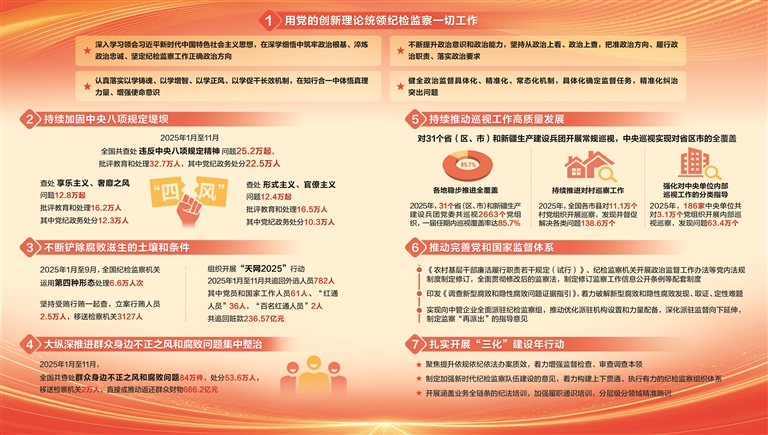
特别报道|2025:纪检监察工作高质量发展取得新进展新成效
Zhong Yang Ji Wei Guo Jia Jian Wei Wang Zhan· 2026-01-11 01:58
Core Viewpoint - The article emphasizes the importance of political supervision in ensuring the implementation of the Party's political line and maintaining a high-pressure stance against corruption and misconduct within the Party and government institutions [3][20]. Group 1: Political Supervision - Political supervision is crucial for maintaining the centralized leadership of the Party and ensuring that major decisions and directives from the Party are implemented effectively [3][4]. - The focus of political supervision should be on specific tasks and responsibilities, ensuring that the directives from the Party are translated into actionable plans [4][6]. - Various regions, such as Beijing and Zhejiang, have implemented targeted political supervision measures to ensure compliance with Party directives and enhance governance [5][6]. Group 2: Anti-Corruption Efforts - The article highlights the ongoing efforts to combat corruption, particularly in local governance, by addressing both minor and major corruption issues [20][28]. - There is a strong emphasis on the need for collaboration among different departments to effectively tackle corruption and misconduct [24][29]. - The article notes that significant progress has been made in addressing corruption linked to public services, with various regions reporting successful interventions [32][33]. Group 3: Integration of Supervision Mechanisms - The integration of various supervisory mechanisms is essential for enhancing the effectiveness of anti-corruption efforts, with a focus on collaboration between different supervisory bodies [39][40]. - The establishment of clear communication and coordination among supervisory entities is emphasized to ensure a unified approach to governance and oversight [41][42]. - The article discusses the importance of grassroots supervision in extending the reach of anti-corruption measures and ensuring accountability at all levels of government [43][44]. Group 4: Continuous Improvement and Education - Continuous education and training for supervisory personnel are highlighted as vital for maintaining high standards of governance and accountability [45][46]. - The article stresses the need for ongoing learning and adaptation of supervisory practices to meet the evolving challenges in governance and corruption prevention [47].