Cost of Living

Search documents
X @Investopedia
Investopedia· 2025-11-28 12:30
More Americans are retiring abroad in search of lower costs and adventure, but taxes, visas and healthcare make planning essential. https://t.co/a9CLorTi6s ...
X @Investopedia
Investopedia· 2025-11-28 02:00
Cape Coral, Florida, offers retirees easy airport access and affordable living on the Gulf Coast. Find out what makes it travel accessible and wallet-friendly. https://t.co/y7vSnoVzQe ...
How £50,000 became the worst salary to earn
Yahoo Finance· 2025-11-27 18:07
Core Insights - The article discusses the significant changes in income tax burdens for middle-income earners in the UK over the past two decades, highlighting the impact of tax freezes and rising living costs on disposable income and overall financial well-being [4][5][9]. Taxation Changes - In 2005, an individual earning £50,000 paid approximately £12,200 in income tax, whereas now they pay just under £7,500, but this does not account for inflation [1]. - The proportion of taxpayers affected by higher tax rates has increased, with over 18% currently facing the levy, projected to rise to over 20% by the end of the decade [1]. - The extension of tax thresholds has resulted in an additional £220 annual bill for basic rate taxpayers by 2030-31, and £600 for those on the 40% rate [3]. Living Standards and Income - Real household disposable income is expected to grow only 0.5% by the end of the current parliament, significantly lower than the 1.8% growth recorded between 2001 and 2005 [10]. - By 2030, real terms hourly pay is projected to remain 0.5% below its 2009-10 level, indicating stagnation in wage growth [11]. Cost of Living - Food prices have more than doubled since 2005, and electricity bills have increased nearly four-fold, leading to reduced spending among middle-income earners [14]. - The average first-time buyer's income has risen by 67% since 2005, but home prices have more than doubled, resulting in a 91% increase in the amount they need to borrow [17][18]. Pension and Savings Impact - The percentage of private sector workers enrolled in defined benefit pension schemes has decreased from 24% to 12% over two decades, with most now relying on less generous defined contribution pensions [24]. - The savings allowance for basic rate taxpayers has eroded due to inflation, with the initial £1,000 threshold losing over a quarter of its value [27]. Child Benefit and Student Loans - The High Income Child Benefit Charge has led to a clawback of benefits for families with one parent earning over £50,000, with the threshold frozen and eroded by inflation [30]. - Student loan repayment thresholds will be frozen at £29,385 for three years starting April 2027, impacting young professionals' financial burdens [33].
X @Bloomberg
Bloomberg· 2025-11-21 16:52
Grocery Prices & Inflation - Thanksgiving is seen as a gauge for grocery prices [1] - Americans are increasingly frustrated with the cost of living [1] Consumer Sentiment - Cost of living is a growing concern for Americans [1]
Labour treating travel industry ‘as a cash cow’, complains Jet2 boss
Yahoo Finance· 2025-11-19 16:09
Core Viewpoint - The airline and holiday industry is being treated as a "cash cow" by the government, leading to increased taxes that could make flying unaffordable for lower-income individuals [1][2][3]. Taxation Impact - The government has already imposed significant taxes on the airline sector, and further increases in air passenger duty (APD) are expected to raise airfares, making it difficult for financially constrained Britons to afford holidays [2][4]. - The Chancellor is considering an increase in APD, which would result in a £2 rise for short-haul flights and a £12 increase for long-haul flights, with domestic flight taxes also increasing to £8 [6][7]. Economic Consequences - Increased taxation will likely be passed on to customers, leading to higher prices and potentially reduced demand, which would disproportionately affect lower-income individuals who may not be able to afford holidays [4][5]. - The airline industry is facing a significant increase in business rates, with Heathrow expected to incur costs of about £600 million, Gatwick £200 million, and Manchester Airports Group £150 million, which will also be transferred to airlines and passengers [7][8]. Consumer Behavior - There is a trend of consumers delaying holiday bookings due to cost of living concerns, with more customers opting for offers that allow them to lock in prices with a £60 deposit [9][10]. - Jet2 reported a 7% decrease in flight-only fares over the summer as the company reduced prices and increased marketing efforts to fill planes, resulting in a 6% rise in passenger numbers to 14 million and a 1% increase in pre-tax profit to £800 million [10].
X @The Economist
The Economist· 2025-11-19 13:00
The barest necessities of life in Cuba cost far more than the official average monthly wage. According to a Spanish-backed think-tank, 89% of Cuban families “live in extreme poverty” https://t.co/2EwH44bMXc ...
Trump lowers food tariffs aimed at reducing grocery prices
NBC News· 2025-11-15 00:45
Trade Policy Changes - The President will reduce tariffs on some imported foods to lower grocery prices [1] - The order exempts hundreds of products from reciprocal tariffs [1] - The move impacts imported agricultural products like coffee, tea, bananas, and other tropical fruits [2] - Dozens of products are listed for potential tariff adjustments, suggesting more changes could come [3] Price Trends - Grocery prices overall are up slightly, around 1% since January [2] - Ground beef prices are up 13% [2] - Orange juice prices are up 17% [2] - Beef and oranges are now exempted from tariffs [3]


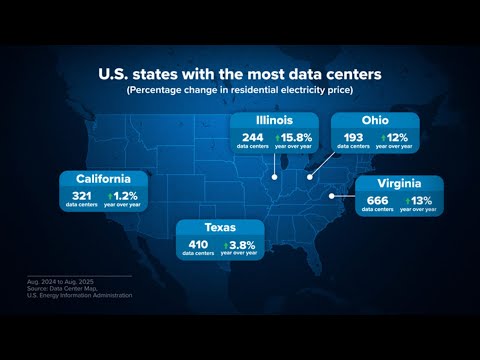
Here's what's happening to electricity bills in states with the most data centers
CNBC Television· 2025-11-14 19:49
Illinois, Virginia, Ohio, Texas, and California have the highest concentration of data centers in the US. Residents in those states have seen their electricity bills go up substantially this year. >> If we look at Department of Energy data, on average, electricity prices have increased about 6% year-over-year from August of 2024 until August of 2025.The independent market monitor for PJM found that data centers are overwhelmingly responsible for the increase in capacity prices. a data center campus running ...