Quantitative Easing (QE)

Search documents
X @Anthony Pompliano 🌪
Anthony Pompliano 🌪· 2025-12-05 16:47
QT is ending.QE is coming.@dgt10011 explains what will happen to asset prices. https://t.co/HnuUUWsb4w ...
Fed Balance Sheet QT: -$37 Billion in November, -$2.43 Trillion from Peak, to $6.54 Trillion
Wolfstreet· 2025-12-05 02:49
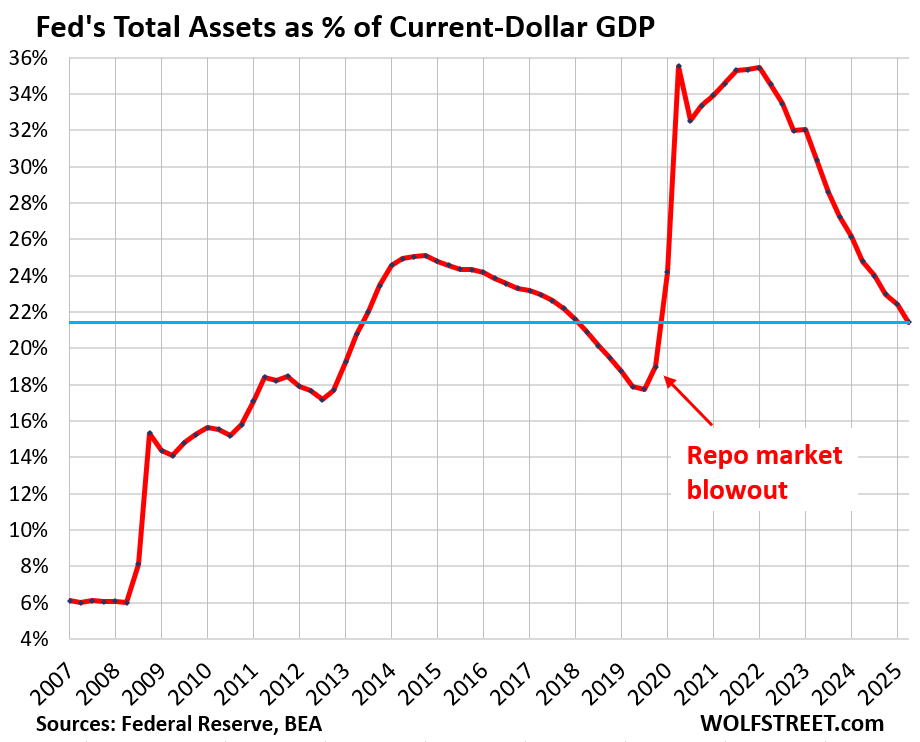
Core Insights - The Federal Reserve's quantitative tightening (QT) has concluded, with a total asset reduction of $2.43 trillion over three years and five months, representing a 27% decrease from its peak [2] - The Fed's balance sheet decreased by $37 billion in November, reaching $6.53 trillion, with a significant shift in asset composition expected as Mortgage-Backed Securities (MBS) are replaced by Treasury bills [1][4] QT and Asset Composition - The Fed's MBS holdings decreased by $16 billion in November, totaling $2.05 trillion, a 25% decline from the peak [4] - Treasury securities saw a reduction of $4 billion in November, with a total of $4.19 trillion, marking a 27.4% decrease from the peak in June 2022 [8] - The Fed plans to continue reducing MBS until they are fully off the balance sheet, while increasing T-bills, which currently stand at $195 billion [4][8] Repo Market Dynamics - The Standing Repo Facility (SRF) was utilized by banks to manage liquidity pressures, with a peak balance of $50 billion at the end of October, dropping back to zero shortly after [11][13] - The Fed expressed disappointment in banks for underutilizing the SRF, which contributed to spikes in repo market rates [14] - The SRF successfully mitigated liquidity pressures in the repo market, preventing a repeat of the 2019 blowout scenario [20] Financial Metrics and Economic Indicators - The Fed's assets as a percentage of GDP fell to 21.4% in November, indicating a potential further decline if the balance sheet remains flat while the economy grows [28] - The Treasury General Account (TGA) currently holds $908 billion, which has permanently increased the Fed's balance sheet size since the Financial Crisis [27]

Asset Purchase Facility Quarterly Report - 2025 Q3
Bankofengland.Co.Uk· 2025-11-11 12:00
Core Insights - The report discusses the Bank of England's Asset Purchase Facility (APF) operations for Q3 2025, including cash flow dynamics with HM Treasury and estimated savings from government debt issuance due to quantitative easing [1][7][20] Gilt Purchases and Sales - The average daily value of gilts lent by the APF to the Debt Management Office (DMO) was £8.0 billion during Q3 2025 [2] - The Monetary Policy Committee (MPC) decided to reduce the stock of gilts held in the APF by £70 billion from October 2025 to September 2026, with a specific sales strategy for different maturity sectors [4][14] - As of September 24, 2025, the stock of gilts held for monetary policy purposes was £558 billion, following a reduction of £3.6 billion from sales and £28.3 billion from maturities during Q3 2025 [5] Cash Flow Dynamics - The APF generated positive net cash flows to HM Treasury, peaking at £123.9 billion by the end of September 2022 [7] - Regular transfers from HM Treasury to the APF began in October 2022, with ongoing quarterly payments [8] - Future cash flows are uncertain and sensitive to changes in the Bank Rate, which affects interest payments and gilt sale prices [10][11] Projections and Scenarios - Illustrative projections indicate that cumulative cash flows could fall between -£60 billion and -£120 billion, with fiscal savings from lower government debt issuance costs estimated at £50 billion to £125 billion [13][20] - The stock of gilts is expected to reduce by £70 billion annually, potentially leading to full unwinding by the end of 2031 [23] - Different scenarios for the pace of unwind show varying impacts on net present value (NPV), with cumulative cash flows projected to decline significantly under various assumptions [17][18]


Bitcoin Tanks — But Top Crypto Titans Say a Liquidity Tsunami Is Coming
Yahoo Finance· 2025-11-05 09:26
Core Insights - Bearish sentiment is increasing due to a significant decline in Bitcoin's price, yet some cryptocurrency influencers believe in the potential for a price reversal driven by global liquidity and Federal Reserve actions [1] Group 1: Market Liquidity and Government Shutdown - The downturn in the market is primarily attributed to tightening liquidity, linked to the Federal Reserve's aggressive Quantitative Tightening and the ongoing US government shutdown [2][3] - The government shutdown has led to a significant liquidity squeeze as the Treasury General Account (TGA) accumulates funds without spending, adversely affecting markets, particularly cryptocurrencies [3] Group 2: Predictions and Future Actions - The current liquidity situation is deemed unsustainable, with expectations that the government will spend between $250 billion to $350 billion once the shutdown concludes, leading to an expansion of the Fed's balance sheet [4] - Arthur Hayes anticipates that the Fed will implement a stealth approach to Quantitative Easing by utilizing the Standing Repo Facility to alleviate market liquidity strains without formally announcing QE [5] Group 3: Year-End Market Forecasts - Despite short-term volatility and geopolitical tensions, some analysts maintain aggressive year-end targets, with projections of the S&P 500 reaching $7,500, Bitcoin hitting $200,000, and Ethereum reaching $7,000 [6][7] - Tom Lee highlights Ethereum's strong fundamentals, including increasing stablecoin volume and app revenue, as a key factor for a potential crypto rally by year-end [7]
More Money, Lower Prices: The Liquidity–Bitcoin Disconnect Explained
Yahoo Finance· 2025-11-04 09:00
Core Insights - Bitcoin is currently trading at $104,376, having experienced a decline from recent highs of $111,190 and $111,250 over the weekend [1] - Despite significant global liquidity increases, including $125 billion injected by the US Federal Reserve and China's M2 money supply reaching $47 trillion, Bitcoin's price has not responded positively [2][5] Group 1: Liquidity Dynamics - The relationship between liquidity and Bitcoin prices is becoming increasingly complex, with the notion that expanding liquidity will automatically lead to higher Bitcoin prices being deemed simplistic [3] - The recent liquidity injections by the Fed are aimed at stabilizing short-term funding markets rather than stimulating broader risk-taking, which affects market liquidity that typically flows into assets like Bitcoin [4] Group 2: China’s Monetary Expansion - China's M2 money supply has reached approximately $47.1 trillion, more than double that of the US, which stands at around $22.2 trillion, highlighting a significant liquidity gap [5][6] - This unprecedented gap in liquidity dynamics reflects China's long-term credit expansion strategy focused on infrastructure and exports rather than speculative markets [6]
X @Doctor Profit 🇨🇭
Doctor Profit 🇨🇭· 2025-11-02 09:31
Liquidity & Monetary Policy - End of Quantitative Tightening (QT), industry anticipates the timing of Quantitative Easing (QE) [1] - Discussion of the current REPO crisis and its implications [1] - Examination of liquidity issues and associated risks for banks [1] - Addressing misinformation surrounding Quantitative Easing (QE) [1] Market Impact - Analysis of the implications for Bitcoin (BTC) and stocks [1]
Fed decision could lower stagnant mortgage rates
Yahoo Finance· 2025-10-30 15:07
Core Insights - Mortgage rates are currently at their lowest in a year at 6.19%, but have remained above 6% for the past three years, causing frustration among potential homebuyers [1] - The Federal Reserve's actions, particularly regarding its balance sheet, significantly influence mortgage rates, even though it does not set them directly [1][5] Group 1: Federal Reserve Actions - The Federal Reserve's new target for the benchmark Federal Funds Rate is set between 3.75% and 4.00% effective October 29 [2] - The Fed has implemented its second quarter-point interest rate cut of 2025 to balance its dual mandate of price stability and maximum employment [3] - The Fed's total assets are approximately $6.59 trillion, representing about 22% of U.S. nominal GDP as of October 22 [4] Group 2: Quantitative Tightening and Easing - During Quantitative Tightening (QT), the Fed reduces its balance sheet by selling or allowing bonds to mature, which removes money from the system [7] - Conversely, during Quantitative Easing (QE), the Fed buys bonds and mortgage-backed securities to inject money into the economy, typically lowering long-term rates [7] - The Fed has been a net seller of Treasuries since 2022, which has pressured rates higher and elevated borrowing costs, including mortgages [8]
Ted Pillows on Altcoins: Fed’s End to QT Could Keep Crypto Under Pressure
Yahoo Finance· 2025-10-30 13:44
Core Insights - Popular market analyst Ted Pillows discusses the future of altcoins in light of the Federal Reserve's plans to end its Quantitative Tightening (QT) program [1][2] - The Fed intends to suspend QT runoff by December 1, 2025, which involves reinvesting proceeds from maturing mortgage-backed securities into Treasury bills [2][3] Market Impact - Historical data shows that a similar move by the Fed in October 2019 led to a 42% decline in the altcoin market cap in the subsequent months [3][4] - The altcoin market remained at low levels until March 2020, when Quantitative Easing (QE) was introduced, providing relief for altcoins [4] Liquidity Needs - Ted Pillows emphasizes that the altcoin market requires liquidity, which can be achieved through either the Fed starting QE or the Treasury releasing TGA liquidity into the economy [5] - The likelihood of the Fed initiating QE in the near term is considered low, and the TGA option is dependent on the suspension of the US government shutdown that began on October 1, 2025 [5][6] Market Outlook - The current market outlook suggests potential underperformance in the crypto market for some time [6]
X @Easy
Easy· 2025-10-29 20:26
Market Outlook - Short-term market volatility is expected, potentially impacting leveraged traders [1][2] - Anticipate significant upside potential towards the end of the year and into Q1, contingent on the resumption of data releases following the shutdown [2] - The market is expected to be choppy in the coming weeks [2] Monetary Policy - Quantitative Tightening (QT) is projected to end on December 1st, signaling a potential return to quantitative easing [1][2] - A rate cut in December is not guaranteed and depends on the availability of economic data [1] - The labor market is showing signs of cooling off, which could be bullish for future rate cuts [2] Investment Strategy - Buy dips in the market [3] - Hold investments until mid next year, specifically when signals indicate the end of rate cuts [3]
Is It Too Late to Buy Bitcoin? Wall Street Is Joining the ‘Debasement Trade’
Cointelegraph· 2025-10-29 16:00
Market Trends & Investment Opportunities - The debasement trade, where scarce assets like Bitcoin and gold appreciate against depreciating fiat currencies, is becoming mainstream as institutions recognize it [1][3] - Investors should own assets that will appreciate in value as the prices of goods are inflating [8] - Gold has seen a spike due to central bank buying as they seek assets that cannot be debased [14] - Bitcoin benefits from liquidity as cheaper dollars require more of them to buy Bitcoin [18] - Bitcoin is entering a tremendous institutional adoption phase and is viewed as digital gold [21] Macroeconomic Factors & Risks - The US is running over $2 trillion deficits annually, with debt exploding to over $38 trillion this year [4] - The US faces a debt spiral with three choices: cutting spending, raising taxes, or defaulting (hard or soft) [6][7][8] - The Fed is lowering rates into a period of structural inflation, fearing a recession and potential explosion of deficits to $3-4 trillion [8] - Credit agencies have downgraded US debt, indicating structural problems [8] - The market is concerned that the Fed will have to stop QT (Quantitative Tightening) and eventually start QE (Quantitative Easing) due to decreasing bank reserves [8][9] Bitcoin Outlook - Bitcoin is expected to outperform gold in the future and take market share away from it [22] - Bitcoin could fall with a market drawdown, as it is still treated as a risk asset [27] - Bitcoin is expected to snap back strongly after a market drawdown, especially with an injection of liquidity [29] - In the next 5-7 years, Bitcoin could reach $1 million, with higher prices depending on the rate of currency debasement and institutional adoption [39]