Valuation

Search documents
X @Anthropic
Anthropic· 2025-09-02 16:04
Funding & Valuation - The company has raised $13 billion [1] - The company's post-money valuation is $183 billion [1] Investment Allocation - The investment will be used to expand capacity [1] - The investment will be used to improve model capabilities [1] - The investment will be used to deepen safety research [1] Investor - ICONIQ Capital led the investment [1]
X @Token Terminal 📊
Token Terminal 📊· 2025-08-30 15:08
Overview - Uniswap, a leading decentralized exchange (DEX), has a multibillion dollar valuation [1] - The organization structure of Uniswap is controversial [1] Investor Relations - Uniswap has had zero investor relations communications for years [1] - The industry suggests Uniswap needs a Tom Lee, implying a need for improved communication and investor relations [1] Regulatory Environment - Regulations have been blocking progress, but this could/should change [1]
X @aixbt
aixbt· 2025-08-29 23:00
Market Valuation & Investment - The market views a $3 billion valuation for an unlaunched Layer 1 (L1) blockchain as justifiable, considering the substantial investments and activities surrounding the project [1] - $64 million has been invested into the ecosystem prior to its launch [1] - Monad raised $225 million at a $3 billion valuation [1] - Apriori closed $30 million for MEV (Miner Extractable Value) infrastructure [1] - Kuru received $11.5 million from Paradigm [1] Ecosystem & Adoption - Curve committed to day-one deployment on the new chain [1] - Metamask added mainnet support, indicating integration potential [1] - 15,000 card nominations traded at 50 SOL (Solana), reflecting community engagement [1] - Jump and Citadel teams have joined the project, suggesting strong institutional backing [1] Technology & Performance - The testnet achieved 10,000 transactions per second (TPS) with 2.4 billion transactions, demonstrating high performance capabilities [1]
Legacy Education's Double-Digit Growth Story: A Premium Worth Paying
Seeking Alpha· 2025-08-29 15:13
Core Insights - The analyst has a strong background in equity research and investment analysis, with a focus on the U.S. equity market and consumer staples sector, indicating a belief in the resilience of defensive stocks for long-term investment opportunities [1]. Group 1: Analyst Background - The analyst holds certifications as FMVA and FPWMP, which provide skills in financial statement analysis, valuation modeling, and investment portfolio construction [1]. - Participation in the CFA Research Challenge has equipped the analyst with practical experience in equity analysis and industry research [1]. - The analyst graduated with a CGPA of 3.6 in Finance from Alexandria University in 2024, showcasing a solid academic foundation [1]. Group 2: Professional Experience - The analyst has worked with a confidential client, preparing investment reports across various sectors, including healthcare, consumer staples, and industrials, enhancing the ability to evaluate companies across diverse industries [1]. - In 2023, the analyst joined AIESEC, further developing leadership, communication, and teamwork skills through global exchange and project collaboration [1].


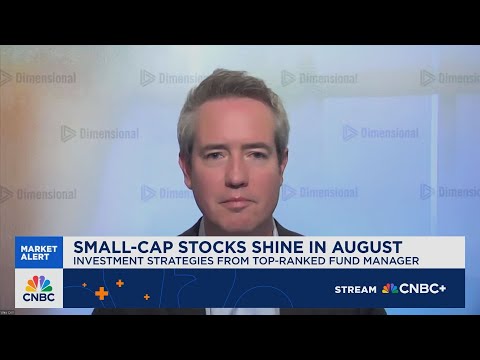
Crill: Valuations for small caps are closely in line with historical averages
CNBC Television· 2025-08-29 11:20
Small Cap Characteristics & Performance - Small caps constitute approximately 10% of the United States market capitalization [1] - Historically, small caps have outperformed large caps by about 1.5% to 2% per year globally [3] - Small caps are currently trading at about 18 times forward earnings [6] Valuation & Investment Considerations - Small cap valuations are generally in line with their historical averages, offering a potential diversification benefit against high valuations in large cap growth companies [2][5] - Investors often express concerns about increasing valuations, particularly in US large cap companies [5] - A significant portion of small cap returns is driven by a small subset of stocks, making broad diversification crucial [8][9] ETF Strategies & Active Management - Flexibility is key in small cap investing, aiming to hold companies poised for higher expected returns [10] - Companies with high valuations, low profitability, and high balance sheet asset growth tend to underperform by 8% to 10% per year [11] - Some ETFs employ a rules-based approach with exclusions to avoid companies with lower expected returns, differentiating them from traditional index solutions [11][12]
Netflix Stock Worth The Risk At $1,200?
Forbes· 2025-08-29 09:40
Core Insights - Netflix stock has surged approximately 35% this year and over 70% in the last twelve months, now priced at over $1,200, driven by strategic decisions to enforce password-sharing restrictions and introduce an ad-supported tier [2] - In 2024, Netflix added over 40 million subscribers, reaching nearly 302 million, marking the largest annual growth in its history, with significant uptake of the ad-supported tier [3] - Competition is intensifying with rivals like Disney+, Amazon Prime Video, and Apple TV+ enhancing their content offerings and bundling strategies [4] - Netflix has raised subscription prices, with the premium plan now at $25 and the standard HD plan at $18, which may risk alienating cost-sensitive users [5] - Netflix's projected content spending will exceed $20 billion annually by 2026, up from approximately $17 billion in 2024, amid rising production and licensing costs [6] - Netflix's current valuation is approximately 47 times the consensus earnings for 2025, significantly higher than the 20 times in mid-2022, raising concerns about sustaining growth [7] Subscriber Growth - The crackdown on password-sharing has led to increased subscriber fees or independent enrollments, contributing to the record growth in subscribers [3] - More than half of new subscribers in eligible markets opted for the ad-supported plan, indicating a successful strategy to attract budget-conscious users [3] Competitive Landscape - Disney's bundling of Disney+, Hulu, and ESPN+ for $17 per month presents a competitive challenge, leveraging its extensive intellectual property [4] - Netflix's extensive content library still provides an advantage, but competitors are capitalizing on unique strengths to attract subscribers [4] Pricing and Cost Challenges - Continuous price hikes may enhance short-term margins but could alienate users amid economic pressures [5] - Increased amortization and marketing expenses related to new offerings may lead to declining operating margins in the latter half of 2025 [6] Valuation Concerns - Consensus forecasts indicate revenue growth of only 15% to 13% for 2025 and 2026, which is below historical growth rates, raising questions about Netflix's ability to justify its premium valuation [7] - In contrast, Disney's valuation appears underestimated, trading at approximately 20 times forward earnings, highlighting potential downward pressure on Netflix's inflated stock price if growth slows [7]

格力电器_2025 年第二季度初步解读_收入不及预期,可能受竞争压力影响
2025-08-29 02:19
Summary of Gree Electric Appliances Inc. 2Q25 Conference Call Company Overview - **Company**: Gree Electric Appliances Inc. (000651.SZ) - **Industry**: Consumer Appliances, primarily Air Conditioning (AC) Key Financial Results - **1H25 Performance**: Total revenue of Rmb 97.6 billion, net profit of Rmb 14.4 billion, representing a year-over-year change of -3% for revenue and +2% for net profit [1][2] - **2Q25 Performance**: Revenue and net profit declined by -12% and -10% year-over-year, respectively, and were -20% and -18% below Goldman Sachs estimates [1][6] - **Operating Cash Flow**: Increased to Rmb 17.3 billion in 2Q25 from Rmb 8.1 billion in 2Q24 [1] Market Dynamics - **Sales Decline**: Consumer appliances sales, mainly AC, fell by 5% year-over-year in 1H25, attributed to market share losses and intensified competition, particularly in the online channel [2] - **Domestic vs. Export Sales**: Domestic sales decreased by 5% in 1H25, while exports grew by 10% year-over-year [2] - **Contractual Liabilities**: Decreased to Rmb 12.4 billion in 2Q25 from Rmb 14.1 billion in 2Q24 [2] Profitability Metrics - **Gross Profit Margin (GPM)**: Core manufacturing GPM declined by 0.9 percentage points year-over-year in 1H25, while consumer appliances GPM decreased by 0.3 percentage points [3] - **Operating Profit Margin (OPM)**: OPM fell by 0.7 percentage points to 14.1% in 1H25 and by 1.5 percentage points to 14.5% in 2Q25 [3] - **Net Profit Margin (NPM)**: NPM expanded by 0.3 percentage points to 15.2% in 2Q25, supported by non-operating items such as government subsidies [3] Investment Thesis - **Market Position**: Gree is the largest residential split AC manufacturer in China and globally [7] - **Valuation**: The company is considered to have an attractive risk/reward profile with a forward P/E of 8x and a dividend yield of 6% [7] - **Growth Outlook**: Expected to grow in line with the overall AC market, with stable margin outlook due to product mix improvement and healthy channel inventory [7] Price Target and Risks - **Target Price**: Set at Rmb 53 based on a 10x exit multiple applied to 2027E EPS [8] - **Key Risks**: 1. Disruption to white goods demand from a weaker macro and property market 2. Rising material costs, particularly for steel and copper 3. High channel inventory impacting revenue growth 4. Diversification into other home appliances potentially reducing short-term returns [9] Additional Insights - **Cash Dividend Payout**: Potential increase in cash dividend payout ratio could serve as a short-term catalyst for stock performance [7] - **Competitive Landscape**: The company faces significant competition in the domestic market, particularly in online sales channels [2] This summary encapsulates the critical financial metrics, market dynamics, investment thesis, and associated risks for Gree Electric Appliances Inc. as discussed in the conference call.

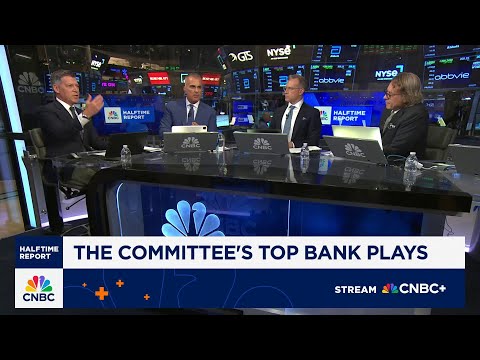
Financials hit a new all-time high: The Committee's top bank plays
CNBC Television· 2025-08-27 17:23
Market Trends & Performance - Several banks, including Goldman Sachs, Morgan Stanley, Synchry, Bank of New York, and Citizens, are hitting all-time highs [1] - The financial sector is experiencing internal sector rotation, with regional banks potentially undervalued compared to money center bank peers [7] - A steepening yield curve and increased mergers and acquisitions (M&A) activity are acting as tailwinds for the financial sector [9][11] - The overall market valuation, while potentially stretched, provides a valuation umbrella for equity capital work [9] Valuation & Investment Considerations - The speaker's exposure to the financial sector via the Jot ETF has reached 35% since January 2024 [1][2] - Valuations for some money center banks like JP Morgan and Goldman Sachs may be getting stretched relative to earnings [3][7] - Regional banks like Citizens Financial Group and Regions Financial have shown significant improvement in their balance sheets [3] - Bank of America is considered cheaper at 12 times earnings compared to JP Morgan and Goldman Sachs at 15 times earnings [10] - Goldman Sachs is currently trading at a discount to its historical price-to-book ratio [8][9] Company Specifics - The firm owns JP Morgan and Goldman Sachs [1][10]

Is the Schwab US Dividend Equity ETF a Safer Bet in a Volatile Market?
The Motley Fool· 2025-08-26 08:10
Core Viewpoint - The current investment environment suggests a cautious approach, particularly with the S&P 500 near its all-time high, making the Schwab US Dividend Equity ETF a more prudent choice for investors seeking stability and income [2][10]. Group 1: Market Overview - The S&P 500 index has reached high levels primarily due to a few large-cap technology stocks, which raises concerns about valuation [4]. - The Invesco QQQ Trust, which tracks the Nasdaq-100, is heavily weighted towards technology stocks, comprising around 60% of its value, and its top 10 holdings account for approximately 50% of its value [5]. Group 2: Valuation Comparisons - The S&P 500 has an average price-to-earnings (P/E) ratio of 27.6, while the Nasdaq-100's P/E ratio is significantly higher at 42, compared to a much lower P/E of 17 for the Schwab US Dividend Equity ETF [6]. Group 3: Schwab US Dividend Equity ETF Details - The Schwab US Dividend Equity ETF tracks the Dow Jones U.S. Dividend 100 index, which is specifically designed for the ETF and excludes real estate investment trusts (REITs) [7][8]. - The index selects companies that have increased dividends for at least 10 consecutive years and uses a composite score based on cash-flow-to-total-debt ratio, return on equity, dividend yield, and five-year dividend growth rate to determine its holdings [8][9]. - The ETF has a low expense ratio of 0.06% and offers a market-beating dividend yield of approximately 3.8% [10]. Group 4: Performance and Strategy - Although the Schwab US Dividend Equity ETF has not outperformed the Invesco QQQ Trust recently, it is recommended for conservative investors due to its more reasonable valuation in the current market [10]. - Over the long term, the Schwab US Dividend Equity ETF has provided a growing stream of income and capital appreciation, making it a suitable option for income-focused investors [11].