
Bond Yields

Search documents
Corporates may go to banks for credit due to hardening of bond yields: SBI official
The Economic Times· 2025-09-10 11:04
Group 1 - Corporates are increasingly turning to banks for credit due to the hardening of bond yields in the debt market, with debt paper issuance volumes decreasing in the current quarter compared to the first quarter, where issuances were Rs 3 lakh crore [1][6] - Ten-year bond yields have risen by 6.6%, while 30-year state government bonds have increased to 7.5%, prompting corporates to seek bank credit if this trend continues [2][6] - Domestic banks are reported to have adequate capital to finance growth and are particularly interested in lending to emerging sectors such as renewable energy and start-ups [5][6] Group 2 - The credit to GDP ratio in India is between 65% to 70%, significantly lower than the nearly 100% ratio in developed countries, indicating potential for growth in credit demand [6] - The digital public infrastructure, such as the Unified Payments Interface (UPI), is gaining traction, reflecting a shift in customer behavior towards increased digitalization [6] - Public sector banks (PSBs) have undergone technology modernization and digitalization over the past eight years, resulting in a significant increase in return on assets, while also facing challenges in compliance and technology costs [6]


US Jobs Growth Stalls, Adding Rate Cut Bets | Real Yield 9/5/2025
Bloomberg Television· 2025-09-05 18:09
From New York City. For our viewers worldwide, I'm Scarlet Fu and Bloomberg Real Yield starts right now. Coming up.U.S. payrolls tumble in August with just 22,000 jobs added to the economy, sending bond yields plunging across the curve. Traders are now locking in a September Fed rate cut. We begin with the big issue.A labor market introduces another weak summer employment report. This is a continued deceleration, but there's an ongoing sort of labor market slowdown. We want a labor market that's cool and th ...

X @Decrypt
Decrypt· 2025-09-04 04:37
Bitcoin May Gain as Dollar Drops and Bond Yields Climb, Experts Say► https://t.co/6Z82Ac41bb https://t.co/6Z82Ac41bb ...
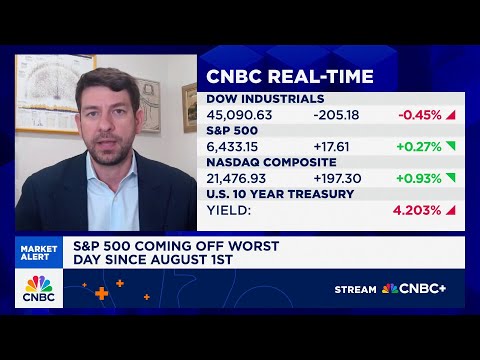
We need the consumer to transfer from cash to leverage, says BCA Research's Marko Papic
CNBC Television· 2025-09-03 18:29
While the focus is on a potential government shutdown, my next guest says historically geopolitical risk has actually been conducive to growth, productivity, and asset returns overall. So, it's not a risk, it may actually be an opportunity. Joining me now is Marco Pepic.He's the macro and geopolitical strategist over at BCA Research. Uh, this is a perfect conversation to have right now, Marco, because we've just now heard the update from Megan with regard to trade and tariffs, the update from Emily with reg ...
Why Long-Dated Bonds Are Falling Out of Favor #stockmarket #business #shorts
Bloomberg Television· 2025-09-03 16:42
Market Trends & Borrowing Costs - Borrowing costs are up, reaching levels unseen in decades, especially for long-term bonds, impacting investors and governments globally [1] - Investors are demanding higher compensation for holding long-term bonds due to persistent inflation and significant budget deficits [2] - Yields on 30-year treasuries are nearing 5%, a level last seen in July, while UK 30-year rates have reached levels last seen in 1998 [3] Government Debt & Fiscal Policy - Governments worldwide accumulated substantial cheap debt following the 2008 global financial crisis and further increased borrowing to address COVID-19 lockdowns and related recessions [4] - Increased inflation and interest rates since the pandemic have made such large-scale borrowing unsustainable [5] - Concerns exist that persistently high bond yields and governments' failure to manage their finances could lead to escalating debt servicing costs [5] Structural Forces - Structural factors, including demographics and geopolitical tensions, are contributing to the rise in borrowing costs [2] - The longer the maturity of a bond, the greater the potential for adverse events, leading investors to demand higher compensation [4]

Stocks are 'about to fall off a cliff' due to market leadership, says Strategas' Chris Verrone
CNBC Television· 2025-09-02 20:21
Market Seasonality & Trends - Strategus notes that while September is historically a weak month, a strong prevailing market trend can mitigate this [2][3] - The market's leadership, with banks and discretionary sectors performing well, suggests limited downside risk [4] - Global markets are generally performing well, further reducing bearish sentiment [4][5] Economic Indicators & Tariffs - The market indicates that the impact of tariffs is not significant, supported by strong consumer discretionary stocks [7] - Credit conditions have not deteriorated, and discretionary stocks are outperforming staples, suggesting no imminent economic weakening [8] - Countries in the "crosshairs" of trade tensions, such as China, the EU, and Japan, have not shown significant weakness [9] Bond Yields & Bank Stocks - Despite breakouts in bond yields across multiple countries (German, French, UK, Japanese, and US 30-year bonds), bank stocks are not responding negatively [9][10] - Japan's NIK index continues to perform well despite movements in Japanese Government Bond (JGB) yields, indicating underlying strength [10] Potential Market Correction - A period of "chop" or consolidation is considered reasonable, especially given pullbacks in stocks like Nvidia and Broadcom [4][5] - A worst-case consolidation scenario is estimated around 6150-6200 [5]

X @Bloomberg
Bloomberg· 2025-09-02 09:25
Market Trends - UK 30-Year Bond Yields reached a 27-year high, a level last seen in 1998 [1]
Markets in 3 Minutes: Nvidia Matters Now But Yields Matter More
Bloomberg Television· 2025-08-27 07:15
Mark, good morning to you. So this is a big event, of course, for the tech world. It's also a huge macro event.I'm talking about the immediate numbers still many hours away, but no doubt investors thinking about how they position for such a big a big event. How are you thinking about the NVIDIA numbers to come. I think it's really important to look at the context of invidious earnings 12 months ago.So we came in to these exact same two Q earnings in August at the end of last year. The market had done well i ...


X @Bloomberg
Bloomberg· 2025-08-26 16:27
Market Trends & Potential Risks - Carmignac predicts French bond yields could surge to 100 basis points above Germany's if political instability escalates [1]
X @Bloomberg
Bloomberg· 2025-08-26 14:10
Market Trends - US stocks experienced mixed performance, fluctuating between small gains and losses [1] - Bond yields increased, adding pressure to the stock market [1] Risk Factors - Concerns arose regarding the Federal Reserve's independence following President Trump's decision to fire a governor [1]