AI bubble

Search documents
We're in the beginning of an AI boom, says Defiance ETF's Sylvia Jablonski
Youtube· 2025-10-09 13:02
Consumer Market Insights - The high-end consumer market is performing well, while lower-end consumers are struggling, indicating a bifurcated consumer landscape [1] - Overall consumer demand remains strong, supported by a resilient job market and potentially steadying inflation, which is driving market growth [2][11] - There is an expectation for increased disposable income among consumers, which could further stimulate market activity [3] AI Investment Trends - The current phase is characterized as the beginning of an AI boom, with AI expected to permeate various market sectors [4] - Capital expenditures (capex) have been increasing, leading to margin efficiencies and cost reductions, particularly benefiting companies like Nvidia [5] - AI investments are anticipated to expand into infrastructure and modern warfare applications, indicating diverse growth opportunities [6][7] Market Sentiment and Earnings Outlook - Market reactions to growth spending can be volatile, with historical examples showing shifts in investor sentiment [8][9] - Earnings season is critical for assessing the performance of major corporations, particularly those heavily investing in AI [10] - Expectations for year-over-year growth in earnings per share (EPS) and revenues for key companies are set at 12% and 14.8% respectively, which could bolster consumer confidence in AI-driven growth [11] Gold and Alternative Investments - The rise in gold prices is attributed to concerns over government debt and currency stability, despite equities also rallying [13][14] - Gold is viewed as a defensive hedge within investment portfolios, alongside cryptocurrencies like Bitcoin, which are also gaining traction among investors [15]


Morgan Stanley's Lisa Shalett Says Nvidia At the Center Of A Possible 'Cisco Moment' For AI In 24 Months: 'Not Going To Be Pretty'
Benzinga· 2025-10-09 11:07
Lisa Shalett, the chief investment officer at Morgan Stanley’s (NYSE:MS) wealth management business, has expressed her concerns about the current market boom, which she believes is heavily reliant on massive capital investments in generative artificial intelligence.AI Spending Surge Could Trigger Dotcom-Style RiskShalett, in an interview with Fortune this week, said the over reliance on generative AI capital expenditures was a potential risk to the market’s stability. She warned that if this narrative falte ...


X @Bloomberg
Bloomberg· 2025-10-09 09:05
A growing group of critics say we’re in an AI bubble. Is it true? If so, how would we know? https://t.co/lHZdjNtLcO ...
The AI Infrastructure Web: Who Does What and Why It Matters
Medium· 2025-10-08 23:24
Core Insights - The article discusses the intertwined ecosystem of key players in the AI infrastructure space, including NVIDIA, OpenAI, AMD, and Oracle, highlighting their roles and relationships in the current AI revolution [1][2]. Group 1: Company Roles - OpenAI serves as the AI model developer and central "demand anchor," requiring substantial compute power, data centers, and scale [3]. - NVIDIA provides GPUs and accelerators to OpenAI, invests in OpenAI-linked infrastructure, and benefits from guaranteed demand [3][4]. - AMD also supplies GPUs with large-scale deployment commitments, similar to NVIDIA [7]. - Oracle builds data center infrastructure and cloud hosting for OpenAI, including "Stargate" facilities and power contracts [7]. Group 2: Economic Implications - OpenAI's AI models drive significant demand for high-performance GPUs, creating a symbiotic relationship with NVIDIA and AMD [7]. - NVIDIA's potential $100 billion investment in OpenAI highlights a strategic focus on long-term demand rather than immediate revenue [7]. - Oracle's $300 billion commitment to data center construction and AI hosting indicates a comprehensive infrastructure approach beyond just GPU supply [7]. Group 3: Market Dynamics - The current AI landscape shows speculative traits, with NVIDIA's forward P/E ratio exceeding 40x, suggesting high investor expectations [9]. - The concentration of capital among a few firms creates a feedback loop that reinforces investment and valuation [9]. - Unlike the dot-com era, the AI buildout involves tangible infrastructure, such as chips and data centers, which retain value even during downturns [10]. Group 4: Risks and Signals - Potential risks include order cancellations, delayed deployments, and regulatory scrutiny, which could impact market confidence and valuations [6][13]. - A 50% order cancellation from OpenAI could lead to a 4-5% short-term earnings hit for NVIDIA and 2-3% for AMD, indicating market sensitivity to earnings misses [13]. - The narrative momentum surrounding AI could drive market performance, but a weakening narrative may lead to valuation corrections [10]. Group 5: Cooling Solutions in AI Infrastructure - Companies specializing in advanced cooling technologies for data centers are positioned to benefit from the expanding AI infrastructure [11]. - Vertiv Holdings Co provides thermal management solutions and has recently acquired Great Lakes Data Racks & Cabinets for $200 million to enhance its capabilities [12][14]. - Schneider Electric has bolstered its data center cooling portfolio by acquiring a 75% stake in Motivair Corp for $850 million [17].


Bank of England on AI mania: ‘Stretched’ stock valuations ‘comparable to the peak of the dotcom bubble’
Yahoo Finance· 2025-10-08 17:58
Core Insights - The discussion around a potential "bubble" in the tech sector, particularly related to AI investments, has gained traction among industry leaders and financial institutions [1][2][3] Group 1: Market Sentiment and Valuations - The Bank of England's Financial Policy Committee (FPC) has expressed concerns about "stretched" equity valuations, particularly in U.S. stocks and AI-focused technology companies, indicating a potential market vulnerability if AI expectations diminish [2] - The FPC highlighted that the earnings yield implied by the cyclically adjusted price-to-earnings (CAPE) ratio is near its lowest level in 25 years, comparable to the peak of the dotcom bubble, suggesting significant overvaluation in the market [4] - The S&P 500 index has been noted to have a price-to-earnings ratio nearing 30, which is viewed as a concerning indicator for investors [4] Group 2: Corporate Perspectives - Nvidia's CEO Jensen Huang defended the company's substantial investments in AI, including a $100 billion deal with OpenAI, framing it as an opportunity to invest in a future multitrillion-dollar company [3] - Huang emphasized that OpenAI's future revenues, which are expected to grow exponentially, will provide returns on Nvidia's investment, reflecting a strong belief in the long-term potential of AI [3]
X @THE HUNTER ✴️
GEM HUNTER 💎· 2025-10-08 17:37
RT unusual_whales (@unusual_whales)Here is how the AI bubble is being created, per Bloomberg: https://t.co/rHlVKVpKgV ...
We're seeing lots of evidence of 'bubble-like behavior' in AI space, says GMO's Ben Inker
Youtube· 2025-10-08 15:55
Market Overview - There is evidence of bubble-like behavior in the AI sector, characterized by speculative actions and aggressive pricing [1][2] - The US market is experiencing a two-speed economy, heavily reliant on AI capital expenditures, which could lead to vulnerability if there is a slowdown [6][12] Investment Opportunities - Europe and Japan are seen as attractive investment areas due to their cheap valuations and resilience against recession fears [3][4] - Value stocks in Europe, particularly in financials, industrials, and pharmaceuticals, are trading at significant discounts compared to US counterparts, presenting good return potential [5] AI Sector Dynamics - The AI ecosystem is increasingly dependent on debt financing rather than cash flow, raising concerns about sustainability [9][12] - Companies like Nvidia are investing heavily in non-profitable firms, which may indicate a shift in the capital structure of the tech industry [8][11] Capital Investment Trends - The tech industry is becoming more capital-intensive, which could challenge the historically high returns on capital that were previously maintained [15][16] - Innovative financing structures, such as special purpose vehicles for debt management, are emerging but may signal underlying risks [14]

We're seeing lots of evidence of 'bubble-like behavior' in AI space, says GMO's Ben Inker
CNBC Television· 2025-10-08 15:55
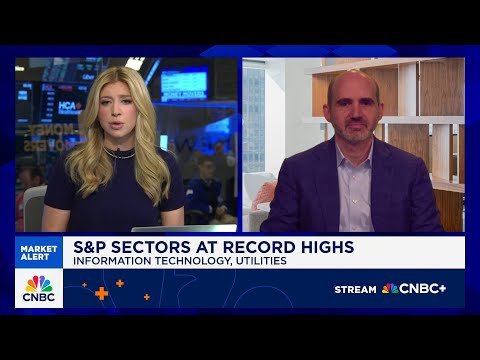
We'll stick with the markets, bring in our next guest who's closely watching the risks around a potential AI bubble, bullish instead on opportunities across Europe and Japan. Joining us now is GMO co-head of asset allocation, Ben Inkler. You think there's a bubble happening in the US market, Ben.>> Uh, we're certainly seeing lots of evidence of bubble-like behavior in the AI space. We see the kind of circular uh revenue deals. we see a lot of very uh aggressive price behavior.So, I mean, is the whole thing ...
X @Bloomberg
Bloomberg· 2025-10-08 15:22
As interest rates come down, many investors will opt moving out of cash and into riskier assets. @edwardnh argues what they may not do is spend more, with these flows signaling the peak of the AI bubble. https://t.co/QXzrsZsZna ...
AI bubble concerns, plus investors flock to gold and bitcoin as US dollar comes under pressure
Yahoo Finance· 2025-10-08 15:10
[Applause] Welcome to Yahoo Finance's flagship show, The Morning Brief. I'm Julie Hyman. Let's get to the three things you need to know today. First up, US stock futures rebounding this morning after the major averages closed in the red, halting seven consecutive days of gains for the S&P 500. But the gold rally, it continues to power higher. Spot gold hitting $4,000 an ounce for the first time ever. Billionaire investor Ray Dalio says he sees gold as more of a safe haven than the dollar. He compared its re ...