
Quantitative Tightening (QT)

Search documents
Fed's Powell say end of balance sheet drawdown may be nearing
Yahoo Finance· 2025-10-14 16:23
By Michael S. Derby (Reuters) -Federal Reserve Chair Jerome Powell said on Tuesday the end of the central bank’s long-running effort to shrink the size of its holdings, widely known as quantitative tightening, or QT, may be coming into view. Given the central bank’s long-running goal of leaving enough liquidity in the financial system to allow for firm control of short-term rates and normal money market volatility, Powell said “we may approach that point in coming months, and we are closely monitoring a ...
Fed Balance Sheet QT: -$15 Billion in September, -$2.38 Trillion from Peak, to $6.59 Trillion
Wolfstreet· 2025-10-03 01:05
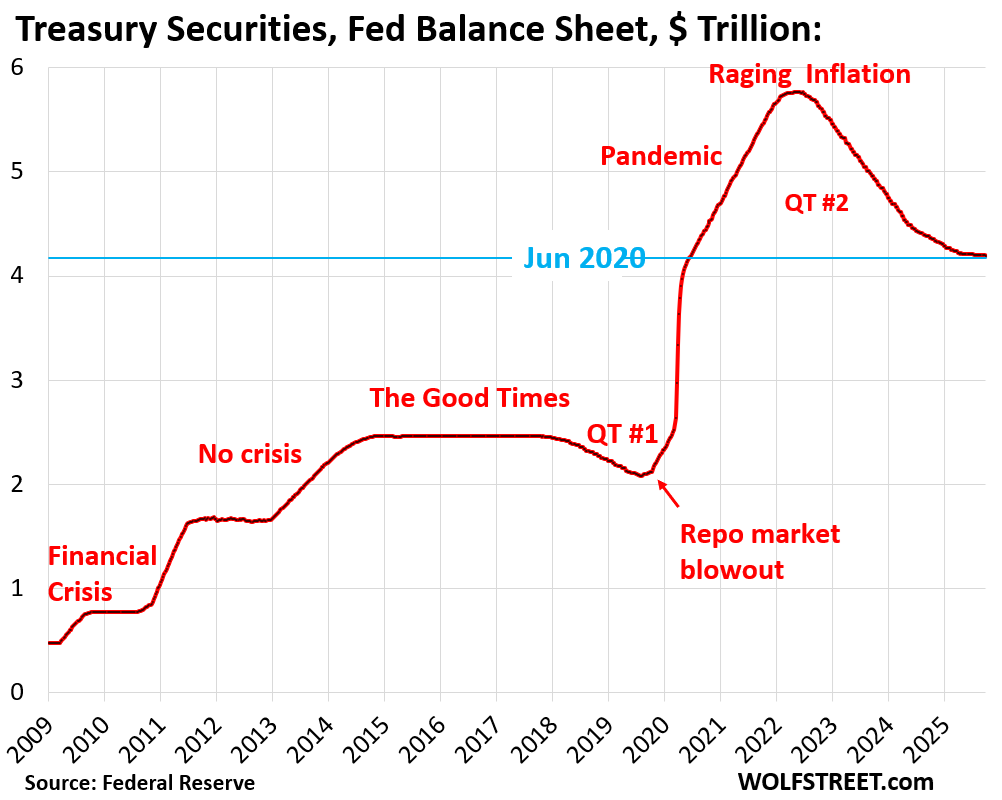
Core Insights - The Federal Reserve's balance sheet decreased by $15 billion in September, totaling $6.59 trillion, marking a 26.5% reduction since its peak in April 2022 [1][2] - The Fed has shed 49.5% of the $4.81 trillion accumulated during the pandemic-era quantitative easing (QE) [1] - The Standing Repo Facility (SRF) saw limited use, with $1.5 billion drawn on September 15, indicating minor liquidity strains in the repo market [1][15] Balance Sheet Changes - Total assets declined by $15 billion, consisting of $24 billion in declines and $9 billion in increases [1] - Treasury securities decreased by $4.4 billion in September, down 27.3% from the peak in June 2022, totaling $4.20 trillion [4] - Mortgage-Backed Securities (MBS) fell by $16.8 billion in September, down 24% from the peak, now at $2.08 trillion [7] Specific Asset Changes - The decline in MBS is attributed to reduced mortgage refinancing and home sales, leading to slower principal payments [8][9] - The Fed has shed 48% of the $1.37 trillion in MBS accumulated during pandemic QE [7] - Unamortized premiums decreased by $1.9 billion in September, reflecting the amortization of premiums paid for bonds during QE [22] Liquidity Facilities - The Discount Window saw an increase of $2.8 billion, reaching $7.2 billion, indicating some uptake by banks to manage liquidity needs [19] - The SRF has been improved to encourage banks to borrow and lend in the repo market, helping to stabilize overnight rates [14][15] Economic Context - The Fed's assets-to-GDP ratio fell to 21.6% in September, a level not seen since Q3 2013 [25] - The remaining pandemic-era Special Purpose Vehicles (SPVs) are declining, with only the MSLP remaining at $3.7 billion [23]

Bitcoin Tops $119K, XRP, SOL, ETH Surge as U.S. Government Shutdown Takes Effect; BTC Options Look Cheap
Yahoo Finance· 2025-10-02 02:14
Core Insights - Bitcoin (BTC) has surged to its highest price in over two months, reaching $119,455, following a U.S. government shutdown that may create a positive liquidity impulse in the financial system [1][2] - Other major cryptocurrencies, including ether (ETH), XRP, solana (SOL), and dogecoin (DOGE), have also experienced price increases ranging from 4% to 7% [1] - The CoinDesk 20 Index (CD20) rose by 5% to 4,217 points, indicating a broader positive trend in the cryptocurrency market [1] Economic Context - The U.S. government shutdown resulted from a divided Congress failing to reach a funding agreement, which could delay the release of the nonfarm payrolls report [2] - This delay may lead to a positive liquidity expansion in the financial system, facilitating easier access to funding and potentially stimulating economic growth and risk-taking in financial markets [2] Federal Reserve Implications - If the ADP report serves as a leading indicator and the Bureau of Labor Statistics (BLS) report is delayed, the Federal Reserve may implement a 25 basis point rate cut in October, with further cuts possible by December [3] - Such actions could lower real yields and weaken the dollar, creating a favorable environment for Bitcoin and other cryptocurrencies [3][4] Market Sentiment - The recent ADP private payrolls report highlighted a weak labor market, reinforcing the case for continued rate cuts by the Federal Reserve [4] - Analysts suggest that Bitcoin's price increase following the government shutdown could signal the potential for a significant rally in the cryptocurrency market [4][5] Options Market - Deribit-listed options are currently perceived as inexpensive, providing a hedged way to capitalize on anticipated volatility in Bitcoin [6] - The U.S. government shutdown may act as a catalyst for increased Bitcoin movement, with steep contango in implied volatility making options attractive [6]
Fed liquidity facilities see tepid demand despite quarter end, repo rates climb
Yahoo Finance· 2025-09-30 23:26
Core Insights - Federal Reserve liquidity facilities experienced lower than expected interest from Wall Street as the third quarter ended, despite a rise in repo rates indicating liquidity pressure [1][4][6] Group 1: Market Conditions - Quarter ends typically present challenging money market conditions, with firms reducing market participation and liquidity management becoming difficult due to volatile interest rates [2] - This quarter end was anticipated to be particularly turbulent due to declining overall liquidity levels as the Fed continues its quantitative tightening (QT) process [2][4] Group 2: Repo Rates and Liquidity - Repo rates spiked, with the general collateral rate opening at 4.45%, reaching a high of 4.60%, and closing at 4.35% [4] - Concerns arose regarding a potential repeat of the 2019 liquidity shortage that led to a spike in short-term borrowing rates, prompting Fed intervention [3][5] Group 3: Federal Reserve's Strategy - The Fed's QT aims to reduce excess liquidity injected during the COVID pandemic, but with reverse repo usage at negligible levels, QT is diminishing underlying liquidity, increasing market friction risks [4][5] - Market participants had initially estimated that the Standing Repo Facility (SRF) could see up to $50 billion in usage, but actual borrowing was only $11 billion, indicating less extreme conditions than expected [6] Group 4: SRF Functionality and Concerns - The SRF is designed to act as a buffer for temporary liquidity shortfalls, but doubts persist about its effectiveness, as firms may hesitate to use it for fear of signaling financial trouble [6][7]
Quarter end fails to spur rush to Federal Reserve liquidity facilities
Yahoo Finance· 2025-09-30 19:27
Core Insights - Federal Reserve liquidity facilities experienced significantly lower interest from Wall Street than anticipated as the third quarter concluded quietly [1][2] Group 1: Market Activity - Money market funds and eligible firms deposited $49.1 billion at the Fed's overnight reverse repo facility, while the Standing Repo Facility (SRF) lent $6 billion, both figures falling short of pre-event estimates [2][6] - The quarter-end typically presents challenging money market conditions, with firms reducing market participation and liquidity management becoming difficult amid volatile interest rates [3] Group 2: Quantitative Tightening (QT) - QT aims to reduce liquidity in the financial system, reversing the excess cash injected during the COVID-19 pandemic, leading to declining overall liquidity levels [4] - The last instance of QT resulted in an unexpected liquidity shortfall in September 2019, causing a spike in money market rates and halting the drawdown process [5] Group 3: SRF Usage Concerns - The SRF, designed to act as a buffer for temporary liquidity shortfalls, has faced skepticism regarding its effectiveness, with concerns that firms may avoid using it to prevent signaling financial distress [7] - Economic factors, particularly higher borrowing rates on Monday compared to Tuesday, likely influenced the lower usage of the SRF [8] Group 4: Repo Rates - The general collateral or repo rate opened at 4.45%, peaked at 4.60%, and closed at 4.35%, indicating fluctuations in borrowing costs [9] - Prior to the Fed's SRF bids, the repo rate reached 4.43%, approximately 18 basis points higher than the rate offered at the SRF [9]
The “Lock-in Effect” and Mortgage Rates: Update on Unwinding a Phenomenon that Wrecked the Housing Market
Wolfstreet· 2025-09-29 23:30
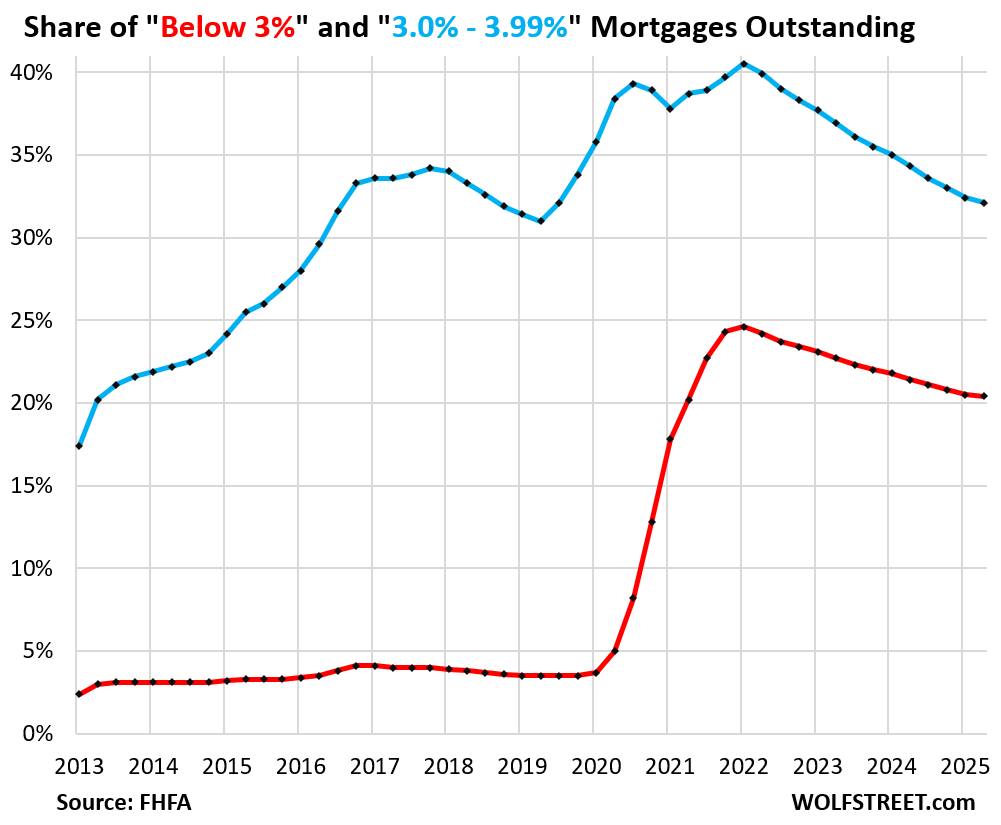
Core Insights - The share of below-3% mortgages has declined to 20.4% in Q2, the smallest since Q2 2021, indicating a slow exit from the "lock-in effect" for homeowners and investors [1][8] - The share of 3%-3.99% mortgages decreased by 30 basis points to 32.1%, the lowest since Q3 2019, reflecting a broader trend of rising mortgage rates [1][8] - The overall mortgage landscape is characterized by a significant decline in ultra-low-rate mortgages, with the share of 4.0%-4.99% mortgages dropping to 17.9%, the lowest since 2013 [8][11] Mortgage Rate Trends - The ultra-low mortgage rates that emerged in early 2020 led to a surge in refinancing, with 65% of all mortgages outstanding having rates of 3.99% or below by Q1 2022 [2][5] - The share of mortgages with rates of 6% or higher rose to 19.7% in Q2, the highest since Q4 2015, as home sales and refinancing activities have significantly declined [11][12] - The share of mortgages in the 5.0%-5.99% range has remained stable at around 9.9% in Q2, indicating a balance between new originations and payoffs [12][13] Economic Context - The ultra-low-rate mortgages were a result of the Federal Reserve's quantitative easing (QE) policies, which began in 2009 and intensified in 2020, leading to historically low mortgage rates [15][16] - The Fed has since initiated quantitative tightening (QT), shedding $2.36 trillion in assets to address the inflation and housing market distortions caused by previous policies [16][18] - The period of negative "real" mortgage rates, where mortgage rates were below inflation, peaked with rates below 3% and CPI inflation exceeding 7%, creating unsustainable conditions in the housing market [18]
NY Fed official flags strong liquidity ahead of potentially choppy quarter end
Yahoo Finance· 2025-09-29 13:36
Core Insights - The Federal Reserve Bank of New York indicates that money markets are currently well-supplied with liquidity, and the central bank has tools to manage temporary disruptions, suggesting that some volatility in money market rates is normal and healthy [1][2]. Group 1: Market Conditions - Julie Remache, a key official, states that reserves remain abundant, implying no immediate need to halt the quantitative tightening (QT) process [2]. - The upcoming quarter-end is typically associated with increased volatility in money markets, which may be exacerbated by the Fed's actions [3]. - The Fed's bond holdings have decreased from a peak of $9 trillion to $6.7 trillion as part of its strategy to reduce excess liquidity introduced during the COVID-19 pandemic [4]. Group 2: Liquidity and Repo Rates - The contraction of liquidity has primarily removed excess cash that was not needed in the markets, with the overnight reverse repo facility shrinking from $2.6 trillion at the end of 2022 to negligible levels [5]. - As QT progresses, it will begin to reduce steady levels of reserves, increasing the potential for unexpected market pressures [5]. - Market participants are anticipating significant activity in Fed liquidity facilities, with estimates of up to $300 billion in reverse repo inflows as they seek short-term cash parking solutions [6]. Group 3: Standing Repo Facility (SRF) - The Standing Repo Facility (SRF), established in 2021, is designed to provide cash loans in exchange for bonds, acting as a short-term buffer for liquidity shortages [7]. - The SRF allows the Fed to monitor longer-term trends while continuing with QT, reducing the need for direct market interventions to manage liquidity [7].
Fed's Standing Repo Facility on track for big test at end of September
Yahoo Finance· 2025-09-17 13:33
Core Viewpoint - The Federal Reserve's liquidity facilities are expected to experience significant activity as the month closes, impacting the central bank's balance sheet reduction process [1][2]. Group 1: Liquidity Facilities - The Fed's reserve repo facility and the Standing Repo Facility (SRF) are anticipated to see major inflows due to month- and quarter-end volatility, amidst ongoing balance sheet reductions that are limiting liquidity [2][3]. - Analysts from Wrightson ICAP project that the reverse repo facility could increase from negligible usage to as high as $275 billion by the end of the month [3]. - The SRF is expected to see inflows of around $50 billion by September 30, significantly higher than the $11 billion recorded on June 30 [4]. Group 2: Market Dynamics - Accurately assessing market liquidity at quarter-end is challenging due to transient factors affecting money flow, which are often reversed at the start of a new quarter [5]. - The performance of the Fed's tools is crucial for maintaining control over short-term interest rate targets, which is influenced by the management of its cash and asset holdings [6]. Group 3: Interest Rate Expectations - The Fed is anticipated to raise its benchmark interest rate by 25 basis points following its upcoming policy meeting, with a policy statement and economic projections to be released [7]. - Since 2022, the Fed has been reducing its balance sheet, which had expanded to approximately $9 trillion during the pandemic, as part of efforts to normalize market liquidity [8].
Ongoing inflation is more important than a Fed rate cut, says Charles Schwab's Kathy Jones
Youtube· 2025-09-15 19:13
Core Viewpoint - The bond market's reaction to Federal Reserve actions is critical, with inflation trends being a more significant driver of bond yields than Fed rate cuts [3][4][6]. Group 1: Federal Reserve Actions - The Federal Reserve's potential rate cuts are largely anticipated by the market, but the actual impact on borrowing costs, such as mortgage rates, remains uncertain [2][4]. - The Fed's balance sheet management, including quantitative easing (QE) and quantitative tightening (QT), is crucial for influencing long-term bond yields [9][10]. Group 2: Inflation and Economic Conditions - Inflation remains a key concern, with current rates around 3% and showing signs of increasing, which complicates the economic landscape and poses risks of stagflation [3][7]. - The bond market is experiencing hesitancy in longer-term investments due to inflation expectations and significant fiscal deficits in various countries [6][7]. Group 3: Market Dynamics - There is a possibility of a bond market rally following Fed rate cuts, but it may not be sufficient to lower mortgage rates below 6% [8]. - The dynamics of supply and demand for bonds, particularly longer-term bonds, are influenced by investor confidence and the Fed's actions regarding its bond holdings [6][7].

Andrew Bailey under political attack on all fronts
Yahoo Finance· 2025-09-15 09:00
Core Viewpoint - The article discusses the growing criticism of the Bank of England's approach to managing interest on reserves and the implications of quantitative easing (QE) on public finances, highlighting the urgent need for reform in light of rising government borrowing costs and losses incurred by the Bank. Group 1: Criticism of Current Policies - Louise Haigh calls for a more strategic unwind of QE and criticizes the excessive cash given to commercial banks at taxpayers' expense [1] - Richard Tice highlights that the current approach is leading to tens of billions in losses and urges the Bank to stop selling bonds and reduce interest payments to banks [2][5] - The Bank of England's profits have diminished significantly, with forecasts indicating a potential loss exceeding £130 billion by 2033 [2][3] Group 2: Financial Implications of QE - The QE scheme has created £895 billion in electronic money, leading to annual costs exceeding £20 billion, which is viewed as a catastrophic expense during fiscal constraints [4] - The Treasury is now required to refund the Bank, which initially profited over £120 billion from QE but is now facing substantial losses due to higher interest rates and lower bond prices [3][4] - The current fiscal situation necessitates a reevaluation of the Bank's policies to alleviate pressure on government borrowing costs [8][15] Group 3: Calls for Coordination and Reform - There is a coalition of voices from various political factions urging the Bank to adjust its policies to mitigate financial strain on the government [5][8] - David Aikman suggests that the Treasury and the Bank should coordinate to limit the costs of quantitative tightening (QT) on public finances [14][16] - Proposals include ceasing bond sales and potentially imposing a tax on income from the Bank to generate additional revenue for the government [19][22] Group 4: Future Outlook and Decisions - The Bank is expected to make decisions regarding the pace of QT, with predictions of slowing down active sales to avoid market disruptions [20][21] - Analysts are working on estimates to counter claims that QE has become a financial burden, emphasizing the long-term benefits of lower debt issuance costs [12][18] - The Chancellor's upcoming letter to the Bank may not lead to significant changes in monetary policy, as the MPC retains operational independence [13][23]