Economic uncertainty

Search documents
Insiders are winning more CFO turnovers: Crist Kolder
Yahoo Finance· 2025-09-10 15:56
Group 1 - The trend of hiring external CFOs has reversed, with internal hires rising significantly in the first half of 2025 [3][6] - Only 15.1% of CEO turnovers in the first half of the year were external hires, a decrease from 21% in 2024 and below the historical average of 22% [4] - The share of public companies appointing CFOs from within their ranks increased to nearly 71.8% in the first half of 2025, up from 52.9% last year, surpassing the historical average of 62% [6] Group 2 - Major companies like Jack in the Box, Lockheed Martin, and Automatic Data Processing have filled CFO positions with internal candidates [6] - The shift towards internal hiring may be influenced by economic uncertainty, with companies preferring candidates with institutional knowledge [6] - There is an observable trend of companies focusing on succession planning and internal talent development for both CFO and CEO roles [4][6]
Flowers Foods, Inc. (FLO) Presents At Barclays 18th Annual Global Consumer Staples Conference 2025 Transcript
Seeking Alpha· 2025-09-04 22:37
Group 1 - The consumer is currently facing pressures related to inflation and the job market, which is consistent with broader market trends [1] - The company's category is unique due to the presence of private label products, which have been in long-term decline but typically see a rise during economic uncertainty [1]



The Beige Book: Summary of Commentary on Current Economic Conditions by Federal Reserve District
Federal Reserve· 2025-09-04 03:28
National Summary - Overall economic activity remained mostly unchanged across the twelve Federal Reserve Districts, with four Districts reporting modest growth [12] - Consumer spending was flat to declining due to wages not keeping pace with rising prices, leading to promotions in retail and hospitality sectors [12] - Manufacturing firms are shifting to local supply chains and increasing automation, while data center construction is a noted strength in commercial real estate [12] Labor Markets - Eleven Districts reported little or no change in employment levels, with some firms hesitant to hire due to weaker demand [13] - Wage growth was modest across half of the Districts, while a reduction in immigrant labor availability was noted, impacting sectors like construction [13] Prices - Ten Districts reported moderate or modest price growth, with tariff-related increases being a common theme [15] - Many firms hesitated to raise prices due to customer sensitivity and competition, despite rising input costs [15] Highlights by Federal Reserve District - **Boston**: Economic activity expanded slightly, with flat consumer spending and moderate home sales [16] - **New York**: Economic activity declined slightly, with modest wage growth and strong input price increases [17] - **Philadelphia**: Business activity increased modestly, with steady employment levels and rising inflation expectations [18] - **Cleveland**: Business activity increased slightly, but demand remained flat due to uncertainty [19] - **Richmond**: Modest growth driven by consumer spending, with flat manufacturing activity [20] - **Atlanta**: Slight decline in economic activity, with moderate price increases and steady employment [21] - **Chicago**: Modest increases in consumer spending and manufacturing activity, with moderate price growth [22] - **St. Louis**: Unchanged economic activity, with concerns about immigration policies affecting labor supply [23] - **Minneapolis**: Slight contraction in economic activity, with a decline in consumer spending [24] - **Kansas City**: Generally flat economic activity, with modest wage pressures and input price growth [25] - **Dallas**: Modest rise in economic activity, with slow hiring and persistent price pressures [26] - **San Francisco**: Slight decline in economic activity, with stable lending and modest price increases [27] Federal Reserve Bank of Boston - Economic activity expanded slightly, with mixed results across sectors and modest price increases [28] - Consumer spending was flat, while manufacturing sales rose modestly, particularly in AI-related products [32] Federal Reserve Bank of New York - Economic activity continued to decline slightly, with modest wage growth and rising input prices [37] - Manufacturing activity picked up modestly, while service sector activity declined [45] Federal Reserve Bank of Philadelphia - Business activity increased modestly, with steady employment levels and moderate wage growth [53] - Firms reported concerns about rising tariffs and their impact on inflation expectations [62] Federal Reserve Bank of Cleveland - Slight increase in overall business activity, with flat consumer spending and modest wage pressures [73] - Manufacturers reported flat demand due to trade policy uncertainty [80] Federal Reserve Bank of Richmond - Continued modest growth in the economy, with increased consumer spending and flat manufacturing activity [88] - Wage growth remained moderate, with price growth picking up in retail and wholesale services [90] Federal Reserve Bank of Atlanta - Slight decline in economic activity, with steady employment and moderate price increases [21] - Consumer spending slowed, particularly in leisure travel [21] Federal Reserve Bank of Chicago - Modest increases in economic activity, with consumer spending and manufacturing activity rising [22] - Prices rose moderately, with financial conditions loosening slightly [22] Federal Reserve Bank of St. Louis - Economic activity remained unchanged, with concerns about immigration policies affecting labor supply [23] - Prices and wages increased at a faster pace recently [23] Federal Reserve Bank of Minneapolis - Slight contraction in economic activity, with a decline in consumer spending and manufacturing [24] - Wage pressures were moderate, with slight improvements in construction activity [24] Federal Reserve Bank of Kansas City - Economic activity was generally flat, with modest wage pressures and broad-based input price growth [25] - Expectations of sustained price pressures were noted [25] Federal Reserve Bank of Dallas - Modest rise in economic activity, with slow hiring and persistent price pressures [26] - Loan demand grew, but the housing market remained weak [26] Federal Reserve Bank of San Francisco - Economic activity edged down slightly, with stable lending activity and modest price increases [27] - Conditions in agriculture and retail trade eased slightly [27]
2 Air Freight & Cargo Stocks to Keep An Eye On Amid Demand Woes
ZACKS· 2025-08-13 17:41
Core Viewpoint - The Zacks Transportation—Air Freight and Cargo industry is facing significant challenges due to ongoing supply-chain disruptions, high inflation, and weaker demand, leading to reduced package volumes [1][4]. Industry Overview - The industry comprises companies providing air delivery and freight services, with many offering specialized transportation and logistics solutions. The health of these companies is closely tied to the overall economy, with major players like FedEx transporting millions of packages daily [3]. Key Trends - **Economic Uncertainty & Tariff Concerns**: The industry is affected by market volatility and tariff uncertainties, particularly with China, which may lead to higher costs and dampen consumer spending [4]. - **Demand Slowdown**: A decline in shipping demand, especially in Asia and Europe, is negatively impacting key players like UPS and FedEx, leading to withheld earnings and revenue forecasts [5]. - **Strong Financial Returns for Shareholders**: Companies are increasing dividends and buybacks to reward shareholders, indicating financial strength. UPS raised its quarterly dividend to $1.64 per share, while FedEx increased its dividend by 5.1% to $1.45 [6]. Industry Performance - The Zacks Air Freight and Cargo industry ranks 202, placing it in the bottom 18% of 245 Zacks industries, indicating poor near-term prospects [7][8]. - The industry has underperformed the S&P 500, decreasing by 26.5% over the past year compared to the S&P 500's increase of 17.7% [9]. Current Valuation - The industry is currently trading at an enterprise value-to-EBITDA (EV/EBITDA) ratio of 7.97X, significantly lower than the S&P 500's 17.45X and the sector's 9.37X [12]. Stocks to Watch - **FedEx (FDX)**: The company is focused on rewarding shareholders through dividends and buybacks, with a solid liquidity position and cost-cutting efforts driving its bottom line. FDX has surpassed earnings estimates in two of the last four quarters [16][17]. - **GXO Logistics (GXO)**: The company is enhancing its logistics capabilities, benefiting from increased e-commerce and automation. GXO has consistently surpassed earnings estimates, with shares rising 9.7% over the past year [19].




When political leaders meddle in government data, it rarely ends well, says reporter
MSNBC· 2025-08-04 13:25
Government Data Manipulation Risks - Political leaders meddling in government data rarely ends well, as seen in Greece, China, and Argentina [1][2] - Undermining data integrity erodes a country's international standing and increases borrowing costs [2][4] - Accurate data is crucial for citizens to hold leaders accountable and for informed decision-making [5] Economic and Investment Implications - Data manipulation creates uncertainty for investors and companies making capital expenditure decisions [10][11] - Distrust in government data can undermine confidence in the country's credibility domestically and internationally [4][13] - The US is at a critical juncture, and the integrity of data production needs to be maintained to avoid a loss of confidence [7][8] Historical Parallels and Warnings - Argentina's systematic understatement of inflation led to a loss of international confidence and a debt crisis [2][3] - Greece's prosecution of the head of its statistical agency further eroded its international standing [1][5] - Janet Yellen likens the US situation to that of a banana republic, highlighting the severity of the concern [6]

Dining demand is steady despite uncertainty, says OpenTable CEO #shorts #dining #nyc #economy
Bloomberg Television· 2025-07-17 19:13
Dining Trends - Despite economic uncertainty, people continue to prioritize dining out across all price points [1] - The industry observes year-over-year growth even in the $50 per person and up segment [2] - Restaurants are largely full and busy, indicating sustained consumer demand [2] Consumer Behavior - Consumers are willing to allocate discretionary income to restaurant experiences [1] - People want to go out to restaurants, have a good time, and enjoy good food [2]

What’s Keeping the Fed on Hold? | Presented by CME Group
Bloomberg Television· 2025-06-26 15:33
Monetary Policy - The Federal Reserve maintained the Fed funds rate unchanged for the fourth consecutive time, continuing to monitor inflation and labor market data amid economic uncertainty [1] - The chairman highlighted uncertainty regarding the inflationary effects of tariff policy, noting that these effects are expected to become more apparent in the coming months [1] - Futures markets are pricing in over 60 basis points (0.6%) of rate cuts by the end of 2025 [2] Economic Projections - The Fed reduced its GDP growth projection for 2026 to 1.4%, a decrease of over 0.6% from current levels above 2% [3] - Inflation expectation projections were raised to 3%, raising concerns about a potential stagflationary period possibly fueled by exogenous forces [3] Upcoming Data - The CPI data on July 15th is expected to provide a clearer picture of the inflation path and could influence expectations for the next Fed rate cut [3]
Economic uncertainty isn't unusual from a historical stance, says Deutsche Bank's Bankim Chadha
CNBC Television· 2025-06-24 17:41
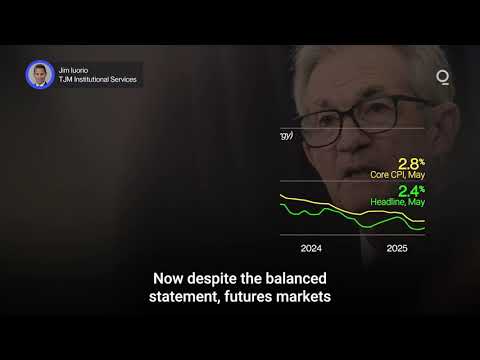
Market Trends & Analysis - Deutsche Bank chief global strategist Bankim Chadha discusses Fed Chair Powell's testimony and the bond market [1] Financial Institutions - Deutsche Bank's perspective on the bond market is highlighted [1]

Coop Pank AS results for May 2025
Globenewswire· 2025-06-11 05:00
Core Insights - Coop Pank is experiencing solid growth in its loan portfolio due to lower loan burdens and improved investment opportunities, despite ongoing economic uncertainty [1] - The bank has successfully reduced its deposit volume while securing long-term funding through covered bond issuance, allowing for a decrease in more expensive deposits [2] - Coop Pank has expanded its Teacher's Home Loan product to include vocational school teachers and has received recognition as the most recommended bank in Estonia [3] - A new cashback loyalty program has been launched in collaboration with Coop retail, offering customers 1% back on purchases made with Coop Pank debit cards [4] - The bank reported a net profit of 2.4 million euros in May, with a return on equity of 13.1% and a cost-to-income ratio of 50% [5] Financial Performance - The number of clients increased by 1,500 in May, reaching a total of 216,000, while active clients decreased by 800 to 102,400 [6] - Customer deposits decreased by 47 million euros in May, totaling 1.76 billion euros, while the loan portfolio increased by 29 million euros to 1.90 billion euros [6] - Year-over-year, the customer base has grown by 11%, and the loan portfolio has increased by 19% [6] - The bank's net income for the first five months of the year decreased by 17% compared to the same period last year, totaling 12.1 million euros [6]

Should You Invest $1,000 in TGT today?
The Motley Fool· 2025-06-06 08:15
Core Viewpoint - Target is facing significant challenges despite its long history of dividend increases and a high yield of 4.8%, as it has underperformed compared to the S&P 500 over the last five years [1] Group 1: Market Conditions - Retailers, including Target, are experiencing pressure due to consumer spending tightening amid inflation and economic uncertainty, with consumer sentiment at its lowest since 2022 [3] - Competitors like Walmart and Costco have managed to grow revenue and maintain margins despite macroeconomic challenges, while Target has seen a decline in foot traffic [4] Group 2: Financial Performance - Target has reduced its guidance in its latest earnings announcement, indicating a third consecutive fiscal year of adjusted earnings-per-share (EPS) declines, leading to skepticism among investors [6] - Despite declining sales and earnings, Target remains a profitable business with EPS and free cash flow (FCF) per share significantly higher than its dividend per share, having raised its dividend for 53 consecutive years [8] Group 3: Dividend Analysis - Target's current situation is unique as its dividend remains affordable despite a stock price at six-year lows, with a high FCF yield of 8.2% compared to its 4.8% dividend yield [10][11] - A $1,000 investment in Target would yield approximately $48 in annual dividend income, significantly more than the expected $13 from an S&P 500 index fund [13] Group 4: Strategic Outlook - Management is focusing on turning the business around by improving efficiency and revamping the product lineup, while also needing to manage costs and align inventory with consumer behavior [7] - Target's strengths, such as the Target Circle loyalty program and exclusive partnerships, could help in its turnaround strategy, despite challenges in competing on price with larger retailers [12]