
GDP growth

Search documents
Fed Chair Powell: The base line would be solid growth next year
CNBC Television· 2025-12-10 20:05
Economic Outlook - The forecast suggests an optimistic outlook for next year due to additional GDP growth, easing inflation, and a steady unemployment rate [1] - Outside forecasts also indicate a pickup in growth [2] - Consumer spending has been resilient, contributing to the growth [2][4] - AI spending on data centers and related areas has been supporting business investment [2][4] - Fiscal policy is expected to be supportive [4] Growth Expectations - The baseline expectation for next year is a pickup in growth from the current 1.7% [3] - The SCP median growth is 1.7% for this year and 2.3% for next year [3] - Adjusting for the shutdown, the growth would be 1.9% and 2.1% for 2025 and 2026 respectively [3]

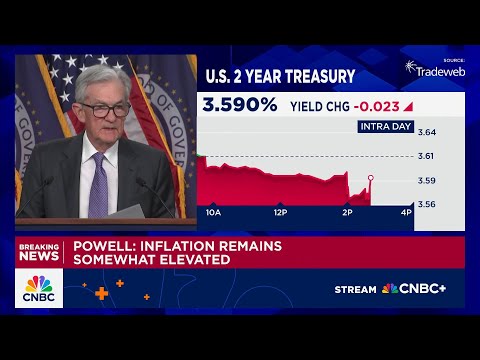
Fed Chair Powell: The base line would be solid growth next year
Youtube· 2025-12-10 20:05
Economic Outlook - The economic outlook for next year appears optimistic due to additional GDP growth, easing inflation, and a steady unemployment rate [1] - The forecast indicates a pickup in growth from the current low level of 1.7% to 2.3% for next year, with adjustments accounting for previous shutdown impacts [3] Drivers of Growth - Key drivers of the positive forecast include resilient consumer spending and sustained business investment in AI-related sectors, particularly data centers [2][4] - Fiscal policy is expected to remain supportive, contributing to solid growth alongside ongoing AI spending [4]

We're expecting 2026 U.S. GDP growth of 2.2%, says Mastercard's Michelle Meyer
CNBC Television· 2025-12-10 17:47
Economic Outlook - Mastercard Economic Institute expects US GDP growth of 22% in 2026, driven by AI and trade realignment [2] - The Institute anticipates moderate inflation in the US, with continued disinflation in the services sector [7][8] - Global GDP is forecasted to grow by 31% [14] Consumer Spending - Black Friday spending increased by 41% year-over-year [4] - The Institute projects mid-3% growth for overall holiday spending [4] - US spending on e-commerce from Chinese mainland initially grew by 20% year-over-year (January-April) but contracted by 6% (May-September), offset by increased European spending on Chinese mainland e-commerce [6] Labor Market & Investment - Despite some slowdown in job creation in 2025, active investment in the digital economy and AI continued [10] - Lower-income tiers are experiencing a slowdown in wage growth compared to higher-income populations [13] Uncertainty & Policy - Policy changes can create uncertainty, causing businesses to pause and wait for clarity [9]


Blanch: Oil faces mild downside, but the floor is solid
CNBC Television· 2025-12-09 13:07
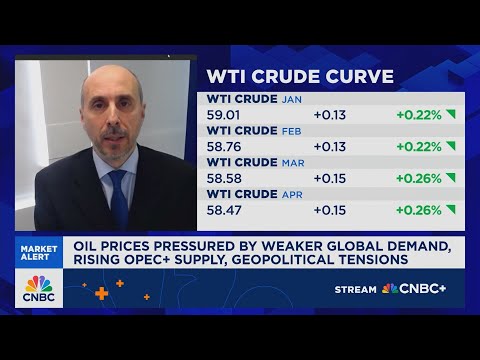
All right, why don't we start off with your uh forecast for the average price for both WTI and Brent coming up in the new year. It's kind of pretty much where we're at right now. Why do you see things pretty much being flat on average.>> So, we just to be clear, we have a $60 a barrel um brand forecast and $57 a barrel WTI forecast average for next year. And uh we think prices will likely be a little weaker in the first half of next year and maybe uh things can improve into the second half. Um now remember ...
Bessent says U.S. will finish the year with 3% GDP growth, sees 'very strong' holiday season
CNBC· 2025-12-07 20:19
Economic Overview - U.S. Treasury Secretary Scott Bessent indicated a "very strong" holiday shopping season and predicted a robust end to the year for the U.S. economy [1] - The economy has outperformed expectations with a reported 4% GDP growth in several quarters, and a forecast of 3% real GDP growth for the year despite challenges such as the Schumer shutdown [2] GDP Performance - The Bureau of Economic Analysis reported a contraction of 0.6% year-over-year in GDP for the first quarter of 2025, followed by a significant increase of 3.8% in the second quarter [2] - Initial estimates for third-quarter economic results are set to be published on December 23, with the Federal Reserve Bank of Atlanta projecting an annual GDP growth of 3.5% for that quarter [3] Consumer Sentiment - Consumer spending, which constitutes nearly 70% of U.S. GDP, remains pessimistic, as indicated by the University of Michigan's consumer sentiment survey, which recorded a score of 53.3 in December. This reflects a 4.5% increase from November but a 28% decrease compared to the same period last year [3]

RBI GDP Growth 2025: Central bank raises FY26 growth forecast to 7.3%
The Economic Times· 2025-12-05 04:41
Economic Growth Projections - The Reserve Bank of India raised its GDP growth estimate for Q3 FY26 to 7.0% from 6.4% and for Q4 FY26 to 6.5% from 6.2% [1][15] - Projections for Q1 FY27 were increased to 6.7% from 6.4%, and for Q2 FY27, growth is projected at 6.8% [1][15] Recent Economic Performance - India's economy recorded a six-quarter high growth of 8.2% in the July-September period, driven by increased consumer demand following a reduction in goods and services tax (GST) [2][15] - The GDP growth in the preceding quarter was 7.8%, and 5.6% in the same quarter of the previous fiscal year, indicating a statistical boost from a low base [4][15] Factors Influencing Growth - Strong agricultural performance and easing inflation are contributing to rural consumption growth, which is expected to continue into the first half of FY27 [8][15] - The recent GST reforms, which introduced a two-slab structure of 5% and 18%, have lowered taxes on various household goods, further supporting consumption [10][15] Trade Relations and Future Outlook - Ongoing negotiations for a US-India trade deal could potentially lift growth to around 8% [9][10][15] - India's Chief Economic Advisor highlighted the economy's relative stability and growth potential amid global uncertainties [11][15] Long-term Economic Position - India is projected to become the world's fourth-largest economy by the end of FY 2025-26, having moved from the tenth to the fourth largest economy in just 11 years [12][16] - This growth trajectory is attributed to sustained economic growth and strategic reforms implemented by the government [13][16]


Musk thinks AI is the only solution to the US $38T debt. 💰
Yahoo Finance· 2025-12-01 21:53
He thinks that AI and robotics can really solve this debt situation by ultimately ramping up productivity that could then impact real GDP growth. What I'm skeptical about here is that he says that this timeline is about 3 years from now. But what we're hearing from these companies is that this timeline, we're waiting to see this all kind of come to fruition.>> When you think about the the debt picture, what helps obviously is is faster GDP growth. If you look at 2026, the AI capex spent is definitely suppor ...

Sensex, Nifty hit fresh highs in early trade
Rediff· 2025-12-01 05:25
Core Insights - Equity benchmark indices Sensex and Nifty reached all-time highs due to positive investor sentiment following India's GDP growth of 8.2% in Q2 FY26, marking the fastest growth in six quarters [1][4] Market Performance - The BSE Sensex increased by 452.35 points to a record high of 86,159.02, while the NSE Nifty rose by 122.85 points to a lifetime high of 26,325.80 [2][3] - Key gainers included Adani Ports, Bharat Electronics, Eternal, Tata Motors Passenger Vehicles, State Bank of India, and Kotak Mahindra Bank, while laggards were ITC, Bajaj Finance, Titan, and Tech Mahindra [4] Economic Context - The 8.2% GDP growth in July-September was attributed to front-loading of production ahead of GST rate cuts, which boosted consumption and mitigated the effects of high US tariffs [4] - Analysts suggest that new record highs for the Nifty may become the norm, supported by broad-based sectoral strength [5] Investment Activity - Foreign Institutional Investors (FIIs) sold equities worth ₹3,795.72 crore, while Domestic Institutional Investors (DIIs) purchased stocks worth ₹4,148.48 crore [6] - Brent crude oil prices increased by 1.62% to $63.39 per barrel, indicating potential implications for sectors sensitive to oil prices [6]
RBI MPC 2025 ET Poll: Rate cut likely amid low inflation, high growth; tough call for Malhotra & co.
The Economic Times· 2025-12-01 00:30
Core Insights - The Indian economy grew at 8.2% in the second quarter of FY26, surpassing the RBI's projection of 6.8%, marking the fastest growth in six quarters [5][8] - Retail inflation dropped to 0.25% in October, the lowest since 2015, complicating the RBI's monetary policy decisions [5][8] - A poll of 20 economists showed 12 expect a 25 basis points rate cut to 5.25%, while 8 anticipate the rate will remain unchanged [8] Economic Growth - The nominal GDP growth for the second quarter was recorded at 8.7%, slightly down from 8.8% the previous year [5][8] - Economists are cautious about future growth, with expectations of a slowdown in the second half of FY26 [7][8] Inflation Forecast - The RBI has revised its full-year FY26 inflation estimate down to 2.6% from 4.2% in February, with forecasts of 4% in Q4 FY26 and 4.5% in Q1 FY27 [6][8] - Current estimates suggest inflation could undershoot the RBI's forecast by 50-60 basis points, potentially supporting a rate cut in December [7][8] Monetary Policy Outlook - The RBI has cut the policy rate by 100 basis points since February, maintaining a pause since August, while rates on outstanding loans have decreased by 54 basis points [8] - Economists express mixed views on the upcoming RBI rate decision, with some indicating a need for caution due to low nominal growth numbers [7][8]
2 big things to watch in the economy: AI & Trump's Fed pick
Youtube· 2025-11-26 20:38
Economic Growth Outlook - The economy is expected to see a slight pickup in growth, with GDP growth projected to be around 4.2% for Q3 and 4% for Q2 [25] - Job growth is anticipated to average around 80,000 for 2026, an increase from the recent average of 70,000 to 60,000 [19] AI's Impact on the Economy - AI spending currently represents about 1.5% of GDP, contributing approximately 25% to the overall GDP growth [6][7] - While AI is a significant driver of growth, it is not in bubble territory, and companies are expected to continue investing in AI [10][11] Federal Reserve Policy and Leadership - The potential nomination of Kevin Hasset as the next Fed chair may lead to a more dovish approach, but consensus among committee members will still be necessary [12][14] - The Fed is expected to implement two more rate cuts, but challenges remain in achieving a dovish policy due to elevated inflation [15][14] Labor Market Dynamics - The labor market is showing signs of strength, with a notable increase in construction employment and a rise in labor force participation [21][28] - The recent jobs report indicated a payroll increase of 119,000, although the unemployment rate rose to 4.4% [21]
