Oil Prices

Search documents
X @Bloomberg
Bloomberg· 2025-09-05 11:38
Market Analysis - Goldman Sachs suggests that an OPEC+ decision to raise production would not necessarily crash oil prices [1]
Petrobras CEO Trump Tariffs, Oil Prices, Supply Chain
Bloomberg Television· 2025-09-02 23:22
Strategy & Outlook - Petrobras aims to balance oil production with energy transition, viewing oil as Brazil's primary export while exploring renewable energy opportunities [6] - The company is adjusting its strategic planning to account for lower oil prices, currently working with a price of $65 per barrel compared to $83 per barrel in the previous strategic plan [17] - Petrobras anticipates that molecules (ethanol, co-processed diesel, biogas, biodiesel) will be a priority until 2035, with wind, photovoltaic, and solar becoming more important thereafter [25][26] Market Dynamics & Trade - Petrobras exports very little to the United States, so a 50% tariff would be manageable by redirecting exports to India, China, and Asia [7] - The company sees India and Asia as potential buyers for increased oil and derivative production [9][10] - Global economic deceleration in countries like China and India could dampen global growth and impact oil demand, potentially leading to lower prices [16] Renewable Energy & Sustainability - Petrobras plans to invest 165 billion (165 * 10^9) USD, which is 165% billion dollars in renewable energy projects, including ethanol, biogas, and co-processed diesel [26][27] - The company is developing a co-processed diesel with 5-10% vegetable oil content, potentially increasing to 20% depending on grain availability [20][21] - Petrobras is implementing a refinery in southern Brazil to produce 15 barrels per day (unit unclear, likely thousand barrels per day) of 100% renewable fuels [28] - Brazil's energy matrix is already 52% clean, and Petrobras aims to support the country in achieving at least 64% renewables [29][30] - Petrobras has reduced CO2 emissions by more than 40% and methane emissions by more than 60% [39] Supply Chain & Project Management - Supply chain issues have caused delays, with delivery times for some goods increasing from two years to three years [12]



X @Bloomberg
Bloomberg· 2025-08-28 17:24
Financial Performance - Alberta is projecting a wider deficit for the current fiscal year [1] Industry Trends - Falling oil prices are denting a key source of revenue for Canada's top energy-producing province [1]
RBC's Croft on Trump-Putin talks: Russian gas flowing into Europe is 'getting way too ahead'
CNBC Television· 2025-08-14 19:00
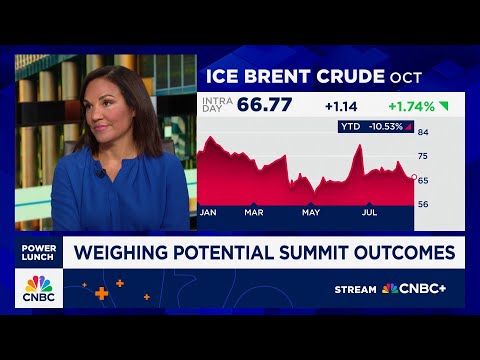
Geopolitical & Economic Context - The meeting between President Trump and Vladimir Putin is critical due to its potential impact on global energy prices [1] - Sanctions relief for Russia is being considered, potentially allowing Russian oil and gas to flow back into Europe [2] - The US has not imposed significant sanctions on Russian energy entities like Rosneft and Gazprom [3] - Russian energy is flowing into Asia, providing Russia with financial resources to continue its military efforts [4] - Russia's economy has not suffered as much as expected due to continued energy sales [5] - Russia is using its financial resources to pay soldiers, potentially recruiting 1,000 people a day, which is double the recruitment rate of Ukraine [5][9][11] - Russia's ability to fund the war, coupled with Ukraine receiving weapons, suggests a prolonged conflict [6] - Both Trump and Biden administrations want to avoid high oil prices, which could result from stricter sanctions on Russia [7] Energy Market Impact - Stricter sanctions on Russia could lead to oil prices rising to $100-120 per barrel [8] - The current approach avoids secondary sanctions on Russian energy companies to prevent higher energy prices for the sanctioning countries [9] - Russia's "ghost fleet" of uninsured or underinsured ships facilitates continued oil sales despite sanctions [8] Socioeconomic Factors - Russia is described as a poor nation, where the opportunity to earn a few thousand dollars motivates men to become mercenaries [10] - Desperate men are being recruited to fight for money, even at the risk of death [5][11]
X @The Wall Street Journal
The Wall Street Journal· 2025-08-10 16:34
Geopolitical Implications - Current oil prices present an opportunity for the US to pressure Moscow to end the war [1]
Trump's tariffs hit dozens of countries, Apple's new $100B investment in the US
Yahoo Finance· 2025-08-07 14:22
Tariffs and Trade - President Trump imposed new tariffs on dozens of countries, boasting billions of dollars flowing into the US [2] - An additional 25% tariff was imposed on India for purchasing Russian oil, stacking on an existing 25% tariff, totaling 50% [2][3] - Switzerland faces a tariff increase up to 39% [4] - President Trump proposed a 100% tariff on semiconductors unless companies commit to building in the US [4] - Companies producing goods in the US would get exemptions from additional tariffs [5] Apple's Investment and Tariffs Impact - Apple announced an additional $100 billion investment in the US, bringing the total US investment to $600 billion over the next four years [6][8] - Apple is launching an American Manufacturing Program to spur more production in America for critical components [9] - Apple is making a $25 billion commitment to produce cover glass for iPhones and Apple Watches at Corning's Kentucky facility [11] - Apple's semiconductor-powered devices, including iPhones, will be unaffected by Trump's 25% reciprocal tariffs on goods made in India [12] - Apple took an $800 million hit from tariffs in Q3 and expects another $11 billion in charges in Q4 [15] Market Movers and Earnings - Eli Lilly's revenue came in at $1556 billion for the quarter, better than the expected $147 billion, but shares fell due to weight loss pill results falling short of expectations [33] - ConocoPhillips' earnings per share came in at $142, better than the expected $134, and shares are up almost 2% in pre-market [36] - Warner Brothers Discovery's revenue came in at $981 billion, topping Wall Street estimates, boosted by HBO Max expansion and blockbuster releases [38] - Krispy Kreme missed expectations with a loss of 15 cents per share, against an expected loss of 12 cents, and revenue came in at $3798 million against an expectation of $3802 million [40] Disney and ESPN Deal - The NFL is set to take a 10% stake in Disney's ESPN ahead of ESPN's standalone streaming launch [20] - Disney CFO Hugh Johnston stated the deal would be accretive by about a nickel before purchase accounting [23] - The NFL stake in ESPN could be worth up to $3 billion [23] Oil Market - President Trump upped US tariffs on India to 50% in retaliation for its purchases of Russian oil, which are estimated to be around 2 million barrels a day [49][50] - OPEC plus made moves to hike output by 547000 barrels per day in September [51] Global Market Overview - Asian semiconductor-related stocks traded mixed after President Trump announced a 100% tariff on chip imports with an exemption for companies building in the US [52] - The Bank of England announced an interest rate cut of 25 basis points to 4% [54]


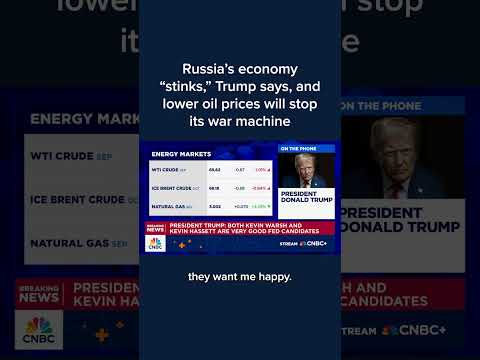
Russia's economy 'stinks,' Trump says, and lower oil prices will stop its war machine
CNBC Television· 2025-08-05 20:01
Energy Market Analysis - Energy price for cars is down to $220 per gallon [1] - Crude oil price is around $65 per barrel and decreasing [1] - OPEC and OPEC plus are increasing drilling activities [1] Geopolitical Impact - Lower energy prices could potentially influence Putin to cease hostilities [1][2] - A further $10 decrease in oil prices per barrel could significantly impact Russia's economy [2]
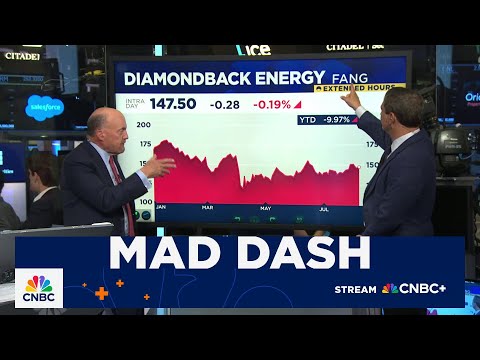
Cramer's Mad Dash: Diamondback Energy
CNBC Television· 2025-08-05 13:49
Oil & Gas Industry Analysis - US shell oil production has likely peaked at current oil prices [2] - Activity levels in the lower 48 (US states) are expected to remain depressed [2] - Oil companies are choosing to return capital instead of putting it in the ground [4] - Oil companies are avoiding repeating the overproduction mistake of 2016, which crushed their margins [4] Company Specifics (Diamondback Energy) - Diamondback Energy is considered a thoughtful company [2] - Diamondback Energy missed their numbers by choice, indicating a strategic decision [2] - Diamondback Energy is choosing not to drill and bring up a lot of oil because prices are depressed [3] - Diamondback Energy has the best properties in the Permian Basin but is not fully utilizing them due to unfavorable returns [4] Market Factors - OPEC plus is putting more barrels on the market, and Russia is pumping oil aggressively [3] - Lower energy prices are bullish for the American economy [4] - Lower insurance costs are contributing to a potentially stronger economy [3]

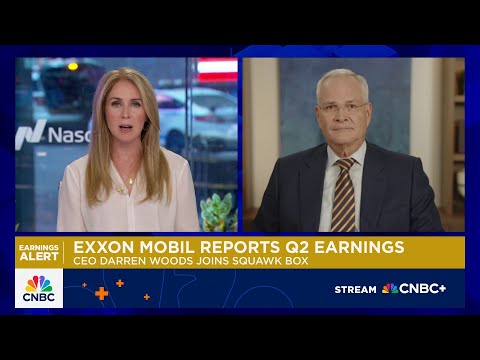
Exxon Mobil CEO on Q2 results: We're prepared for a lower-priced environment
CNBC Television· 2025-08-01 15:16
Market Dynamics - Global demand for transportation fuels, products, and chemicals remains strong, putting pressure on oil pricing [1] - OPEC is unwinding some of its production, impacting supply [1] - The market could become longer in the back end of the year depending on demand and production from national oil companies [2] Financial Strategy & Risk Management - The company is prepared for a lower price environment than current levels [2][3] - Investment plans were developed with a lower price basis in mind [2] - Business and investment scenarios are tested against extreme cases, including pricing worse than COVID [4] - The company can maintain its dividend and continue its buyback program even under adverse pricing scenarios [3][4] - The company has a strong balance sheet [3]

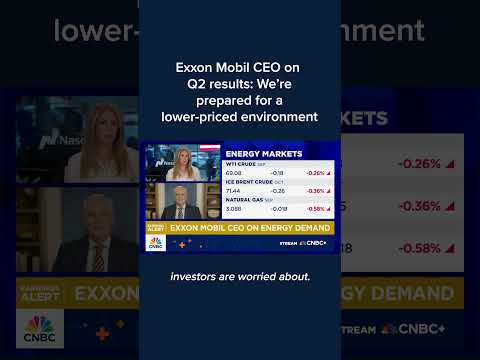
Exxon Mobil CEO Darren Woods on Q2 results: We're prepared for a lower-priced environment
CNBC Television· 2025-08-01 13:04
Financial Performance - ExxonMobil's Q2 earnings beat expectations due to increased production, better product mix, and structural cost reductions, offsetting over half the impact of lower commodity prices [3] - ExxonMobil is confident in maintaining its dividend and share buyback program even under scenarios with significantly lower oil prices than current levels, including those worse than COVID [8][9][10] Market Dynamics & Strategy - Global demand for transportation fuels, products, and chemicals remains strong, but supply challenges are putting pressure on pricing [5] - ExxonMobil is prepared for a potentially lower price environment in the latter half of the year, as OPEC unwinds production and the market may become longer depending on the output of national oil companies [6][7] - The industry balances fierce competition in a commodity business with partnerships around the world, requiring collaboration and competition simultaneously [17][18] Guyana Project & Hess Arbitration - ExxonMobil was surprised by the arbitration outcome regarding the Guyana operating agreement, but the operational impact is unchanged as Chevron will now take Hess's place [11][13][14] - Despite the arbitration loss, ExxonMobil maintains a constructive partnership with Chevron in Guyana and other joint ventures, aiming for successful ventures and value growth [19][20]