Unemployment rate

Search documents
New Century Advisors' Claudia Sahm: Things are 'not normal' at the Fed right now
CNBC Television· 2025-09-17 17:13
like a. >> Big I can't tell you how excited I am. >> When was the last time we talked about the dynamics.>> I'm in. I'm I'm on the edge of my seat. >> Exactly.All right. Let's talk more about it. Joining us is Claudia Sardine, New Century Advisors chief economist and a former fed economist.Claudia, that that will be interesting, right. We'll see who dissents. We'll see how divergent the dot plots are.What are you looking for. >> Yeah. And I want to underscore that even in normal times, like we would expect ...

政策观察 - 9 月FOMC前瞻-Policy Watch - September FOMC Preview
2025-09-15 13:17
Summary of Key Points from the FOMC Preview Industry Overview - The document pertains to the North American economic outlook, specifically focusing on the Federal Open Market Committee (FOMC) and its monetary policy decisions. Core Insights and Arguments - **Rate Cut Expectations**: The FOMC is anticipated to implement a 25 basis point (bp) rate cut at the upcoming meeting, marking the beginning of a series of quarterly "insurance cuts" [5][9][30] - **Cautious Approach to Inflation**: Despite the expected rate cuts, core FOMC members are likely to adopt a cautious stance regarding inflation risks, indicating a gradual approach to easing [5][30] - **Economic Projections**: The median unemployment rate projection for 2025 is expected to remain at 4.5%, with GDP estimates showing a modest upward revision to 1.6% from 1.4% [11][25] - **Dissenting Opinions**: There are expected to be four dissents regarding the decision to cut rates, with some members advocating for a larger 50 bp cut due to recent labor market data [9][28][30] Important but Potentially Overlooked Details - **Labor Market Dynamics**: Despite a slowdown in the labor market, layoffs have remained low, and the unemployment rate has only gradually increased, suggesting that officials may not react strongly to weak non-farm payroll (NFP) data as long as unemployment remains contained [13][18] - **Inflation Risks**: The core Personal Consumption Expenditures (PCE) inflation forecast for 2025 is expected to hold steady at 3.1%, but there are concerns about persistent inflation pressures, particularly in labor-intensive services [19][27] - **Long-Term Projections**: The 2026 median dot is likely to decline to 3.375%, reflecting expectations for additional rate cuts in the following year [7][10] - **Market Reactions**: The markets have priced in aggressive easing in response to disappointing labor data, but the FOMC's cautious approach may temper expectations for rapid rate reductions [5][30] Conclusion - The FOMC's upcoming meeting is set against a backdrop of a slowing labor market and inflation concerns, leading to a cautious yet proactive monetary policy stance. The anticipated rate cut is seen as a necessary measure to manage economic risks while maintaining a focus on inflation and employment stability.
The S&P rally could be running out of steam
Youtube· 2025-09-11 20:23
Economic Outlook - The S&P year-end target is set at 6,600, indicating limited upside potential but also no significant downside risk from current levels [1] - A potential 5 to 10% market pullback is anticipated in September due to various catalysts, including trade uncertainty [2] Labor Market Dynamics - The unemployment rate for the 18 to 34 demographic stands at approximately 10%, raising concerns about job creation for new college graduates [4] - The labor market's weakness is attributed to trade uncertainties and the impact of artificial intelligence on entry-level job availability [3] - The current job creation requirement to maintain stable unemployment is estimated at 150,000 jobs per month, but the new normal may be reduced to 50,000 to 75,000 jobs, with current figures falling below this threshold [5] Demographic Changes - The retirement of 11,000 baby boomers each month contributes to workforce demographic challenges [4] - A decline in immigration further complicates the labor market situation, impacting job availability and unemployment rates [5]
Meet the Press NOW — Sept. 5
NBC News· 2025-09-05 22:04
Welcome to Meet the Press Now. I'm Kristen Welker in Washington where any minute now we are expecting to hear from President Trump. For the first time since today's jobs report showed a dramatic slowdown in the labor market and potential warning signs for the president's economic agenda.The August jobs report from the Labor Department showed just 22,000 new jobs created last month, much lower than economists were expecting, and the unemployment rate ticked up to 4.3%. Even more problematic, the Labor Depart ...
‘They are not pretty’: Nicolle Wallace on another dismal jobs report in Trump’s Presidency
MSNBC· 2025-09-05 21:12
Economic Indicators & Market Reaction - August新增就业岗位仅22,000个 [1] - 失业率小幅上升至4.3% [2] - 纽约时报报道,由于高利率和特朗普政府的关税等经济政策,经济自疫情高峰期以来一直在降温 [2] - 股市最初希望美联储降息而上涨,但随后因担心经济衰退而下跌,道琼斯指数下跌超过200点 [2] Policy Impact & Analysis - 报告认为,就业市场和更广泛的经济放缓是政策导致的,受到关税、移民政策和政府削减开支的影响 [3][4] - 特朗普政府的政策被指责为“自残行为”,与此前专家预测的软着陆(核心通胀率接近2%,经济增长率接近2.5%)背道而驰 [10][11] - 关税和移民政策导致经济放缓的同时,通货膨胀也在上升,对普通民众造成双重打击 [14] Job Market Details - 6月份劳动力市场减少了13,000个工作岗位,是自2020年12月以来的首次负增长 [2] - 前两个月的就业数据被下调了21,000个 [2] - 在过去的四个月里,平均每月新增就业岗位为29,000个 [12] - 如果不包括医疗保健等行业,建筑业和制造业等领域实际上已经损失了142,000个工作岗位 [13] Political Context & Credibility - 特朗普政府被指责歪曲经济数据,前劳工统计局局长因公布“真实数据”而被解雇 [2] - 特朗普声称至少一年内不会有“真实数据” [2] - 劳工统计局的数据收集方式没有改变,数据是真实的,但特朗普政府的政策是经济放缓的原因 [2][3]
BREAKING: U.S. adds only 22K jobs in August, well below estimates
MSNBC· 2025-09-05 15:35
The August jobs report was released moments ago, showing that the US added just 22,000 jobs last month, much much less than the 75,000 that economists expected. The unemployment rate also saw a slight increase to 4.3%. This, of course, the first jobs report released since President Trump fired the head of the Bureau of Labor Statistics last month after that report showed not just a weak level of job creation, but also a dramatic reductions in previous month's totals.There's no way to sugarcoat this. This jo ...
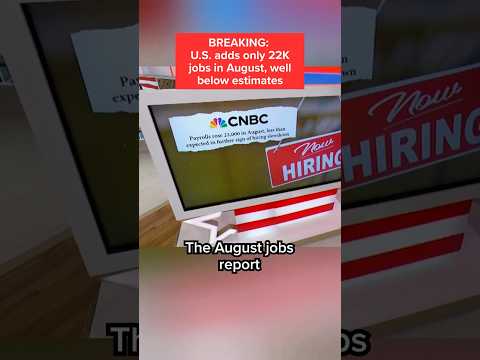
U.S. economy adds just 22,000 jobs in August, far below expectations
NBC News· 2025-09-05 13:58
Labor Market Overview - The US economy added 22,000 jobs in August, significantly below the expected 75,000 [1][2] - The unemployment rate stood at 4.3% [1][9] - Revisions to previous months' reports indicate a potential overestimation of job growth in the past year, with September 9th set to reveal revisions for the past 12 months [3][4][5][8] Sector-Specific Analysis - Healthcare saw robust gains, adding 30,600 jobs [9][10] - Federal government experienced a contraction of 15,000 jobs, influenced by seasonality [10][11] - Manufacturing saw a contraction of 12,000 jobs, a setback for the administration's job creation agenda [11] - Long-term unemployment (27 weeks or more) affected 1.9 million people, an increase of 385,000 so far this year [8][9] Wage and Inflation Trends - Average hourly earnings increased by 3.7% between August of this year and August of last year [14] - This wage growth outpaces the last measured consumer price index (CPI) inflation rate of 2.7% [14] - Wage growth may vary across different demographic groups [15] Monetary Policy Implications - There's a 97% chance the Federal Reserve will lower rates in the upcoming meeting [12] - The labor market's weakness may prompt the Fed to consider more aggressive rate cuts [12][13] Disparities in Unemployment - The black unemployment rate is 7.5%, and the Hispanic unemployment rate is 5.3%, both higher than the national average of 4.3% [13]
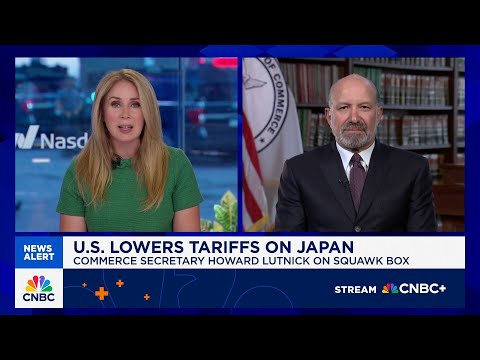
Watch CNBC's full interview with Commerce Secretary Howard Lutnick
CNBC Television· 2025-09-05 12:45
All right, President Trump signing an executive order Thursday that will allow tariffs on auto and other imports from Japan to be coming in at much lower rates, 15% versus the 25 to 27 1.5%. Uh joining us right now to talk about this is Commerce Secretary Howard Lutnik and SE Secretary Lutnik, thank you for being with us today. Let's walk through how this kind of played out and what the specific details are in this agreement. All right. So the Japanese in order to buy down their tariff rate, so they had a 2 ...
Economic data is starting to look weaker and should raise the Fed's eyebrows: Apollo's Torsten Slok
CNBC Television· 2025-09-03 20:20
Welcome back. Economic activity seeing quote little to no growth in recent weeks. That according to the Fed's latest Facebook survey.Investors now looking ahead to this Friday's jobs report for more clarity on where this economy is going. Joining me now to Slack. He is Apollo partner and chief economist.And I mispronounced your last name and you I hope will accept my sincere apologies for that. >> Of course. All good.I've heard many variants of my name over the last many many years. So >> the the correct on ...
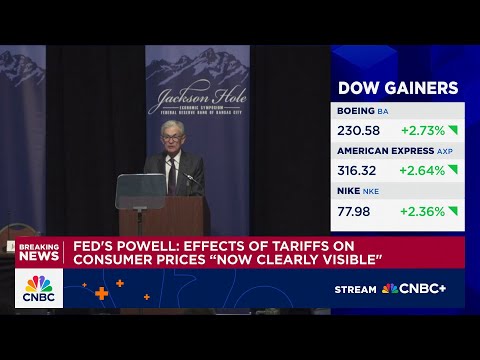
Fed Chair Powell: Labor market is in a 'curious kind of balance'
CNBC Television· 2025-08-22 14:41
Labor Market Conditions - The unemployment rate is at a historically low level of 42% and has been broadly stable [1] - Labor supply has softened in line with demand, lowering the break-even rate of job creation [1] - Labor force growth has slowed considerably due to a sharp falloff in immigration and a decrease in the labor force participation rate, suggesting rising downside risks to employment [2] Economic Growth and Inflation - GDP growth has slowed to a pace of 12%-2% in the first half of the year, roughly half the 25% pace in 2024, reflecting a slowdown in consumer spending [3] - Total PCE prices rose 26% over the 12 months ending in July, while core PCE prices rose 29% [4][5] - Prices of goods increased 11% over the past 12 months, contrasting with the modest decline seen in 2024 [5] Impact of Tariffs - The effects of tariffs on consumer prices are now visible and are expected to accumulate, with uncertainty about timing and amounts [6] - A reasonable base case is that the effects of tariffs will be relatively short-lived, representing a one-time shift in the price level [7] - There is a risk that upward pressure on prices from tariffs could spur a more lasting inflation dynamic [8] Inflation Expectations - Measures of longer-term inflation expectations appear to remain well-anchored and consistent with the long-run inflation objective of 2% [10] - The industry will not allow a one-time increase in the price level to become ongoing inflation [10]