
Inflation

Search documents
Fed official signals openness to more interest-rate cuts this year
Yahoo Finance· 2026-01-19 16:07
Core Viewpoint - The Federal Reserve is facing a divergence in opinions regarding interest rate cuts, with some officials advocating for cuts in response to labor market weaknesses, while others emphasize inflation concerns as a reason to maintain current rates [1][2]. Group 1: Federal Reserve's Stance - Federal Reserve Vice Chair Michelle Bowman suggests that the Fed should be ready to cut interest rates further if the labor market shows signs of weakening [1]. - The current Federal Funds Rate is set between 3.50% and 3.75%, with a total of 75 basis points cut in 2025 [4]. - The Fed's dual mandate requires balancing maximum employment with low inflation, indicating a complex decision-making environment [3][4]. Group 2: Economic Implications - Higher interest rates are associated with lower inflation but can lead to increased job losses, while lower rates can reduce unemployment but may raise inflation [6]. - Economists define the neutral rate, or r-star (r*), as the interest rate that maintains full employment and stable inflation around the Fed's 2% target [5]. - The neutral rate is not fixed and can fluctuate based on various economic factors, including productivity growth and demographic trends [9]. Group 3: Future Projections - The Fed's median projection indicates only one additional 25 basis points cut is expected in 2026 [8]. - The next Federal Open Market Committee (FOMC) meeting is scheduled for January 27-28, with a low probability of a quarter-percentage point cut estimated at 5% [9].
Economics professor warns ‘we definitely have a bubble in the stock market'
Finbold· 2026-01-19 15:42
Core Viewpoint - The Federal Reserve is shifting towards easier monetary policy due to political pressure, which may lead to sustained high prices and inflated asset bubbles [1][3]. Monetary Policy Changes - The Federal Reserve has halted quantitative tightening and is expanding its balance sheet, planning to purchase $40 billion in Treasury bills, indicating a move towards monetizing the deficit [3]. - The consumer price index (CPI) remains at 2.7%, above the Fed's target of 2%, suggesting that inflation is not being effectively controlled [2][3]. Inflation and Asset Bubbles - Monetizing government debt is expected to increase the money supply, leading to higher inflation and asset bubbles, particularly in commodities and the stock market [4][3]. - Predictions indicate that looser monetary conditions will continue to drive up prices of hard assets, with gold, silver, platinum, and copper reaching record highs [7]. Banking Sector Implications - Upcoming regulatory changes will enhance commercial banks' lending capacity, allowing for greater credit expansion and accelerating money growth [5]. Political Influence - The shift in monetary policy is perceived as being influenced by the Trump administration, with expectations that this loosening will persist [6].


US Futures Slide on MLK Day Amidst Fresh Tariff Threats, Global Markets React
Stock Market News· 2026-01-19 11:07
Market Overview - U.S. stock markets are closed on January 19, 2026, for Martin Luther King Jr. Day, with no cash equity trading or after-hours sessions occurring [1] - U.S. equity futures are experiencing notable declines, with E-mini S&P 500 futures down approximately 0.7% to 0.9%, Nasdaq 100 futures down between 1% and 1.2%, and Dow Jones Industrial Average futures sliding by about 0.6% to 0.7% [2] Geopolitical Developments - President Trump announced a 10% tariff on imports from eight European countries, effective February 1, which could escalate to 25% by June 1 if no agreement is reached regarding the U.S. acquisition of Greenland [3] - European leaders are considering retaliatory measures, including activating the EU's Anti-Coercion Instrument, in response to the tariff threats [3] Safe-Haven Assets - Investors are flocking to safe-haven assets, with gold futures surging to a record high above $4,670 an ounce and silver futures reaching a new record above $94 an ounce [4] Global Market Performance - European equity markets are broadly lower, with the STOXX Europe 600 index down approximately 0.9%, Germany's DAX declining by 1.1%, and France's CAC 40 down 1.3% [5] - Asian markets show mixed results, with Japan's Nikkei 225 dipping by 0.7% to 0.8%, while China's economy expanded by 4.5% year-on-year in Q4 2025, despite disappointing retail sales figures [6] Upcoming Market Events - Key economic data and corporate earnings reports are expected to influence market sentiment upon the reopening of U.S. markets [7] - The Personal Consumption Expenditures (PCE) price index and a further estimate of third-quarter GDP growth are scheduled for release, which will be vital for assessing the U.S. economy [8] Earnings Season - The fourth-quarter earnings season is underway, with major companies such as Netflix, Intel, Visa, 3M, Johnson & Johnson, Procter & Gamble, and NextEra Energy set to report their results [10] Major Stock News - BRC Group Holdings reported a significant turnaround with a net income of $89.1 million in Q3, contrasting with a loss in the same period last year [14] - Goldman Sachs shares increased by 4.6% due to record-setting equity trading revenue [14] - European defense stocks are gaining amidst geopolitical tensions, while European car manufacturers are seeing declines due to fears of increased U.S. tariffs [14]

Best CD rates today, January 19, 2026 (Lock in up to 4% APY)
Yahoo Finance· 2026-01-19 11:00
Core Insights - Today's CD rates are significantly higher than the national average, influenced by the Federal Reserve's interest rate cuts in 2025, which may present a final opportunity to secure these elevated rates with certificates of deposit [1] Group 1: Best CD Rates - As of January 19, 2026, the highest CD rate available is 4% APY, offered by Marcus by Goldman Sachs for a 1-year CD [2] - The competitive nature of CD rates is evident, with various financial institutions providing attractive offers [2] Group 2: National Average CD Rates - The national average CD rate for a 1-year term is currently at 1.63%, which is considerably lower than the best available rates [3] - The current average CD rates are among the highest seen in nearly two decades, primarily due to the Federal Reserve's strategy to combat inflation by maintaining elevated interest rates [3] Group 3: Finding the Best CD Rates - To secure the best CD rates, it is advisable to shop around and compare rates from multiple financial institutions [4] - Online banks typically offer more competitive rates due to lower overhead costs, making them a preferred option for consumers [4] - It is essential to check minimum deposit requirements and review account terms, including early withdrawal penalties and auto-renewal policies, to ensure alignment with financial goals [4]
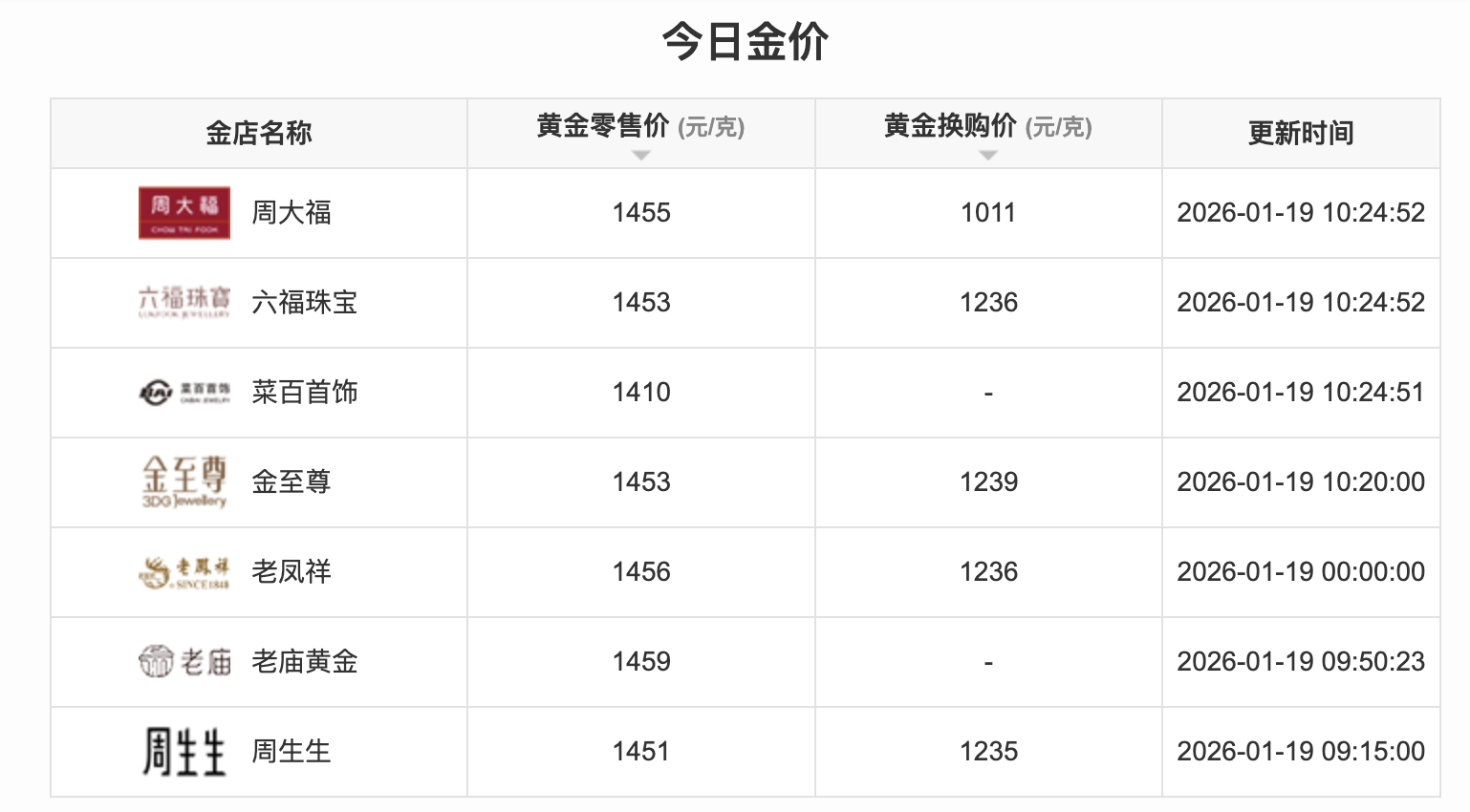
金价再创历史新高!金饰克价日涨24元,最高报1459元
2 1 Shi Ji Jing Ji Bao Dao· 2026-01-19 02:51
Group 1 - The international gold market experienced a significant surge on January 19, with spot gold reaching a historical high of $4,690 per ounce, marking a daily increase of over 2% [1] - COMEX gold futures also rose sharply, peaking at $4,698 per ounce, just shy of the $4,700 mark [1] - Domestic gold jewelry brands in China reported prices at historical highs, with notable increases such as Lao Miao gold at 1,459 yuan per gram, up 24 yuan from the previous day [1] Group 2 - The recent surge in gold prices is attributed to a combination of short-term geopolitical risks and long-term macroeconomic expectations [3] - Reports indicate that former U.S. President Trump announced plans to impose tariffs on eight European countries starting February 1, which may heighten geopolitical tensions and influence precious metal market volatility [3] - Analysts suggest that the core driving logic in the gold market is the interplay between delayed policy easing expectations and persistent inflation realities, with central banks, particularly the Federal Reserve, expected to consider rate cuts by 2026 [3]
美国经济:2025 年经济数据意外表现、我们的预测表现与市场反应-US Economics Analyst_ Economic Data Surprises, Our Forecast Performance, and Market Reactions in 2025
2026-01-19 02:32
Summary of Economic Data Surprises and Market Reactions in 2025 Industry Overview - The report focuses on the US economy, analyzing economic data surprises, forecasting performance, and market reactions related to growth and inflation in 2025 [1][2]. Key Points Economic Growth - The US GDP is projected to have increased just under 2.5% Q4/Q4 in 2025, aligning with the initial forecast of 2.4% and surpassing the consensus forecast of 1.9% [3][4]. - Initial growth forecasts were lowered by 1.9 percentage points due to anticipated large tariffs, but were later adjusted upward after the most disruptive tariffs were scaled back [4][5]. Inflation - The core PCE price index increased by approximately 2.8% Q4/Q4 in 2025, which is higher than the forecast of 2.4% and reflects a modest progress in disinflation [12][16]. - The overshoot in inflation is attributed to larger-than-expected tariffs, contributing an estimated 60 basis points to the year-on-year rate [12][16]. Forecast Performance - The hit rate for economic indicator forecasts averaged 71% in 2025, slightly above the 64% average since 2017, with notable accuracy in GDP (100% correct) and core CPI (90% correct) [16][22]. - The performance lagged for the ISM manufacturing index, achieving only a 44% hit rate, indicating overly optimistic forecasts for manufacturing surveys [22][29]. Market Reactions - Market sensitivity to inflation data surprises was notably high, with stock market reactions at 1.5 times the normal level and bond market reactions at 2.6 times the historical average [29][33]. - The relative importance of the unemployment rate in market reactions has increased, with an estimated 80% weight on unemployment surprises compared to 20% on nonfarm payrolls, reflecting uncertainty in labor market conditions [36][39]. Economic Indicators - The report includes various economic indicators such as consumer expenditures, business fixed investment, and housing market statistics, projecting a mixed outlook for these areas in 2025 and beyond [43][44]. - Notable projections include a decline in residential fixed investment by 2.1% and an increase in business fixed investment by 4.1% in 2025 [43]. Additional Insights - The report highlights the impact of frontloading imports ahead of tariff increases, which distorted GDP measurements due to the differing treatment of imports and inventory investments [8][9]. - The economic outlook for 2026 suggests potential moderation in market reactions due to expected healthy growth and lower inflation, but uncertainties in the labor market may keep reactions elevated [39]. Conclusion - The analysis provides a comprehensive overview of the US economic landscape in 2025, emphasizing the interplay between tariffs, inflation, and market reactions, while also highlighting the forecasting accuracy and challenges faced by analysts in predicting economic trends.

亚洲经济-2026 年十大问题-Asia Economics Analyst_ Ten questions for 2026
2026-01-19 02:29
Summary of Key Points from the Conference Call Industry Overview - The report focuses on the Asia-Pacific economic outlook for 2026, with specific emphasis on China, Japan, India, Taiwan, and New Zealand. Core Insights and Arguments 1. **China's GDP Growth**: - Expected real GDP growth of 4.8% in 2026, surpassing consensus expectations of 4.5%-4.6% due to strong export growth and easing fiscal policy [6][5][4] 2. **Housing Market in China**: - The housing market is not expected to bottom out across all indicators; housing starts are down approximately 80% from peak levels in 2020, while construction activity has fallen about 60% [7][4] - Home prices have significantly declined, with expectations that they will remain lower by the end of 2026 [7][4] 3. **China's Trade Surplus**: - Anticipated to increase further, with a record trade surplus of nearly $1.2 trillion in 2025 expected to rise in 2026 due to competitive manufacturing and a focus on exports [13][14][4] 4. **US Tariff Relief**: - Modest tariff relief expected for Asia, particularly benefiting India, as negotiations continue to lower trade barriers [19][4] - Taiwan has signed an agreement to reduce US tariffs in exchange for significant investments in semiconductor and AI production [21][4] 5. **Japan's Fiscal Policy and Yields**: - No significant rise in bond yields expected post-election; fiscal policy may loosen but will be constrained by market pressures [25][26][4] - The yen is expected to strengthen slightly, moving away from the current weak levels [31][4] 6. **Growth Surprises in Asia-Pacific**: - Taiwan and New Zealand are projected to outperform consensus growth expectations, driven by tech exports and recovering economic conditions, respectively [33][4] 7. **Inflation Outlook**: - Inflation pressures are not expected to drive significant policy shifts among Asia-Pacific central banks, with CPI inflation returning to pre-COVID levels [41][4] - China and Thailand are expected to see continued easing in monetary policy due to low inflation [42][4] 8. **Central Bank Policy Rate Expectations**: - Anticipated tightening in Japan, Taiwan, and New Zealand, with the Bank of Japan expected to resume rate hikes [47][48][4] 9. **Asian Currencies Performance**: - Majority of Asian currencies expected to appreciate against the USD in 2026, with the CNY anticipated to strengthen due to strong fundamentals [52][4] Other Important Insights - The report highlights that most themes from the previous year were accurate, with notable surprises including the rise in government bond yields in China and the underperformance of the Indian Rupee [56][4] - The analysis includes a review of past predictions and their outcomes, reinforcing the credibility of the current forecasts [56][4]
Trump Speech, Earnings and Other Key Things to Watch this Week
Yahoo Finance· 2026-01-18 18:00
Economic Policy and Market Impact - President Trump's upcoming speech is expected to outline economic priorities and policy initiatives, with a focus on tax policy changes, infrastructure spending, regulatory approaches, and trade policy, particularly regarding China [1][2] - The speech's timing amid earnings season and critical economic data releases creates a complex backdrop for market reactions, as political rhetoric and corporate results will compete for investor attention [1][2] Economic Data Releases - Thursday will see a significant convergence of economic data, including the Q3 GDP revision and the November Core PCE Price Index, both released at 8:30am, which could lead to market volatility as investors assess growth and inflation data simultaneously [4] - The GDP revision will provide insights into consumer spending, business investment, and net exports, while the Core PCE Price Index will be crucial for understanding inflation trends [4] Company Earnings Insights - Netflix's earnings report will be critical for understanding the streaming industry's economics, including subscriber growth sustainability and content investment returns, especially in light of competition from platforms like Disney+ and Amazon Prime Video [5] - Intel's earnings will be a key indicator of its manufacturing transformation and competitive positioning in the semiconductor market, while GE Aerospace's results will provide insights into commercial aviation demand and defense spending trends [7] - Johnson & Johnson's earnings will offer perspectives on pharmaceutical demand and healthcare spending trends, while Procter & Gamble's results will assess consumer resilience in personal care and household products [8]


Munis, Mortgage-Backed Securities Among Advisors’ Top Picks for 2026
Yahoo Finance· 2026-01-18 13:00
Core Insights - Municipal bonds are providing elevated returns in 2025, with yields around 6% to 7%, which are historically high, making them attractive for high-net-worth clients [1] - The securitized sector, including agency and non-agency mortgage-backed securities, is considered an attractive investment area due to tight spreads with US Treasuries [2] - Advisors are focusing on fixed income investments, emphasizing quality and tailoring guidance to client-specific needs [3] Municipal Bonds - High-net-worth clients are encouraged to extend maturities in municipal bonds due to their competitive yields [1] - The market's performance will depend on supply and demand dynamics, with expectations of improved conditions compared to the previous year [1] Securitized Sector - Both agency and non-agency mortgage-backed securities are viewed as good investment options, but require extra due diligence due to the lack of government guarantees [2] Fixed Income Strategy - A general theme among advisors is to prioritize quality in fixed income investments, with a focus on not stretching for income [3] - The bond market is expected to steepen, indicating potential volatility in long-term bonds [6][7] Inflation and Interest Rates - The correlation between fixed income and equities has turned negative, which is beneficial for diversified portfolios [4] - The Federal Reserve may ease monetary policy, but interest rates are not expected to return to pre-COVID levels [4] High Yield and Private Credit - There is a slight increase in allocation to high yield bonds, with over 50% rated double B or higher, indicating improved credit quality [8] - Diversification remains crucial, and while high-yield bonds are not being avoided, there is caution against chasing yields [9] - Private credit is seen as valuable, with a focus on high quality and strong management, despite market growth and potential risks [9][10] Investment Outlook - The expectation is for rates to continue to fall due to slowing inflation, with a normalization of the yield curve [5] - Companies are cautious about long-term US Treasuries amid potential market volatility and inflation risks [6]
‘Am I doomed forever?’: Credit card debt overwhelming better-educated US households. How to tackle your debt
Yahoo Finance· 2026-01-18 12:00
Core Insights - The article highlights the increasing burden of credit card debt on American households, particularly among middle-class and well-educated individuals, despite a recent slowdown in inflation [1][6][18] - It emphasizes that a significant portion of Americans are relying on credit cards to manage their living expenses, with many struggling to afford basic necessities [2][4][6] Group 1: Credit Card Debt Statistics - American household debt, including credit card debt, is at a record high, with credit card balances reaching $1.23 trillion as of Q3 2025 [3] - 43% of Americans struggling with credit card debt hold a four-year university or master's degree, an increase from 34% in 2021 [5] - 85% of U.S. workers carry some form of personal debt, with 58% specifically carrying credit card debt [7] Group 2: Consumer Behavior and Economic Impact - Inflation has slowed to 2.7% in November, but consumers have been financing their expenses through credit card debt, leading to over-indebtedness [1][4] - One-third of middle-class families are reported to be struggling to afford basic necessities such as food, housing, and child care [2][4] - The reliance on credit cards is not limited to low-income households, indicating a broader economic issue affecting various income levels [3][6] Group 3: Debt Management Strategies - The article suggests various methods for managing credit card debt, including the avalanche and snowball repayment methods, balance transfers, and debt consolidation loans [10][12][13] - Seeking help from credit counseling services is recommended for those feeling overwhelmed by debt [14] - It also discusses the importance of reducing spending and increasing income as strategies to manage debt effectively [15][16]