
China

Search documents
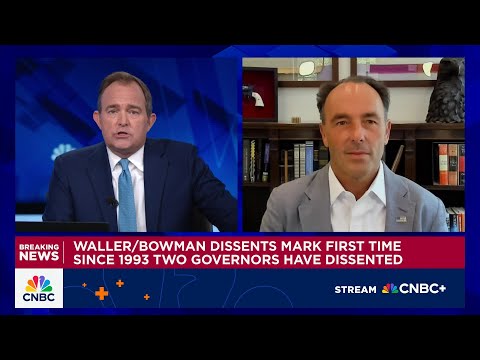
Fed's too restrictive and rates have to come down, says Hayman Capital's Kyle Bass
CNBC Television· 2025-07-30 19:08
Economic Outlook & Monetary Policy - Consumption growth has slowed significantly, from 3% last year to only 1% this year, marking the first two descents since 1993 focused on consumer behavior and the labor market [1] - With inflation around 2-4% and short rates at 43%, the Fed's monetary policy is considered too restrictive, suggesting potential for more rate cuts than the dot plot indicates [1] Geopolitical Risks & US-China Relations - Despite potential diplomatic efforts, both the US and China are reportedly preparing for potential conflict over Taiwan [1] - The exchange of Nvidia H20 chips for rare earth magnets is viewed as a questionable transaction, potentially enabling China's military advancements [1] - Concessions to China are seen as enabling the modernization of their combat forces, particularly in AI capabilities [1] US-Russia Relations & Sanctions - President Trump is setting a deadline for a peace deal between Russia and Ukraine, threatening stricter sanctions if no progress is made [1] - The US has the ability to impose more impactful sanctions on Russia by targeting remaining foreign correspondent banks that facilitate dollar transactions [2][3]

US Treasury Secretary Bessent on US Trade Deals, Federal Reserve, Tariff Rates
Bloomberg Television· 2025-07-23 12:15
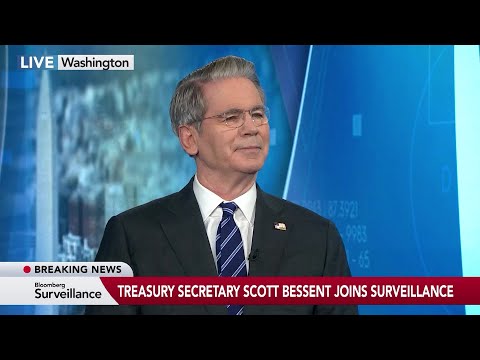
US-Japan Trade Agreement - The US and Japan have reached a trade agreement involving reciprocal tariffs, particularly on autos, with Japan proposing an innovative solution involving equity, credit guarantees, and funding for major projects in the US [5][6] - Japan will provide new capital targeted at strategic industries in the US to de-risk supply chains, especially in areas like medicine and semiconductors [6][7] - The agreement includes a 15% tariff rate for Japan, specifically for reciprocal tariffs on autos, which is linked to Japan's innovative financing mechanism [5][6] - The 15% tariff rate for Japan is considered a result of their innovative package, with President Trump pushing them to do even more [10] US-EU Trade Relations - The EU has not yet presented an innovative package similar to Japan's, but trade talks are progressing [11] - The EU is reportedly preparing to impose 30% tariffs on €100 billion (approximately $107 billion USD) worth of goods if no deal is reached [12] - The US views itself as a deficit nation compared to the EU's surplus, suggesting that trade escalations would impact the EU more [13] US-China Trade Relations - The US is in a good place with China and can start moving on to bigger discussions, with the potential for a rebalancing of the US-China relationship [14][15] - The US aims to bring back precision manufacturing and wants China to become more of a consumption economy [15] - Discussions with China will include purchasing agreements, especially for agriculture, with a focus on rebalancing the trade relationship [16][17] - Regular meetings with China are planned, with no desire to decouple but a need to de-risk part of the US supply chain [19] Federal Reserve and Monetary Policy - The Treasury Secretary believes the Federal Reserve's analysis of tariffs is off, as they have seen very little price pressure from tariffs [26] - The Treasury Secretary suggests the Federal Reserve should conduct an internal review to separate monetary policy from other activities [31] - The Treasury Secretary believes that regulation has been too stringent since the great financial crisis, leading to a build-up outside the regulated financial system, with private credit up ten times [36]
X @The Economist
The Economist· 2025-07-22 16:40
Our weekly podcast on China. This week, why the country needs to get better at end-of-life care https://t.co/TiDR6ODsYR ...
X @Bloomberg
Bloomberg· 2025-07-18 15:38
Regulatory Scrutiny - US House Select Committee on China criticized the Trump administration's decision regarding Nvidia's H20 AI chip shipments to China [1] Technology and Trade - Nvidia was allowed to resume shipments of its H20 AI chips to China [1]

CNBC Property Play: Building data centers on the moon
CNBC Television· 2025-07-16 18:20
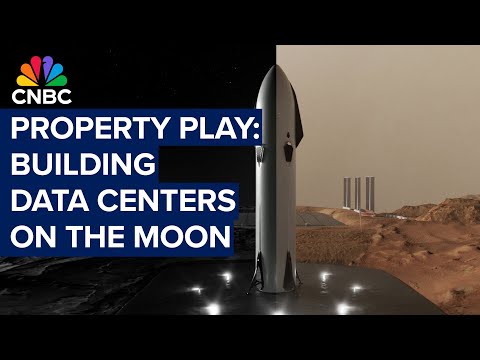
Real Estate & Space Industry Trends - Data centers are a rapidly growing sector in real estate, driven by AI, cloud computing, and online activities, but their high energy consumption poses a challenge [1] - Private capital is flowing into the space industry, with new companies emerging to serve various aspects of the sector from both public and private perspectives [3] - The space industry is experiencing a revolution, with companies seeking to monetize space through manufacturing and serving as a base for further space exploration, including potential data center production on the moon [6] - Space offers unlimited power from the sun, unlimited cooling from the vacuum, and unlimited real estate, potentially unlocking constraints faced on Earth and providing clean energy [9] - The current economic environment presents challenges for global development, with stagflation, higher rates, and slower growth making it difficult for developers to make projects financially viable [19][20] Technological Advancements & Infrastructure - Reusable rocket technology is advancing, with potential for 1,000 tons of launch capability, moving towards a million tons per year [32] - Robotics are becoming increasingly advanced and advantageous in the lunar environment due to the challenges of sustaining human life in space [31] - Ethos is developing technology to utilize lunar geological resources, such as anorthosite, to create building materials like synthetic igneous rock, which is twice as strong as concrete, for constructing landing pads, roads, and foundations on the moon [26][27][28][29] Energy & Power Consumption - Data centers are projected to consume a significant portion of US power generation, potentially reaching 40% by 2030, highlighting a serious infrastructure problem [42] - China has a significantly larger installed power base than the US and is investing heavily in solar energy, necessitating the exploration of new, non-Earth-bound power generation methods [44] - The cost of solar energy is declining rapidly, and nuclear energy is gaining traction, suggesting that energy problems will be solved, but the demand for power is infinite [47] Investment & Future Outlook - Capital is seeking great opportunities and returns, with space emerging as a promising area for investment [21] - Infrastructure investments require a long-term perspective, considering future disruptors and their potential interplay with the current world [14] - The space industry is in its early stages, similar to the railroad era, representing a major investment opportunity and creating new "rails" for the future [17]
X @The Economist
The Economist· 2025-07-16 08:29
Geopolitical Analysis - India has successfully balanced relations with the US, China, and Russia [1] - A potential second Trump term is causing uncertainty for Indian policymakers [1] - Cynical realism may not protect India from Donald Trump's policies [1]
X @Bloomberg
Bloomberg· 2025-07-15 15:23
AMD Says It Will Restart Sales to China After US Review. Get caught up on the day's gainers and decliners on the latest Stock Movers report https://t.co/AB6E5ASkrH ...

Mike Waltz faces grilling from Senators in UN confirmation hearing after Signal-gate
MSNBC· 2025-07-15 14:55
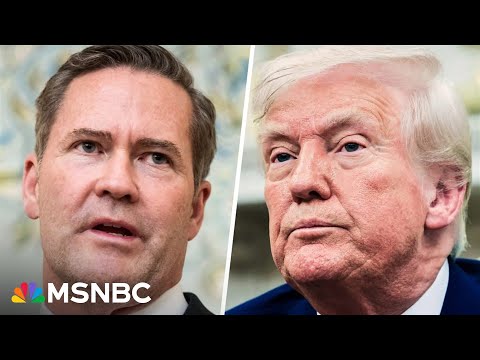
Nomination & Confirmation - Mike Walsh's nomination as UN ambassador faces scrutiny due to the "signal gate" controversy [1][2][3][7] - Democrats seek explanations regarding the use of Signal for sensitive information [1][2][3] - Confirmation hinges on Republican support, with a 53-47 majority in the Senate making it likely [6][11][12] - The White House anticipates Walsh's confirmation by the start of the United Nations General Assembly in early September [13] Policy & International Relations - Concerns exist regarding Trump's view of the UN as a "waste of time and money" and potential funding cuts [19][20][26] - Questions arise about whether Walsh's nomination signals a diminished US role in the UN [20] - China's growing influence and the need to address it in the UN are key issues [9][17][18] - The administration's foreign policy is perceived by some as "America isolated," with concerns about declining US prominence [15][9] Relationship with the Administration - Walsh's relationship with President Trump is perceived as not being "top of mind" for the president [22] - Secretary of State Marco Rubio is seen as taking on the role of national security advisor, potentially diminishing the UN ambassador's influence [22][29] - There are questions about whether the UN ambassador will have the authority to speak for the administration [27]
X @TechCrunch
TechCrunch· 2025-07-15 04:38
Market Dynamics - Nvidia is poised to restart chip sales in China following regulatory changes [1] Regulatory Landscape - Regulatory whiplash impacted Nvidia's China chip sales for months [1]
X @The Economist
The Economist· 2025-07-02 16:28
China wants to pick the Dalai Lama’s successor. He has other ideas. It will be a historic test of the democratic world’s will—and capacity—to resist Chinese coercion and disinformation https://t.co/Oh6qo3xX6s ...