万物并育

Search documents
学习时报:君子成人之美
Xin Lang Cai Jing· 2026-01-31 23:41
Group 1 - The core idea emphasizes the importance of the "gentleman" (君子) in recognizing and nurturing the beauty and potential in others, transcending personal limitations and fostering a harmonious society [1][2] - The concept of "knowing beauty and recognizing beauty" is crucial for a gentleman, as it involves self-awareness and the ability to appreciate the strengths and potentials of others [1] - Historical examples illustrate the principle of "adulting beauty," where individuals support and promote the talents of others, leading to collective success and harmony [2] Group 2 - The notion of "harmony in diversity" is highlighted, suggesting that a gentleman respects different values and perspectives, seeking solutions that accommodate various reasonable claims [3] - The idea of "nurturing all things without harm" expands the gentleman's vision to a broader context, emphasizing the importance of collective well-being and environmental harmony [3][4] - The contemporary relevance of the "nurturing all things" concept is underscored, as it addresses global challenges such as ecological crises and social inequalities, advocating for a higher level of civilizational exchange and mutual understanding [4]
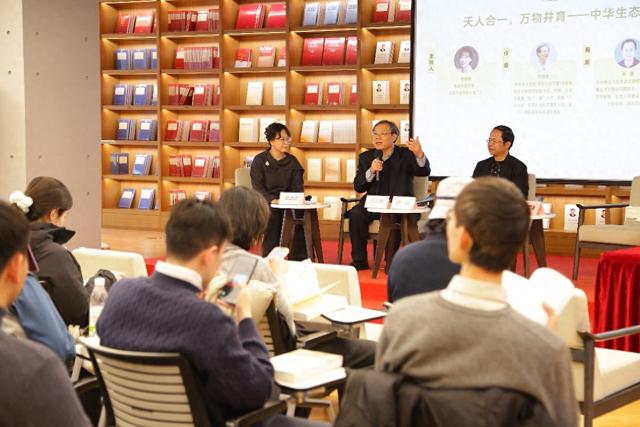
“天人合一,万物并育”,乔清举历时7年完成《中华生态智慧讲读》
Xin Lang Cai Jing· 2026-01-03 04:50
Core Viewpoint - The event "Harmony between Heaven and Humanity, All Things Nurtured Together" focused on the contemporary value and global significance of Chinese ecological wisdom, featuring discussions and a new book release [1][5]. Group 1: Book Overview - The book "Harmony between Heaven and Humanity, All Things Nurtured Together" was completed by Qiao Qingju over seven years, systematically organizing the lineage of Chinese ecological thought and interpreting concepts like "harmony between heaven and humanity" and "all things nurtured together" through engaging explanations and classic cases [3][11]. - The book aims to bridge ancient and modern dialogues, guiding readers to draw ecological philosophy from classics and promoting practical applications [5]. Group 2: Discussion Highlights - In the salon discussion, Qiao Qingju emphasized that "harmony between heaven and humanity" should be integrated into modern systems and lifestyles, suggesting that the concept of "moderate extraction" can be transformed into a circular economy idea [11]. - Lin Zhen highlighted that ecological civilization is rooted in "harmony between heaven and humanity," representing its scientific expression and practice in contemporary times [11]. - The discussion on "all things nurtured together" and "human-centeredness" revealed that classical Chinese literature embodies an ethical view of "unity of man and nature," advocating for a reconstruction of the connection between humans and nature in contemporary narratives [12]. Group 3: Global Significance and Education - Qiao Qingju stated that concepts like "benevolence towards all living things" and "natural law" provide Eastern wisdom for global ecological governance, emphasizing the responsibility humans have towards nature [12]. - The panelists agreed on the importance of interdisciplinary education, nature experiences, and new media to convey Chinese ecological wisdom to the younger generation, integrating traditional wisdom into contemporary life and values [12]. - The interactive session addressed topics such as carbon neutrality goals, urban construction, ecological aesthetics, and media dissemination, suggesting that Chinese ecological wisdom can support carbon action and infuse urban planning with the concept of a "community of life" [12].