
万物智行

Search documents
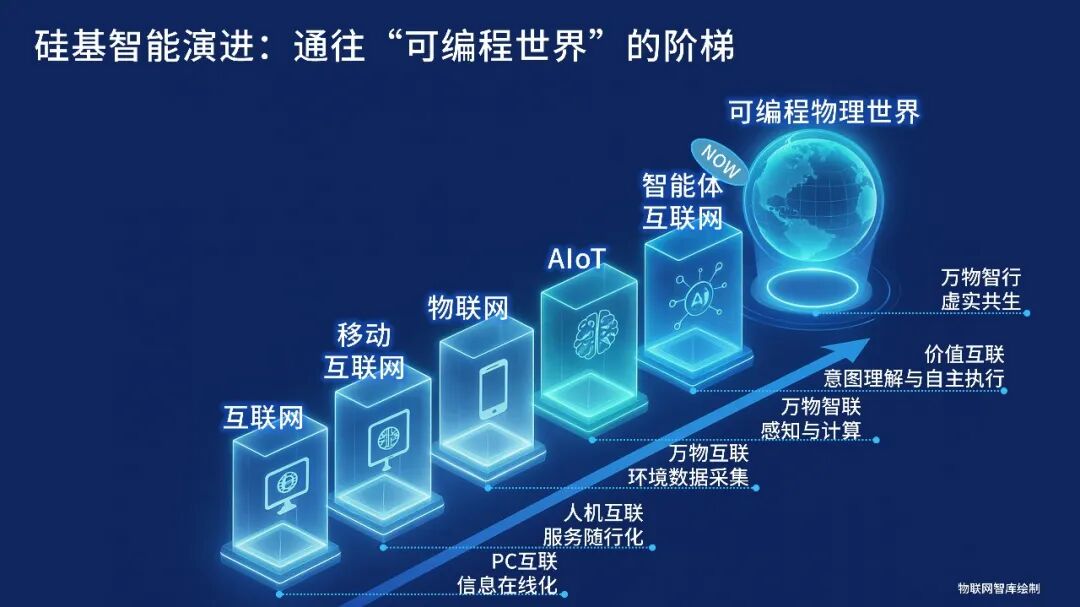
智能体互联网引发物联网的重新定位,如何完成从"智联万物"到"可编程世界"的惊险一跃?
3 6 Ke· 2025-12-10 09:28
Core Insights - The rise of AI does not threaten the Internet of Things (IoT); instead, it emphasizes the importance of IoT as a foundational infrastructure for AI applications [1] - The concept of "intelligent agent internet" is emerging, where IoT devices evolve from passive data terminals to active intelligent partners that can collaborate and deliver results [1][8] - The evolution of digital technology over the past 30 years has been marked by five key phases, each addressing limitations of the previous one, ultimately aiming to dissolve the boundaries between the digital and physical worlds [2][4][5][6][7] Evolution of Digital Technology - The 1990s saw the digitalization of information through the internet, allowing access to knowledge previously limited by physical location [4] - The launch of the iPhone in 2007 marked the beginning of mobile internet, connecting people and enabling services to be accessed anytime, anywhere [5] - The development of IoT in the mid-2000s allowed physical objects to communicate through data, creating a digital twin of the physical world [6] - The AIoT era began in 2016, where AI enhanced IoT devices with cognitive capabilities, although they remained largely reactive [7] - By 2025, the intelligent agent internet will enable devices to understand intent and collaborate autonomously, marking a significant shift in how technology interacts with users [8] The Future of IoT - IoT is predicted to further sink into the background, becoming the digital foundation for AI applications, akin to how electricity operates invisibly yet fundamentally [13][16] - By 2025, global data volume is expected to reach 213.56 ZB, with a significant portion generated by IoT devices, highlighting their role as data supply bases for AI [14] - The value of IoT is increasingly realized through AI, with B2B applications contributing approximately 65% of its total value, often hidden beneath the surface [15] - IoT is transitioning from a connection layer to a foundational layer, becoming integral to AI's functionality and data processing [16] Intelligent Agent Economy - The concept of "liquid physical capabilities" suggests that services will no longer be confined to specific applications but will be modular and combinable based on user intent [21] - Companies must adapt to a new competitive landscape where interoperability and open protocols are crucial for being recognized and utilized by intelligent agents [22] - The focus for IoT companies is shifting from controlling user entry points to enhancing their infrastructure and ensuring their devices are easily accessible to intelligent agents [23] Conclusion - The ultimate success of IoT will be its seamless integration into the digital ecosystem, functioning as an invisible yet essential infrastructure, much like the electrical grid today [24]

2025物博会促成26个重大项目签约 合作金额超320亿元
Zhong Guo Xin Wen Wang· 2025-11-03 17:04
Core Insights - The 2025 World Internet of Things Expo in Wuxi showcased significant advancements in the IoT sector, resulting in the signing of 26 major projects with a total cooperation amount exceeding 32 billion yuan [1][2] - The theme of the expo was "Everything Connected, Endless Frontiers," focusing on the dual empowerment of AI and IoT, with interactive exhibits demonstrating cutting-edge technologies and products [1] Group 1: Event Highlights - The expo lasted for three days and featured four main thematic pavilions, emphasizing the latest technologies in the IoT field [1] - Major achievements unveiled included the global trial network for 5G NTN satellite IoT and the city-level "vehicle-road-cloud integration" practices [1] - High-level platforms such as the Industrial Internet Platform Empowerment Center and advanced communication system testing centers were launched during the event [1] Group 2: Industry Trends - The IoT is evolving from "Everything Connected" to "Everything Intelligent," transitioning towards a closed-loop model of "perception-decision-execution" [2] - With AI integration, IoT devices have shifted from passive data collection to autonomous decision-making, enhancing production efficiency [2] - Wuxi has established itself as a leading city in the IoT industry, with a national sensor network innovation demonstration zone and a national-level advanced manufacturing cluster, achieving over 250 billion yuan in industrial revenue [2] Group 3: Future Directions - Wuxi aims to enhance the IoT industry by developing a comprehensive AIoT industrial map, forming innovation coalitions to tackle key technologies, and establishing a technology matchmaking platform [2] - The city plans to cultivate platform-based enterprises and improve financial service systems while solidifying international standards and safety capabilities [2]