
世界级城市群建设

Search documents
粤港澳大湾区内地九市即将迈入内涵式高质量发展之路
Zhong Guo Fa Zhan Wang· 2025-12-09 03:03
Core Viewpoint - The Guangdong Provincial People's Congress has passed a decision to promote high-quality development in the nine cities of the Guangdong-Hong Kong-Macao Greater Bay Area, emphasizing the need for innovation, collaboration, and sustainable urban development to enhance the region's global competitiveness [1][2]. Summary by Sections Decision Overview - The decision consists of seven parts and twenty-two articles, focusing on optimizing urban systems, promoting efficient development, building a global innovation hub, enhancing regional characteristics, prioritizing people's needs, gathering high-end resources, and strengthening implementation [3]. Economic Significance - The nine cities in the Greater Bay Area are crucial for China's economic growth, contributing over 80% of Guangdong's GDP, which is projected to reach 11.54 trillion yuan in 2024, supporting Guangdong's position as the leading province in economic scale for 36 consecutive years [4]. Urban Development Characteristics - A modern urban system with complementary functions is forming, with Guangzhou and Shenzhen as core engines driving regional development. The cities are enhancing their roles in international trade, innovation, and industrial transformation [5]. Transportation Infrastructure - A comprehensive transportation network is being established, with over 2,800 kilometers of railway and 5,458 kilometers of expressways. The region is also developing a world-class airport and port system, with a projected cargo throughput of over 1.64 billion tons in 2024 [8]. Innovation and Industry - The region is focusing on technological innovation, with over 70,000 national high-tech enterprises and significant advancements in strategic emerging industries such as AI and new energy. Collaborative industrial clusters are forming across cities [7]. Quality of Life Improvements - Efforts are being made to enhance public services, healthcare, and education, with a focus on creating a livable environment. The air quality is expected to reach a 93% good rate, and forest coverage is over 52% by 2024 [10]. Future Development Directions - The decision outlines plans for deeper regional cooperation, enhanced industrial collaboration, improved transportation connectivity, and a focus on marine economy development, aiming to integrate the Greater Bay Area with Hong Kong and Macau [11][12][13].
利好来了!刚刚,国家重磅发布
Zhong Guo Ji Jin Bao· 2025-12-03 13:10
Core Viewpoint - The State Council has approved the "Yangtze River Delta Land Space Planning (2023-2035)", which serves as a national-level land space special plan and a sustainable development blueprint for the Yangtze River Delta region, guiding various development, protection, and construction activities [3][4]. Group 1: Key Objectives and Guidelines - By 2035, the Yangtze River Delta will maintain a cultivated land area of no less than 16.148 million acres, with permanent basic farmland protection of at least 14.290 million acres, and ecological protection red line covering no less than 77,000 square kilometers [4][7]. - The plan emphasizes the need to implement the Yangtze River Delta integration development strategy, aiming to build a world-class urban agglomeration and support the region's leadership in China's modernization efforts [3][6]. Group 2: Spatial Development and Coordination - The plan outlines the optimization of a spatial pattern led by metropolitan areas, supporting Shanghai's leading role and enhancing spatial integration with surrounding urban areas such as Suzhou, Wuxi, Changzhou, Nanjing, Hangzhou, Hefei, and Ningbo [4][8]. - It highlights the importance of cross-regional collaboration in technological and industrial innovation, ensuring the spatial needs of key innovation corridors and traditional industry upgrades are met [4][8]. Group 3: Safety and Environmental Considerations - The plan identifies key areas for natural disaster risk prevention, establishing control lines for geological disasters and floods, and ensuring the protection of strategic mineral resources and cultural heritage [4][7]. - It aims to enhance the resilience of land space safety, improve emergency food supply layouts, and promote coordinated disaster prevention and reduction infrastructure [8][10]. Group 4: Implementation and Governance - The plan mandates strict adherence to its guidelines, with local governments required to integrate its objectives into their land space planning and ensure compliance with the established framework [9][10]. - A monitoring and evaluation mechanism will be established to assess the implementation of the plan, ensuring that significant matters are reported promptly to higher authorities [10][11].


事关长三角空间发展 重磅文件来了!
Zhong Guo Ji Jin Bao· 2025-12-03 13:03
Core Viewpoint - The State Council has approved the "Yangtze River Delta Land Spatial Planning (2023-2035)", which serves as a national-level guideline for spatial development and sustainable growth in the Yangtze River Delta region, aiming to support the integrated development strategy and establish a world-class urban agglomeration [3][5]. Summary by Sections Spatial Development Goals - By 2035, the Yangtze River Delta will maintain a cultivated land area of no less than 16.148 million acres, with permanent basic farmland protection of at least 14.290 million acres and ecological protection redline of no less than 77,000 square kilometers [3][6]. - Total water usage must not exceed the national targets set [3][6]. Risk Management and Safety - The plan identifies key areas for natural disaster risk prevention, including geological hazards and flooding, and establishes safety zones for strategic mineral resources and cultural heritage [3][6]. Urban and Regional Coordination - The spatial layout will be optimized with urban agglomerations leading the way, enhancing the integration of the Shanghai metropolitan area with surrounding urban clusters such as Suzhou, Wuxi, Changzhou, Nanjing, Hangzhou, Hefei, and Ningbo [3][7]. - The plan emphasizes cross-regional collaboration in technological and industrial innovation, particularly in the G60 Science and Technology Corridor and along the Hu-Ning industrial innovation belt [3][7]. Marine and Coastal Development - The spatial structure will be improved to promote coordinated development of coastal areas, enhancing port and shipping functions, and rationally utilizing deep-sea spaces to unlock marine development potential [4][8]. Implementation and Governance - The planning document is a comprehensive framework for land use, protection, and restoration in the Yangtze River Delta, requiring strict adherence and regular assessments to ensure compliance [5][9]. - Local governments are tasked with leadership and coordination to integrate the planning goals into their respective land use strategies, ensuring a unified spatial planning system [9].
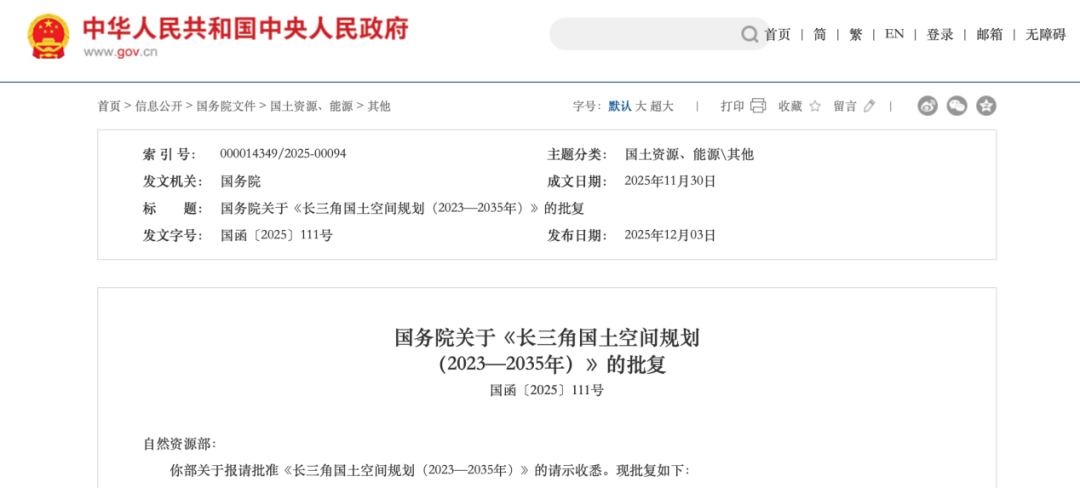
国务院批复:原则同意
证券时报· 2025-12-03 11:58
Core Viewpoint - The State Council has approved the "Yangtze River Delta Land Space Planning (2023-2035)", emphasizing sustainable development and high-quality growth in the region, with specific targets for agricultural land, ecological protection, and disaster risk management [1][2][3]. Group 1: Key Objectives - By 2035, the Yangtze River Delta will maintain a minimum of 16,148 million acres of arable land, with at least 14,290 million acres designated as permanent basic farmland [3]. - The ecological protection red line will cover no less than 77,000 square kilometers, and total water usage must not exceed national limits [3]. Group 2: Development Framework - The planning aims to create a land space system that supports a new development pattern, enhancing regional coordination and optimizing productivity layout [3][4]. - It emphasizes the integration of urban areas, particularly supporting Shanghai's role as a leading city and fostering collaboration with surrounding metropolitan areas [4]. Group 3: Safety and Compliance - The planning establishes a framework for safety in development, including risk control lines for geological disasters and floods, and ensures the protection of strategic mineral resources and cultural heritage [3][5]. - Strict adherence to the planning guidelines is mandated, with mechanisms for monitoring and evaluating implementation to prevent unauthorized modifications [5][6]. Group 4: Implementation Support - Local governments in Shanghai, Jiangsu, Zhejiang, and Anhui are tasked with organizing leadership and clarifying responsibilities to ensure the planning's objectives are integrated into local land space planning [6][7]. - A unified land space planning system will be developed, enhancing digital governance and coordination across different levels of government [7].

北京“十五五”规划:积极构建现代化首都都市圈 推进世界级城市群建设
Xin Lang Cai Jing· 2025-11-25 23:33
Core Viewpoint - The article emphasizes the importance of constructing a modernized capital metropolitan area in Beijing, focusing on spatial coordination and collaborative development to enhance the city's global competitiveness [1] Group 1: Urban Development - The proposal aims to implement spatial collaborative planning for the metropolitan area, leveraging Beijing's role as a core to drive regional development [1] - There is a focus on deep integration of commuting circles and strengthening regional express connections, particularly between Tongzhou District and neighboring areas [1] Group 2: Economic Zones and Innovation - The development of the Xiong'an New Area is highlighted, with plans to improve public service levels and establish a technology park in Xiong'an [1] - The creation of a talent and innovation corridor between Beijing and Xiong'an is intended to support technological advancements [1] Group 3: Regional Cooperation - The article discusses the ongoing collaboration between Beijing and Tianjin, particularly through the development of the Tianjin Binhai-Zhongguancun Science Park and the Beijing-Tianjin Zhongguancun Science City [1] - It emphasizes the transformation of the Beijing-Tianjin cooperation demonstration zone to enhance regional economic integration [1] Group 4: Industrial Cooperation - The proposal includes initiatives to strengthen industrial cooperation and enhance the quality and efficiency of industrial collaboration platforms [1] - Development of key industrial belts such as Jingbao, Jingtangqin, and Jingzhang is mentioned to promote economic growth along coastal areas [1]