
东亚气候演变

Search documents
青藏高原隆升何以造就烟雨江南?中国团队最新研究揭晓答案
Zhong Guo Xin Wen Wang· 2025-12-03 01:05
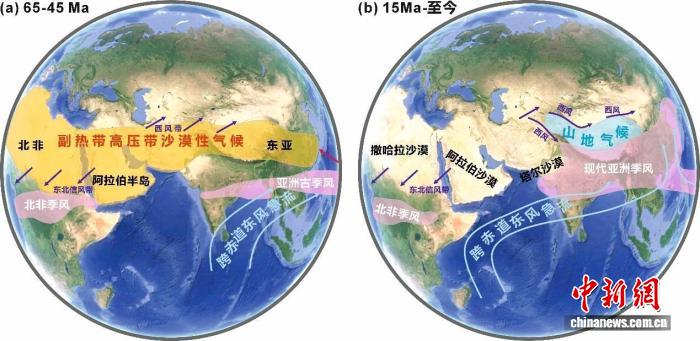
Core Viewpoint - The research led by the Chinese Academy of Sciences reveals the connection between the uplift of the Tibetan Plateau and the transformation of East Asian climate, emphasizing that without the Tibetan Plateau, the fertile region of Jiangnan would not exist [3][6]. Group 1: Uplift Stages of the Tibetan Plateau - The uplift of the Tibetan Plateau has undergone three main stages: 1. Formation of the "two mountains and one basin" structure from 65 million to 40 million years ago, where the Gangdise and Central Mountain ranges rose above 4500 meters, while the central valley remained below 1700 meters [4]. 2. Collaborative uplift of Eastern Tibet and the Central Valley from 40 million to 25 million years ago, leading to the initial formation of a unified plateau [5]. 3. Final shaping of the modern plateau from 25 million to 15 million years ago, with significant uplift of the Himalayas and surrounding regions, establishing the current high-altitude landscape [5][9]. Group 2: Climate Transformation Mechanism - The research illustrates the connection between the differential uplift of the Tibetan Plateau and the transition of East Asia from arid desert to a fertile region known as "the land of fish and rice" [6][9]. - Between 65 million and 40 million years ago, the central valley was a low desert area controlled by subtropical high pressure, while the surrounding mountains were not high enough to block atmospheric circulation [6]. - By 25 million years ago, the central valley had risen to near modern elevation, leading to the establishment of a temperate alpine forest landscape and stabilizing the South Asian and East Asian monsoon systems [9]. Group 3: Future Research Directions - Future research directions include: 1. Employing interdisciplinary methods to develop new types of paleoelevation measurements [10]. 2. Conducting quantitative reconstructions in data-scarce areas around the Tibetan Plateau to fill knowledge gaps [10]. 3. Building high-resolution regional Earth system models to study the impacts of plateau uplift on atmospheric circulation, water cycles, and biodiversity [10].

【中国新闻网】青藏高原隆升何以造就烟雨江南?中国团队最新研究揭晓答案
Zhong Guo Xin Wen Wang· 2025-12-02 02:55
Core Viewpoint - The research team from the Chinese Academy of Sciences has proposed a new model of uplift for the Tibetan Plateau, transitioning from a mountain-building zone to a unified plateau, which is crucial for understanding the climatic evolution of East Asia and its impact on regions like Jiangnan [4]. Group 1: Uplift Stages of the Tibetan Plateau - The uplift of the Tibetan Plateau occurred in three main stages: 1. Formation of the "two mountains and one basin" structure from 65 million to 40 million years ago, where the Gangdise and Central Range mountain belts rose above 4500 meters, while the central valley remained below 1700 meters [5]. 2. Collaborative uplift of Eastern Tibet and the central valley from 40 million to 25 million years ago, with Eastern Tibet reaching heights similar to present-day levels by the late Eocene [5]. 3. Final shaping of the modern plateau from 25 million to 15 million years ago, with the Himalayas rapidly rising above 5000 meters, marking the establishment of the current plateau landscape [5]. Group 2: Climate Transformation Mechanism - The research elucidates the connection between the uplift of the Tibetan Plateau and the transformation of East Asia's climate from arid deserts to fertile regions, with significant climatic changes occurring as the plateau rose [6][8]. - By 25 million years ago, the central valley had reached near-present elevation, leading to the formation of a temperate alpine forest landscape across the Tibetan Plateau, which contributed to the climatic shift in the Jiangnan region [8]. Group 3: Future Research Directions - Future research will focus on three major breakthrough areas: 1. Developing new types of paleoelevation metrics through interdisciplinary approaches [9]. 2. Conducting quantitative reconstructions in data-scarce areas of Northern Tibet and surrounding mountain ranges to fill existing data gaps [9]. 3. Establishing high-resolution regional Earth system models for the Tibetan Plateau to study the impacts of uplift on atmospheric circulation, water cycles, and biodiversity [9].