东方精神

Search documents
艺术家田跃民——以“马”为媒演绎东方精神
Ren Min Ri Bao Hai Wai Ban· 2026-01-02 03:12
Core Perspective - Tian Yuemin is a contemporary Chinese sculptor and new ink painter who uses "horses" as an artistic medium, blending Eastern expressive styles in sculpture and painting, showcasing the essence and strength of Chinese culture. He will participate in the Dubai World Cup in 2025, where his work will be featured alongside international horse racing, attracting significant local attention [1]. Background and Early Life - Born in 1958 in Liaocheng, Shandong, Tian's early exposure to cultural arts led him to pick up painting. He attended art classes organized by cultural centers, which sparked his interest and talent in art [2]. - After graduating from Qufu Normal University with a focus on oil painting, he was assigned to teach physical education, which initially caused him confusion but later became a turning point in his career [2]. Artistic Development - Tian's experience working with renowned artists like He Kongde and Gao Quan significantly influenced his artistic philosophy, emphasizing that art originates from life [3]. - After a decade away from sculpture, a construction accident prompted him to return to the art world, choosing to focus on horses due to their broad appeal and the challenge of capturing their essence [4]. Mastery and Technique - Tian has developed impressive skills, completing a sculpture in 45 minutes and a horse drawing in one minute. His work at charity events has set sales records, demonstrating his efficiency and mastery [5]. - His notable work, "Nine Steeds," created for the Nanjing Youth Olympic Games, symbolizes the spirit of sports and integrates traditional Chinese cultural values [5]. International Engagement - Tian chose to engage with the horse culture in Dubai, where he captured the essence of horses through live sketching, leading to his works being sought after by collectors from Europe and the Middle East [6]. - He believes that art transcends language barriers, with his expressive ink paintings and precise sculptures serving as a bridge for cultural exchange [6][7]. - Tian emphasizes the importance of artistic skill for Chinese artists in promoting cultural exchange, citing examples of renowned artists who gained international recognition through their mastery [7].
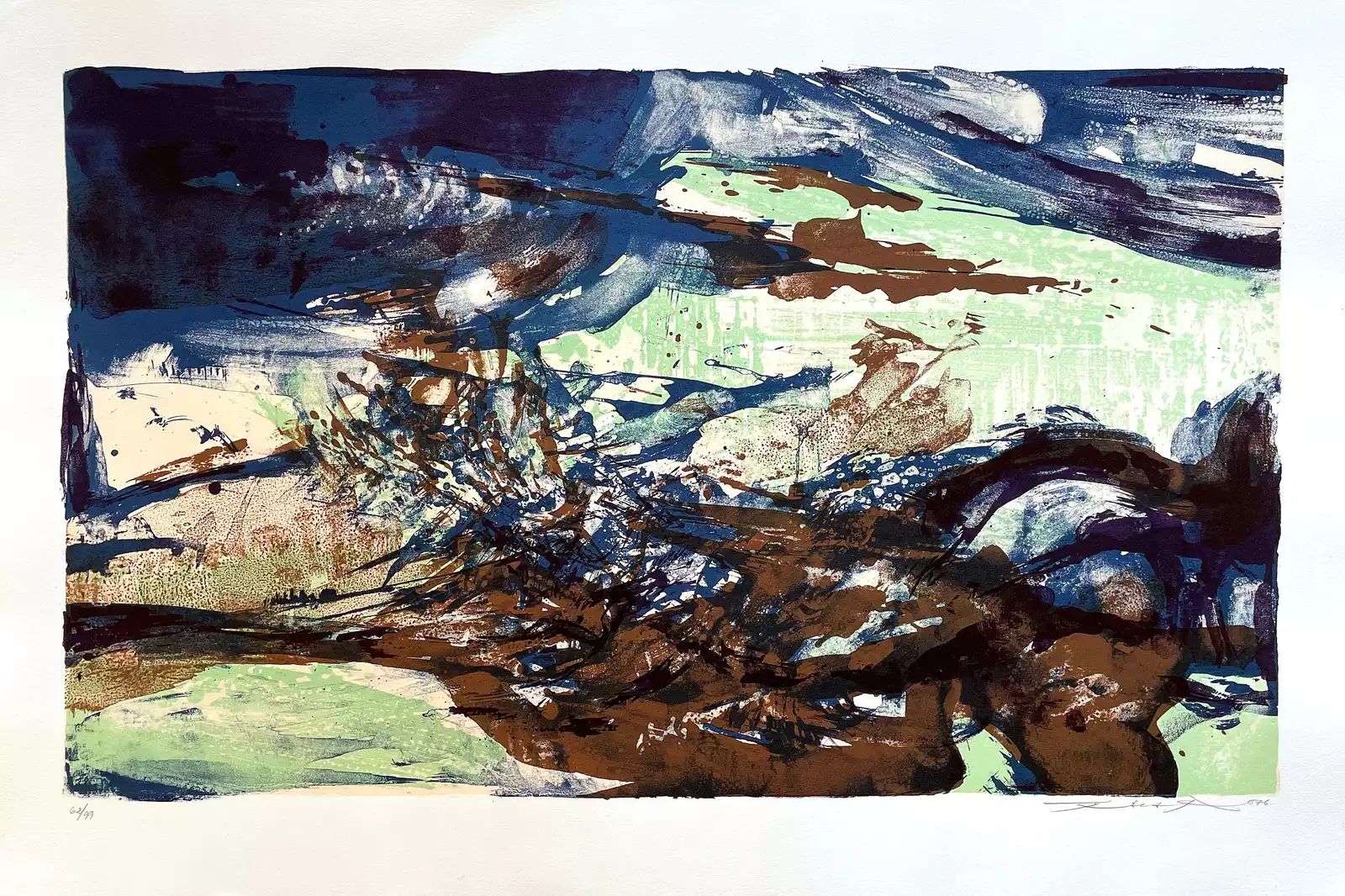
抽象语汇中的东方精神:从赵无极、朱德群、萧勤到王无邪的空间思维
Hua Er Jie Jian Wen· 2025-10-20 10:13
Core Perspective - The article highlights the significant contribution of Eastern artists to abstract art, emphasizing their unique cultural heritage and philosophical thinking that enriches the genre with new dimensions [1][2]. Group 1: Exhibition Overview - Galerie Chantilly is hosting an exhibition titled "Tribute to Chinese Contemporary Masters" in Hong Kong, honoring pioneering Chinese artists such as Zao Wou-Ki, Zhu Dequn, Hsiao Chin, and Wang Wuxie [1]. - The exhibition aims to explore the artistic dialogue between traditional Chinese art and global modernism, showcasing how these artists have forged their independent artistic languages at the intersection of ink, color, structure, and space [1]. Group 2: Eastern Spirit and Abstract Language - Abstract art emphasizes form, color, line, and space, moving away from figurative representation, with Western abstract art focusing on inner emotions and structural forms, while Eastern art traditionally emphasizes harmony with nature and philosophical concepts like "the interplay of existence and non-existence" [2][3]. Group 3: Individual Artist Contributions - Zao Wou-Ki is known for blending Eastern and Western brush techniques, retaining the "qi yun" and "leaving blank" aesthetics of Chinese painting, creating a sense of infinite space and spiritual exploration [4]. - Zhu Dequn is recognized for his mastery of light and color, creating a poetic space in his abstract works that reflects both Eastern meditation and Western passion [5]. - Hsiao Chin draws inspiration from Daoism and Zen, using circular forms and dynamic lines to express the flow of cosmic energy, representing the core spirit of Eastern aesthetics [6]. - Wang Wuxie focuses on the balance between reality and void, utilizing "gaps" and "blank spaces" to evoke Zen-like tranquility and philosophical reflection in his art [7]. Group 4: Overall Impact - The styles of Zao Wou-Ki, Zhu Dequn, Hsiao Chin, and Wang Wuxie, while distinct, collectively embody the essence of Eastern spirit within the context of abstract art, transforming Eastern philosophical concepts into modern artistic language [7]. - This fusion enriches the content of abstract art and opens new possibilities for dialogue between Eastern and Western art forms, as reflected in their works that convey both visual and spiritual dimensions [7].