个险转型

Search documents
个险龙门阵:互相看不上的内外勤,到底先换谁?
Xin Lang Cai Jing· 2026-02-03 11:46
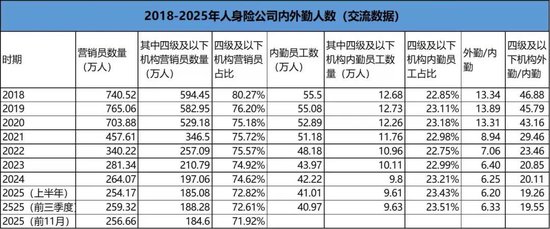
Core Viewpoint - The insurance industry is undergoing significant transformation, with a drastic decline in the number of insurance agents from over 9 million to around 2 million, leading to a reevaluation of the roles of both field agents and internal staff [1][37]. Group 1: Decline of Insurance Agents - The number of insurance agents has dropped sharply, with the industry facing challenges in traditional recruitment methods and a shift towards high-quality elite talent [1][37]. - The internal staff is increasingly viewed as redundant as the number of agents decreases, leading to potential layoffs and restructuring within insurance companies [9][44]. Group 2: Internal Staff's Role and Challenges - Internal staff are often seen as not matching the needs of the evolving insurance landscape, with criticisms regarding their effectiveness and contribution to business outcomes [2][38]. - Many internal staff members are burdened with high workloads and low income, leading to a perception of being overworked without adequate recognition or support [5][54]. Group 3: Organizational Structure and Efficiency - The organizational structure of insurance companies has historically been built around a large number of agents, and as this number decreases, the internal staff is viewed as a cost that can be cut [9][44]. - The current ratio of internal staff to agents is often criticized, with suggestions that there are too many internal staff relative to the number of agents, although this view may oversimplify the complexities of their roles [10][46]. Group 4: Future of Internal Staff - The future roles of internal staff need to be redefined to align with the industry's shift towards elite, professional agents, requiring a reevaluation of their skills and responsibilities [8][43]. - There is a growing need for internal staff to develop capabilities that support the transformation of the insurance sector, including a focus on business understanding and operational efficiency [8][25].

个险转型战略未稳,董事长钱仲华离场,横琴人寿转型路在何方?
Hua Xia Shi Bao· 2026-01-28 10:52
本报(chinatimes.net.cn)记者吴敏 北京报道 近日,《华夏时报》记者从知情人士处获悉,横琴人寿第二任董事长钱仲华提出离职并已获董事会批 准。而这距离其2024年7月正式履职不足两年。 钱仲华本人也曾在其微信朋友圈发布感言,称"横琴人寿的增资工作已经全部完成,2026年的开门红工 作也顺利展开,我的'任务'基本完成了"。让外界不禁揣测其去职的深层逻辑。 对于董事长离职详情以及影响等问题,本报记者曾致电横琴人寿方面采访,截至发稿,尚未获得对方回 应。 钱仲华所言"已完成的任务",首要所指无疑是横琴人寿在2025年底落下帷幕的18.52亿元增资。这次增 资不仅将该公司注册资本提升至49.89亿元,更关键的是彻底重塑了股权版图。 横琴人寿成立于2016年,初期股权结构为五家股东各持股20%,其中既有珠海本地国资背景的铧创投 资,也有亨通集团等民营企业,在设计上体现了"混合所有制"与股权制衡的理念。然而,这种平衡近年 来被彻底打破。 2024年3月,横琴人寿进行第二次增资,大股东铧创投资单独出资7.5亿元,持股比例从32.9%跃升至 49%,突破了保险公司单一股东持股不超过三分之一的上限,成为控制类股东 ...