
中华文化走向世界

Search documents
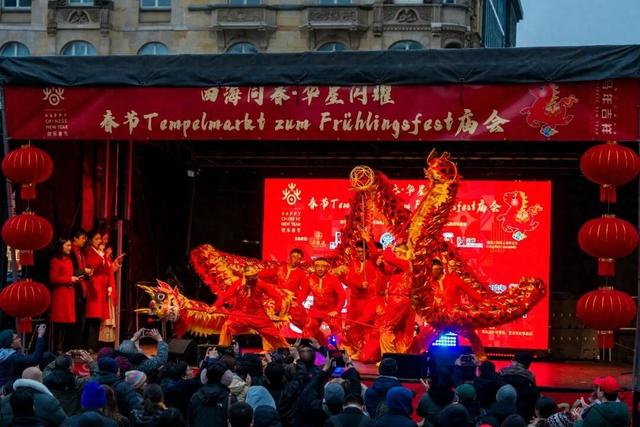
非遗出海!浙江泰顺碇步龙亮相德国春节庙会
Xin Lang Cai Jing· 2026-02-21 03:55
Core Viewpoint - The performance of the TaiShun DiBu Long at the Frankfurt Spring Festival showcases the charm of Chinese intangible cultural heritage and aims to promote Chinese traditional culture to an international audience [1][14]. Group 1: Event Overview - The second "Four Seas Spring · Chinese Stars Shine" Spring Festival fair took place in Frankfurt from February 20 to 22, featuring the TaiShun DiBu Long as a cultural highlight [7]. - The event was attended by notable guests, including the Chinese Consul General in Frankfurt, Huang Danyang, and other dignitaries who participated in the opening ceremony [1][3]. Group 2: Cultural Significance - The DiBu Long, originating from the Qing Dynasty, embodies ancient rituals and agricultural culture, representing the local heritage of the TaiShun region [7][10]. - It has a history of over 200 years and was officially recognized as a national intangible cultural heritage representative project in 2011, being referred to as a "living fossil of culture in the southern Zhejiang mountainous area" [10]. Group 3: Performance Details - The performance featured synchronized movements and vibrant costumes, aiming to convey the beauty of "human-dragon unity" and the local sentiments associated with the DiBu Long [7][8]. - The team undertook extensive preparations, focusing on rhythm training and teamwork to enhance the visual impact of the performance, while also ensuring the preservation of the cultural essence [12]. Group 4: Cultural Exchange - The event serves as a platform for cultural dialogue between China and Germany, allowing international audiences to appreciate the unique charm of Chinese folklore and the wisdom embedded in intangible cultural heritage [8][14]. - The performance is seen as a significant step in promoting Chinese culture globally, fostering understanding and appreciation among foreign audiences [14].

推动中华文化更好走向世界
Jing Ji Ri Bao· 2025-04-30 00:52
Group 1 - The core argument emphasizes the importance of cultural soft power in national development, highlighting that China's cultural construction remains a shortcoming compared to its hard power [1][2] - The article discusses the need for China to enhance its cultural soft power to transform its development advantages into discourse advantages on the global stage, especially in the context of rising international competition [2][4] - It points out that the process of enhancing cultural soft power is lengthy and requires a strategic approach, as seen in the modernization experiences of East Asian countries [2][3] Group 2 - The article notes the increasing global attention on Chinese culture and the misinterpretation of its international exchanges as cultural infiltration by the West, which reflects a misunderstanding of China's cultural outreach [3][4] - It stresses the necessity for China to articulate the values embedded in its culture, which contribute to global issues, and to promote a deeper understanding of its cultural essence rather than superficial symbols [3][4] - The discussion includes the contrasting approaches of Western countries and China regarding cultural dialogue, emphasizing China's commitment to openness and respect in cultural exchanges [4]