中国+N战略布局

Search documents
中国企业新型全球化报告发布 以“中国人经济”拓展价值链新边界
Sou Hu Cai Jing· 2025-11-14 06:02
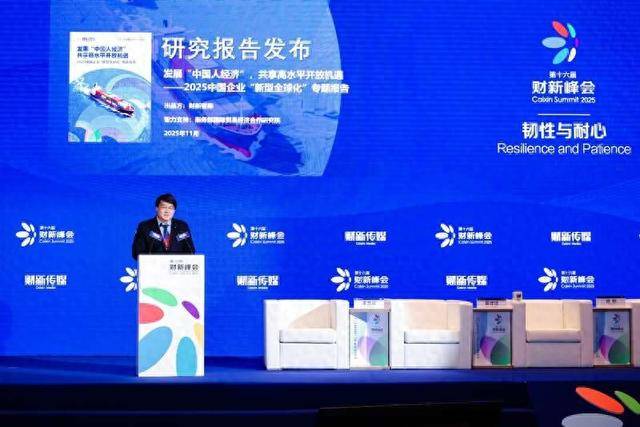
Core Insights - The report titled "Developing the 'Chinese Economy' and Sharing Opportunities for High-Level Opening Up - 2025 China Enterprises' 'New Globalization' Special Report" was officially released at the 16th Caixin Summit, highlighting new trends and challenges for Chinese enterprises going global in the new globalization phase [1][3] - The report advocates for a "China + N" strategic layout for Chinese enterprises, emphasizing the need to leverage China's manufacturing and industrial chain advantages to connect with global markets and enhance value from products to brands [1][3] Policy Recommendations - The report suggests constructing a comprehensive policy support system to facilitate higher levels of openness and better international engagement for enterprises during the 14th Five-Year Plan period [3][4] - It emphasizes the importance of establishing a complete overseas service system, deepening international cooperation, and upgrading the value connotation of going global [3] Enterprise Capability Development - The report recommends that Chinese enterprises focus on strategic positioning and compliance risk management when going global, promoting localized operations and ecological integration [3] - It also highlights the need for deepening ecological collaboration and value co-creation, as well as driving innovation and brand upgrades [3][4] Case Studies and Methodologies - The report, supported by the Ministry of Commerce's International Trade and Economic Cooperation Research Institute, includes research on various scenarios and case studies from over ten local governments and enterprises, extracting methodologies for going global [4] - Notable industry benchmark cases such as Liansheng Group, Pop Mart, and MiniMax are included in the report [4]

【2025链博会】樊星:联想供应链智能体打造“中国+N”战略布局
Huan Qiu Wang· 2025-07-19 08:48
Core Viewpoint - Lenovo Group has developed a "China + N" supply chain network, maintaining 80% of its production capacity in China while ensuring access to over 97% of global markets within 24 hours [3][4]. Group 1: Supply Chain Strategy - The "China + N" network serves as a foundation for Lenovo's global supply chain, with key nodes in Southeast Asia, Saudi Arabia, Brazil, Mexico, and Europe [3]. - Lenovo employs a "three-line defense" risk management strategy, which includes departmental risk control, cross-departmental collaboration, and independent audits, supported by an AI-driven early warning system [3][4]. - The company has developed a digital twin model that simulates over 300 risk factors, allowing for impact predictions and alternative routing 72 hours in advance [3]. Group 2: Technological Advancements - Lenovo recently launched the iChain supply chain intelligence system, which features a "brain" for decision-making and "senses" for real-time data perception, enabling autonomous supply chain management [4]. - The iChain system significantly reduces the time required to adjust to demand fluctuations from 48 hours to just 15 minutes [4]. Group 3: Global Manufacturing and Market Presence - Lenovo operates over 30 manufacturing bases globally and manages more than 2,000 suppliers, creating a complex and integrated supply chain network [4]. - The company has established production bases in Brazil, Hungary, and Mexico to enhance local market responsiveness and efficiency [5]. - A new manufacturing facility in Riyadh, Saudi Arabia, is set to begin operations in 2026, with an expected annual output of millions of laptops, desktops, and servers [5]. Group 4: Business Model and Market Strategy - Lenovo's strategy combines "self-manufacturing + outsourced production (ODM+)," allowing for a "global resources, local delivery" operational model [4][5]. - Approximately 80% of Lenovo's production, 70% of its R&D personnel, and 60% of its workforce are based in China, while 75% of its revenue is generated from overseas markets [5]. - The company aims to export a resilient, green, and innovative Chinese model to the global market [5].