
中小银行改革

Search documents
中小银行改革提质加速462家退出市场 差异化整合路径构建多层次金融格局
Chang Jiang Shang Bao· 2026-02-08 23:38
Group 1: Core Insights - 2025 is a pivotal year for the reform of small and medium-sized banks in China, marked by structural adjustments such as the reform of provincial rural credit cooperatives and the integration of village banks, indicating a shift from scale expansion to quality and efficiency improvement [1][2] - A total of 462 banks are expected to exit the market in 2025, with village banks accounting for 291 of these, representing approximately 63% of the total [4][5] - The establishment of new provincial rural commercial banks or joint banks is set to reach 7 by the end of 2025, with 13 provinces already completing the reform of provincial rural credit cooperatives [2][3] Group 2: Provincial Reforms - The Xinjiang Rural Commercial Bank, with an asset scale of 760 billion yuan, marks a significant breakthrough in the reform of provincial rural credit cooperatives, becoming the first unified legal entity rural commercial bank in the northwest region [2][3] - The reform has led to two main models: the unified legal entity rural commercial bank model and the provincial rural commercial joint bank model, with the former being more comprehensive in its reform [2][3] Group 3: Village Bank Integration - The "village to branch" model has become the mainstream path for the integration of village banks, allowing for comprehensive management, risk control, and business integration [5][6] - State-owned banks have played a significant role in the integration process, with major acquisitions and transformations of village banks into branches, enhancing governance structures and service methods while maintaining their focus on supporting agriculture and small enterprises [4][6]



中小银行改革“瘦身”提质
Xin Lang Cai Jing· 2026-01-06 22:38
Group 1 - Xinjiang Rural Commercial Bank has officially opened, marking a significant reform from the previous rural credit cooperatives, enhancing its risk resistance and overall strength, which is crucial for supporting the real economy [1] - By the end of August 2025, 11 provincial-level associations have completed the establishment of provincial legal entities, with various provinces adopting different models for their rural commercial banks [1] - The integration reform of small and medium-sized banks is accelerating, showing a clear trend of "reducing quantity and improving quality," which is a key indicator of deepening financial system reforms [1][2] Group 2 - The 2025 Central Economic Work Conference emphasized the need to "deeply promote the reduction and quality improvement of small and medium-sized financial institutions," with regulatory bodies providing clear guidance for reform [2] - Local financial institutions are increasing credit support for livelihoods and agriculture, with specific initiatives like Inner Mongolia Rural Commercial Bank focusing on rural financial services [2] - Small and medium-sized banks, after restructuring, are expected to concentrate their operations regionally, aligning closely with local economic needs to provide stable financial support [2][3] Group 3 - The urgency for reform and restructuring of small banks is heightened in the context of larger banks expanding their reach [3] - Small banks, particularly rural commercial banks and village banks, are essential components of the financial system, and they should optimize their service networks to focus on rural and county markets [3] - Leveraging digital financial technology, these banks aim to enhance service coverage and support rural revitalization strategies, emphasizing local service and inclusive finance [3]
村镇银行撤牌背后: 一场“毛细血管”的重构与新生
Zhong Guo Zheng Quan Bao· 2025-12-29 21:13
Core Viewpoint - The ongoing reform wave in rural banks is transforming them into branches of larger banking institutions, enhancing their risk resistance and service capabilities while maintaining their focus on local economies [1][2][4]. Group 1: Reform Trends - Over 250 rural banks have been deregistered since 2025 due to regulatory approvals for mergers or dissolutions [1]. - Many rural banks are transitioning to become branches of state-owned banks, joint-stock banks, or urban commercial banks through models like "village to branch" and "village to division" [1][4]. - In December alone, nearly 50 rural banks were approved for mergers or dissolutions by regulatory authorities [2]. Group 2: Structural Changes - The restructuring of rural banks can occur through four main methods: absorption by the main initiating bank, mergers of multiple rural banks, direct dissolution, or increasing shareholding in rural banks by the main initiating bank [4]. - The goal of these reforms is to optimize the quality of rural financial services and enhance support for agriculture and local economies [4][6]. Group 3: Service Continuity and Improvement - Despite the structural changes, the customer base remains the same, focusing on familiar local clients, and the service mission continues to support agriculture and small enterprises [6]. - Post-reform, the service capabilities and risk resistance of these banks have significantly improved, allowing them to offer services comparable to larger banks [6]. Group 4: Future Directions - The success of these reforms hinges on improving corporate governance to stimulate the internal motivation of small and medium-sized banks, ensuring they meet the diverse financial needs of the real economy [6]. - There is a call for these institutions to focus on their core business and differentiate their operations, avoiding blind expansion and homogenized competition [6].
银行业金融机构半年减少225家
Shang Hai Zheng Quan Bao· 2025-10-11 00:44
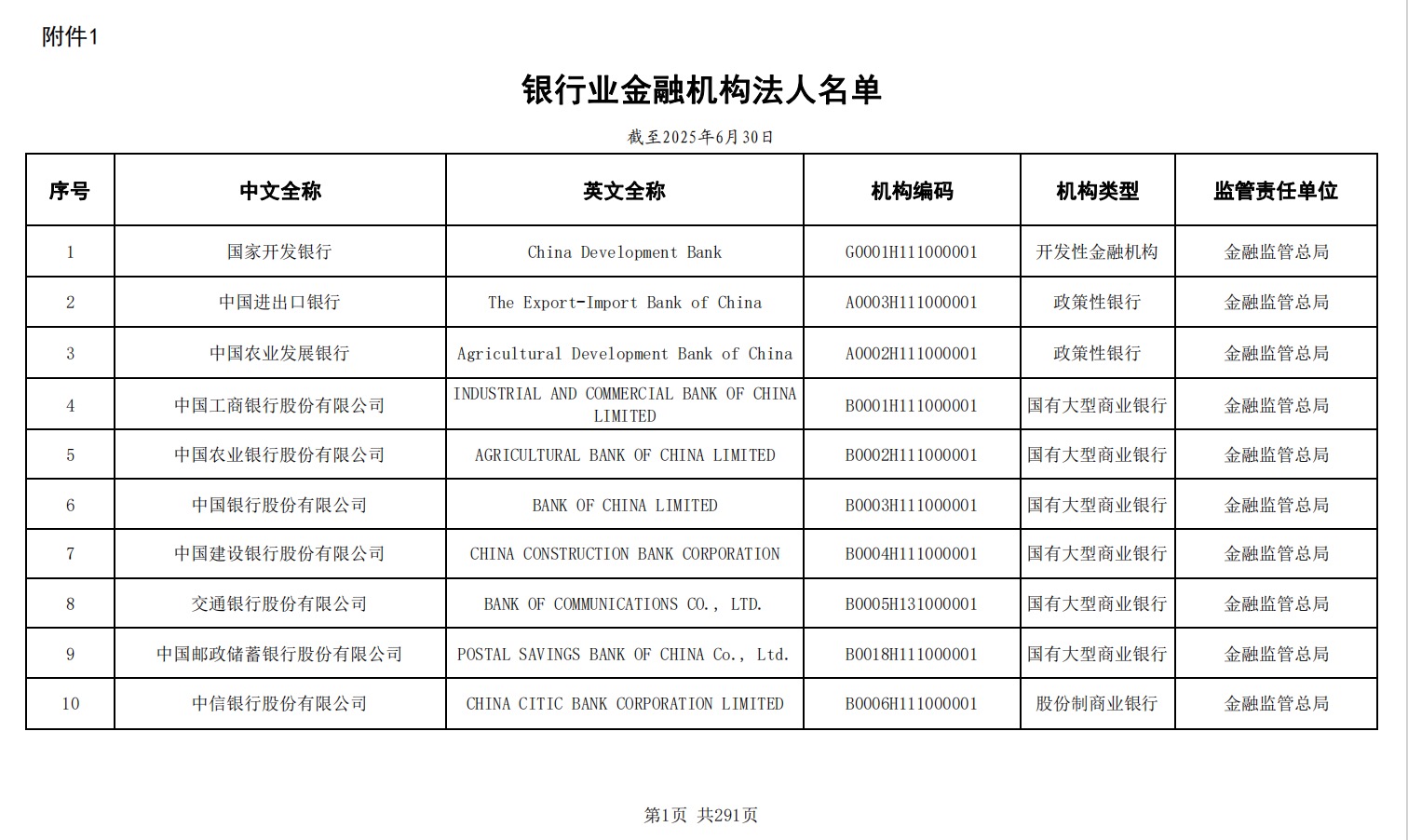
Core Insights - The number of banking financial institutions in China has decreased from 4,295 at the end of 2024 to 4,070 by June 2025, a reduction of 225 institutions [1] - Rural financial institutions have seen a significant decline, with a total of 222 institutions exiting the market in the first half of the year, including a decrease of 98 village banks [1] - The exit rate of rural financial institutions has accelerated, with a total of 283 institutions reduced from 2022 to 2024, indicating a trend of rapid contraction [1] Summary by Category Overall Banking Sector - As of June 2025, the list of banking financial institutions includes 1 development financial institution, 2 policy banks, 6 large state-owned commercial banks, and 12 joint-stock commercial banks [1] - The total number of banking institutions has decreased significantly compared to previous years, indicating a consolidation trend in the sector [1] Rural Financial Institutions - The number of rural commercial banks stands at 1,505, down by 58 from the previous year, while rural cooperative banks have decreased to 20, a reduction of 3 [1] - Rural credit cooperatives have seen a decline of 57, bringing their total to 401, and rural mutual aid funds have decreased by 6 to 15 [1] - Village banks have reduced to 1,440, marking a significant drop of 98 institutions [1] Trends and Causes - The acceleration in the exit of rural financial institutions is attributed to ongoing reforms in small and medium-sized banks, which include mergers and restructuring [2] - The approval of new provincial banks indicates a trend of "survival of the fittest" within the banking sector, where stronger institutions are favored over weaker ones [2]

获批!河南农商行,吸收合并82家机构
Jing Ji Wang· 2025-09-29 02:09
Core Viewpoint - Henan Rural Commercial Bank has announced the absorption and merger of 82 financial institutions, including rural commercial banks and village banks across nine cities in Henan province, which will now operate as branches of Henan Rural Commercial Bank [1] Group 1: Merger Details - The merger includes 55 rural commercial banks, 4 village banks, and 23 rural credit cooperatives [1] - Customers' existing accounts, cards, contracts, and agreements will remain valid, and services will continue unchanged [1] - The merger is part of a broader reform strategy for small and medium-sized banks in the Henan region [2] Group 2: Background and Previous Plans - The initial reform plan for the rural credit cooperatives in Henan proposed the establishment of "Henan Rural Commercial United Bank," which was approved in 2023 [2] - The new Henan Rural Commercial Bank was officially established on February 26, 2023, following the approval of its establishment by the National Financial Supervision Administration [1][2] - The restructuring of the banking system in Henan has faced changes, indicating a complex landscape for financial reforms in the region [3] Group 3: Challenges and Considerations - The joint bank model has not resolved issues related to the dual legal entity structure, raising questions about governance and operational efficiency [3] - The complexity of merging numerous legal entities in the Henan region contributes to the challenges faced in the reform process [3]
获批!河南农商行,吸收合并82家机构!
券商中国· 2025-09-28 23:27
Core Viewpoint - The article discusses the merger of 82 rural financial institutions into Henan Rural Commercial Bank, which aims to streamline operations and enhance efficiency in the banking sector in Henan province [1][2]. Summary by Sections Announcement of Merger - On September 28, Henan Rural Commercial Bank announced the approval of its merger with 82 institutions, including rural commercial banks and village banks across nine cities in Henan [1]. - The merger will allow Henan Rural Commercial Bank to inherit all assets, liabilities, and rights from the absorbed institutions, which will now operate as branches of the bank [1]. Continuity of Services - The announcement assures customers that their accounts, cards, contracts, and services will remain unchanged and valid post-merger [2]. - The absorbed entities include 55 rural commercial banks, 4 village banks, and 23 rural credit cooperatives [2]. Background of the Reform - The reform of small and medium-sized banks in Henan has seen changes, with a previous plan to establish "Henan Rural Commercial United Bank" approved in 2022, which was later adjusted [3]. - The new plan for Henan Rural Commercial Bank was included in the government's economic measures for the second half of 2024, indicating a shift in strategy [3]. Challenges of the Reform - The article highlights the complexity of merging numerous legal entities in the Henan banking sector, which has led to adjustments in the reform plans [4]. - The previous "united bank" model did not resolve issues related to the dual legal entity structure, raising questions about governance and operational efficiency [4].

找准中小银行改革着力点
Xin Hua Wang· 2025-08-12 06:28
Core Insights - The overall profitability of commercial banks has significantly improved, but national banks are experiencing much higher growth rates compared to regional small and medium-sized banks, indicating a widening gap in performance [1] - Small and medium-sized banks face challenges in capital replenishment, governance structure, and asset quality, which are critical for their development [1] - The government has emphasized the need for reforms in the equity structure and corporate governance of small and medium-sized banks, as well as accelerating the disposal of non-performing assets [1] Group 1: Governance and Structural Issues - There is an urgent need to deepen the reform of equity and corporate governance in small and medium-sized banks due to inadequate governance and internal control systems [2] - Many small and medium-sized banks are exposed to risks from significant related-party transactions and internal control failures, which can lead to severe credit crises [2] - Improving corporate governance is essential to prevent small and medium-sized banks from becoming tools for major shareholders or executives, which would undermine their long-term sustainability [2] Group 2: Non-Performing Asset Management - Accelerating the disposal of non-performing assets is a key strategy for risk prevention and should be a current priority [3] - The overall non-performing loan rates for city commercial banks and rural commercial banks were reported at 1.9% and 3.63% respectively in Q4 2021, indicating a rise from the previous quarter [3] - There is a need for enhanced collaboration among various stakeholders to improve the capacity for managing non-performing assets in small and medium-sized banks [3] Group 3: Market Conditions and Future Outlook - Predictions indicate that the pressure for new credit supply will remain high in 2022, with an expected increase in new non-performing loans [4] - The market for non-performing assets is likely to expand, while the disposal methods currently employed by small and medium-sized banks are too limited [4] - Encouraging more market participants to engage in innovative disposal methods for non-performing assets is crucial for improving efficiency and effectiveness in asset management [4]
兼并重组、减量提质——中小银行改革提速
Jing Ji Ri Bao· 2025-06-08 22:04
Group 1 - The core viewpoint is that small and medium-sized banks are undergoing significant reforms and restructuring in China, with many institutions being merged or dissolved, particularly village and rural commercial banks [1][2] - In the first five months of this year, approximately 180 small and medium-sized banks have been approved for mergers or dissolutions, indicating a rapid decline in their numbers [1] - The restructuring wave includes the establishment of new financial entities, such as the Inner Mongolia Rural Commercial Bank, which was formed by consolidating over 100 institutions into a unified legal entity [1][2] Group 2 - As of the end of March this year, there are 3,713 banking institutions participating in deposit insurance, a decrease of 48 from the end of 2024, with village banks making up a significant portion of this reduction [2] - The total number of banking institutions in China has decreased from 4,490 at the end of 2023 to 4,295 by the end of 2024, with rural commercial banks, rural credit cooperatives, and village banks seeing notable declines [2] - The acceleration of "thinning" among small and medium-sized banks is attributed to various factors, including historical burdens, structural issues, and governance challenges [2][3] Group 3 - The risks associated with small banks are heightened due to their smaller size and weaker risk resistance, necessitating reforms to mitigate these risks [3] - The Chinese banking sector is facing increased operational pressure due to macroeconomic downturns and narrowing net interest margins, prompting the need for tailored risk mitigation strategies [3] - Regulatory authorities emphasize the importance of restructuring rural small and medium-sized banks to enhance their adaptability and competitiveness, advocating for a reduction in the number of institutions and improved management practices [3] Group 4 - Rural small and medium-sized banks play a crucial role in providing financial services in rural areas, significantly contributing to rural development and supporting initiatives such as rural revitalization and food security [4] - Accelerating reforms in rural small and medium-sized banks is expected to enhance the quality of financial services, facilitating diverse credit products that support infrastructure and living condition improvements in rural areas [4]