银行兼并重组

Search documents
2025年443家银行注销,村镇银行占比超六成!专家:行业整体抗风险能力将显著提升
Jin Rong Jie· 2025-12-29 10:20
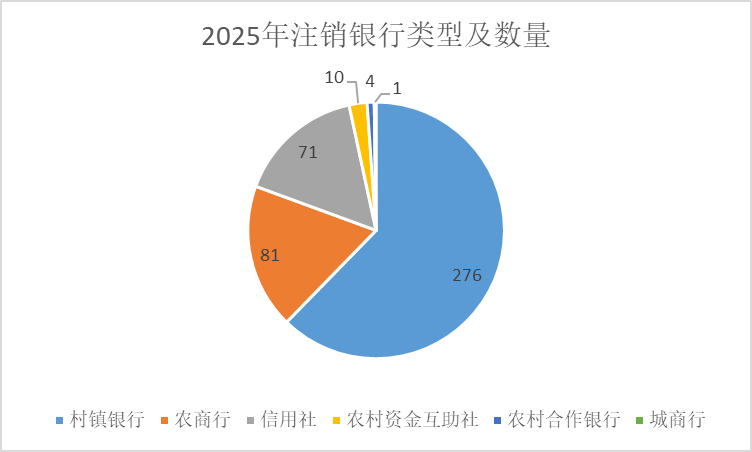
Core Insights - The Chinese banking sector is undergoing a significant exit and consolidation process, with 443 banking institutions deregistered by December 29, 2025, primarily involving rural banks, rural commercial banks, and credit cooperatives [1][2]. Group 1: Exit Characteristics - The exit process is characterized by three structural features: - Village banks are the main contributors, with 276 banks exiting, accounting for 62.3% of total exits [2]. - Rural commercial banks and credit cooperatives follow, with 81 and 71 exits respectively, together making up about 34.3% of the total [2]. - Other institutions, including rural mutual aid societies and city commercial banks, also contributed to the exit landscape [2]. Group 2: Regional Distribution - The exit of banking institutions shows a highly concentrated regional distribution: - Inner Mongolia leads with 140 exits, representing 31.6% of the national total [4]. - Shandong follows with 34 exits, while Sichuan, Hubei, and Henan each have 27 exits, indicating a regional focus in this adjustment [4]. - All 29 provincial-level administrative regions have seen banking institutions exit, highlighting the widespread nature of this industry adjustment [4]. Group 3: Timing of Exits - The exit process is not evenly distributed throughout the year, with a noticeable acceleration in the second half: - May marked the peak month with 130 exits, aligning with reform initiatives in Inner Mongolia [5]. - November and December also saw significant exits, with 64 and 54 respectively, while April recorded the lowest with only 3 exits [5][6]. - Overall, the number of exits in the second half of the year surpassed that of the first half, closely linked to regulatory guidance and regional reform progress [5]. Group 4: Underlying Logic of Consolidation - The concentration of exits is seen as a necessary outcome of the Chinese banking sector's development, focusing on risk management and sustainable growth: - The primary goal of mergers and acquisitions is to address risk management and ensure sustainable development, particularly for small and medium-sized banks facing profitability pressures [7]. - Issues such as fragmented ownership and inadequate corporate governance in rural financial institutions have led to increased risk, necessitating consolidation to improve operational quality [7]. - The consolidation process aims not only to reduce the number of institutions but also to enhance the quality of banking services, fostering a transition towards high-quality development in the sector [7][8]. Group 5: Future Outlook - The future trajectory for village banks indicates a trend towards "reducing quantity while increasing speed": - Currently, there are approximately 1,500 village banks, with expectations that this number will decrease to around 1,000 in the next three to five years, focusing on establishing a robust and specialized banking sector [8]. - The ongoing consolidation reflects the improvement of market exit mechanisms, enhancing the overall resilience and operational efficiency of the banking industry [8].

中小银行掀起兼并重组潮是顺应时代的必然选择
Guo Ji Jin Rong Bao· 2025-07-29 08:43
Core Viewpoint - The trend of "mergers and restructuring" among small and medium-sized banks has become a dominant theme in their reform, with a significant increase in the number of banks exiting the market and a reduction in physical branches [1][2][3][4][5][6][7]. Group 1: Current Situation of Small and Medium-Sized Banks - As of July 14 this year, 90 village banks have appeared on the "exit list," surpassing the total number of village banks that exited last year [1]. - From 2022 to 2024, a total of 307 legal entities are expected to exit, with over 80% being village banks, rural commercial banks, and rural credit cooperatives [1]. - Between 2022 and 2024, 4,433 physical branches are expected to be closed or merged [1]. Group 2: Reasons for Mergers and Restructuring - The primary reasons for the merger and restructuring trend include responding to risks and regulatory requirements, with a focus on reducing the number of institutions and improving industry quality [2]. - High non-performing loan rates among small banks, particularly rural commercial banks, necessitate mergers to integrate bad assets into a stronger risk management framework [2]. - Many small banks rely heavily on high-risk clients, and restructuring can help diversify their business and reduce dependency on specific industries [3]. - The need to improve operational efficiency and risk resilience is driving small banks to consolidate, especially as net interest margins shrink [4]. - Past aggressive expansion has led to an oversupply of banks, prompting a necessary restructuring to align with economic realities [4]. Group 3: Impact of Financial Technology - Increased investment in financial technology and the rise of digital banking services have made many small banks redundant, as customers can perform most banking functions online [5][6]. - The shift towards digital services has diminished the role of physical branches, leading to a decline in the necessity for numerous small banks [6]. Group 4: Future Outlook - The ongoing mergers and restructuring among small banks represent a historical trend towards more concentrated and efficient banking operations, moving from extensive growth to focused management [7]. - This transition is expected to enhance the quality of financial services, improve resource allocation, and allow banks to offer a wider range of products to meet diverse customer needs [7].
兼并重组、减量提质——中小银行改革提速
Jing Ji Ri Bao· 2025-06-08 22:04
Group 1 - The core viewpoint is that small and medium-sized banks are undergoing significant reforms and restructuring in China, with many institutions being merged or dissolved, particularly village and rural commercial banks [1][2] - In the first five months of this year, approximately 180 small and medium-sized banks have been approved for mergers or dissolutions, indicating a rapid decline in their numbers [1] - The restructuring wave includes the establishment of new financial entities, such as the Inner Mongolia Rural Commercial Bank, which was formed by consolidating over 100 institutions into a unified legal entity [1][2] Group 2 - As of the end of March this year, there are 3,713 banking institutions participating in deposit insurance, a decrease of 48 from the end of 2024, with village banks making up a significant portion of this reduction [2] - The total number of banking institutions in China has decreased from 4,490 at the end of 2023 to 4,295 by the end of 2024, with rural commercial banks, rural credit cooperatives, and village banks seeing notable declines [2] - The acceleration of "thinning" among small and medium-sized banks is attributed to various factors, including historical burdens, structural issues, and governance challenges [2][3] Group 3 - The risks associated with small banks are heightened due to their smaller size and weaker risk resistance, necessitating reforms to mitigate these risks [3] - The Chinese banking sector is facing increased operational pressure due to macroeconomic downturns and narrowing net interest margins, prompting the need for tailored risk mitigation strategies [3] - Regulatory authorities emphasize the importance of restructuring rural small and medium-sized banks to enhance their adaptability and competitiveness, advocating for a reduction in the number of institutions and improved management practices [3] Group 4 - Rural small and medium-sized banks play a crucial role in providing financial services in rural areas, significantly contributing to rural development and supporting initiatives such as rural revitalization and food security [4] - Accelerating reforms in rural small and medium-sized banks is expected to enhance the quality of financial services, facilitating diverse credit products that support infrastructure and living condition improvements in rural areas [4]
全国经济第一大省,明确!推动组建农商联合银行……
券商中国· 2025-05-05 06:46
Core Viewpoint - The Guangdong rural credit system is undergoing significant reform, with a focus on establishing rural commercial banks and enhancing management mechanisms, as outlined in the 2024 annual report of the Guangdong Provincial Association [1][2]. Group 1: Reform Direction and Structure - The Guangdong rural credit system has adopted a "1+7" market structure, where several rural commercial banks have transitioned from provincial management to local government oversight between 2021 and 2022 [2]. - The Guangdong Provincial Government has emphasized accelerating the reform of the provincial rural credit union and supporting the establishment of unified local rural commercial banks in regions with weaker financial capacities [2][4]. - The 2024 annual report from the Guangdong Provincial Association indicates a commitment to management reform and the establishment of rural commercial banks by 2025 [1][2]. Group 2: Leadership Changes - In February 2023, Liu Peng was appointed as the deputy secretary of the provincial association, while the former director, Mai Yanhou, was promoted to secretary of the provincial association [3]. - Liu Peng has a background in regulatory roles within the banking sector and has contributed significantly to financial reforms in the region [3]. Group 3: National Trends in Banking Reform - There is a nationwide trend of merging and restructuring banks to enhance risk management and operational stability, with several provinces implementing their own reform plans [4][5]. - The establishment of unified rural commercial banks has been noted in various provinces, including Zhejiang, Shanxi, and others, with significant progress made in 2023 [4][5]. - The unified legal entity model is being adopted in regions with fewer banking institutions, aiming to consolidate financial resources and create scale advantages [5][6]. Group 4: Regional Developments - Multiple provinces, including Hubei and Guizhou, have outlined plans to establish rural commercial banks, indicating a broader commitment to reform across the country [6][7]. - In Anhui, the merger of local banks has marked the successful implementation of unified legal entity reforms [8]. - Regions such as Yunnan and Guangxi are also advancing plans to establish unified rural commercial banks, reflecting a trend towards regional consolidation [8][9].

老搭档再联手,2.58万亿金融“霸主”首届领导班子公布!
券商中国· 2025-02-26 23:24
Core Viewpoint - The restructuring of the Henan financial system, particularly the establishment of Henan Rural Commercial Bank, marks a significant consolidation in the regional banking sector, positioning it as a dominant player with an asset scale of 2.58 trillion yuan, surpassing the previously established Zhongyuan Bank [2][4]. Group 1: Leadership and Management - The newly appointed leadership of Henan Rural Commercial Bank includes experienced figures from the Henan financial system, with Gao Jingtao as Chairman and Wang Jiong as President, both having prior experience in Zhongyuan Bank and other major banks [2][3]. - Gao Jingtao and Wang Jiong's previous roles in the establishment of Zhongyuan Bank provide them with valuable operational insights that are expected to facilitate the successful formation of the new bank [4]. Group 2: Structural Changes and Reforms - The merger involves 25 institutions, including the former Henan Rural Commercial Union Bank and several city-level rural banks, transitioning to a unified legal entity model, which is anticipated to streamline operations and enhance asset management [6][8]. - The restructuring aligns with the broader trend of accelerating reforms in rural credit cooperatives across various provinces, as highlighted in the 2025 government work reports [10][11]. Group 3: Market Implications - The consolidation is seen as a strategic move to address risks within the banking sector, with experts suggesting that merely increasing scale is insufficient for sustainable development; internal reforms and governance improvements are also necessary [8]. - The ongoing reforms in the rural financial system are part of a larger shift towards reducing the number of small banks while enhancing their quality and operational efficiency [10][11].