中微子物理

Search documents
江门中微子实验:藏在地下700米的国之重器 捕捉“幽灵粒子”的超级工程
Xin Lang Cai Jing· 2026-02-12 23:44
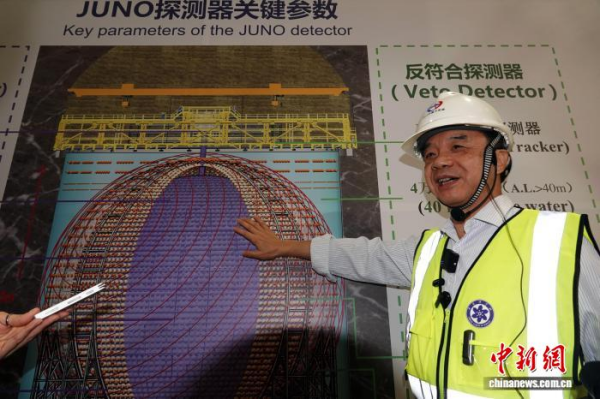
Core Insights - The Jiangmen Neutrino Experiment aims to capture neutrinos, which are fundamental particles that can provide insights into the origins of the universe and support future technological advancements in human life [1][4]. Research and Development - The experiment is located 700 meters underground in a granite layer, which serves as a protective barrier against cosmic rays and other interference, creating an ideal environment for neutrino detection [2]. - The core device of the experiment is a giant acrylic sphere, over 35.4 meters in diameter, filled with 20,000 tons of liquid scintillator that can detect faint light signals produced when neutrinos interact with the liquid [3]. - The experiment began construction in 2015 and is expected to officially start data collection by August 26, 2025, with initial results anticipated by November 2025 [3]. Scientific Breakthroughs - The experiment's design allows for a significant increase in measurement precision of neutrino oscillation parameters, achieving a 1.5 to 1.8 times improvement in accuracy within just 59 days of data analysis [3]. - The results from this experiment could lead to a better understanding of neutrino mass ordering and validate frameworks for three types of neutrino oscillations, potentially achieving in two months what similar international experiments have accomplished in 10 to 20 years [3]. Practical Applications - Neutrino research could fill gaps in the standard model of particle physics and may lead to new theories, aiding in the exploration of dark matter and dark energy [4]. - In the energy sector, neutrino detection technology can enhance nuclear power plant efficiency and safety, while in geological exploration, it can improve the accuracy of subsurface structure assessments [4]. - Medical applications may arise from neutrino-related technologies, potentially leading to advancements in early disease diagnosis and imaging techniques [4][5]. - The experiment's technological innovations, such as photomultiplier tubes and the giant acrylic sphere, could have broader applications in aerospace and precision instruments, contributing to high-quality industrial development [5].
中国江门中微子实验发布首个成果 高精度证实暗示新物理的偏差
Zhong Guo Xin Wen Wang· 2025-11-19 06:43
Core Insights - The Jiangmen Neutrino Experiment has successfully constructed its facility and released its first physical results, confirming the "solar neutrino anomaly" with high precision, suggesting potential new physics beyond the standard model [1][3]. Group 1: Experiment Overview - The Jiangmen Neutrino Experiment, located 700 meters underground, has captured over 2,300 neutrinos from August 26 to November 2, 2025, achieving a measurement precision of the "solar neutrino oscillation parameters" that is 1.5 to 1.8 times better than previous experiments [3][5]. - The experiment aims to resolve the inconsistency in the measurement of mass-squared differences between solar and reactor neutrinos, known as the "solar neutrino anomaly," which indicates the possibility of new physics [3][5]. Group 2: Technical Achievements - After over a decade of design and construction, the Jiangmen Neutrino Experiment has become the world's first next-generation large-scale, high-precision neutrino experiment, with key performance indicators meeting or exceeding design expectations [5][6]. - The core detector, a liquid scintillator with an effective mass of 20,000 tons, is housed in a 44-meter deep water pool, featuring a 41.1-meter diameter stainless steel support structure and various critical components, including 20-inch and 3-inch photomultiplier tubes [6]. Group 3: Historical Context - The concept for the Jiangmen Neutrino Experiment was proposed by the Institute of High Energy Physics in 2008, receiving support from the Chinese Academy of Sciences and the Guangdong provincial government in 2013, with international collaboration beginning in 2014 [5][6]. - The construction of the underground laboratory was completed in December 2021, with detector installation starting thereafter, and the experiment is set to officially begin data collection in August 2025 [5].

【中国新闻网】中国江门中微子实验发布首个成果 高精度证实暗示新物理的偏差
Zhong Guo Xin Wen Wang· 2025-11-19 06:03
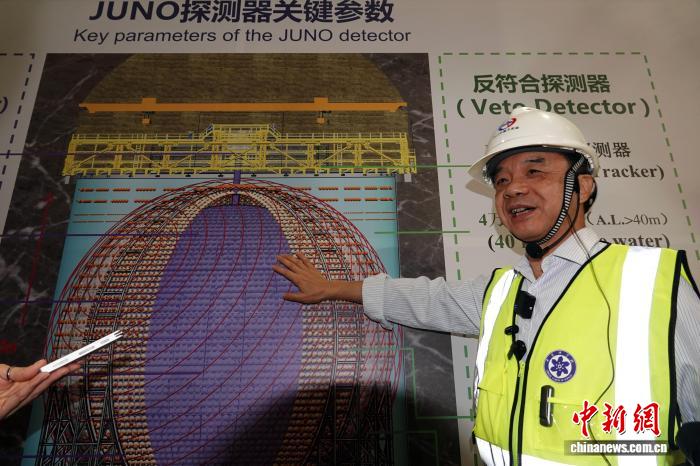
Core Insights - The Jiangmen Neutrino Experiment (JUNO) has successfully constructed its experimental facility and announced its first physical results, confirming the "solar neutrino anomaly" with the highest precision to date, suggesting potential new physics beyond the standard model [2][3] Group 1: Experimental Achievements - The experiment, located 700 meters underground, captured over 2,300 neutrinos between August 26 and November 2, 2025, achieving a measurement precision of the solar neutrino oscillation parameters that is 1.5 to 1.8 times better than previous experiments [2] - The experiment's detector performance indicators have met or exceeded design expectations, indicating readiness for cutting-edge neutrino physics research [3] Group 2: Historical Context and Development - The concept for the Jiangmen Neutrino Experiment was proposed by the Institute of High Energy Physics in 2008, receiving support from the Chinese Academy of Sciences and the Guangdong provincial government in 2013 [3] - The construction of the underground laboratory began in 2015, with the completion of the laboratory and installation of the detector achieved by December 2021, and the detector construction expected to be completed by December 2024 [3] Group 3: Technical Specifications - The core detector consists of a 20,000-ton liquid scintillator, housed in a 41.1-meter diameter stainless steel shell, with a central water pool 44 meters deep [3][5] - The detection system includes 20,000 20-inch photomultiplier tubes and 25,000 3-inch photomultiplier tubes, contributing to its high sensitivity [5]